Guides
Which licences a carpet cleaning business cannot skip for owner-operators
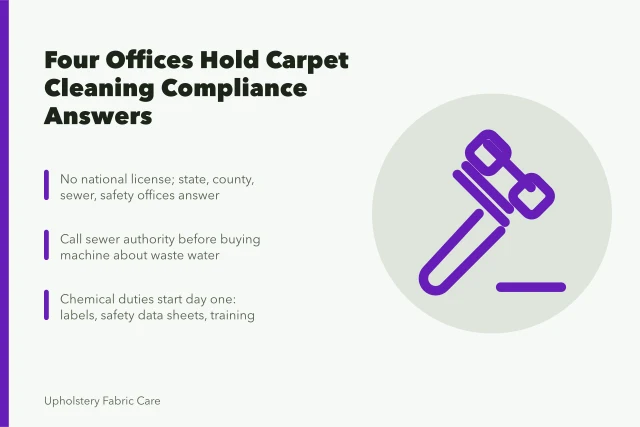
A carpet cleaning licence for owner-operators usually means a general business licence, a wastewater discharge permit and a state registration.
What to take away
- The licence a carpet cleaning business cannot skip is almost never called a carpet cleaning licence. For most owner-operators it is a general business licence from the city or county, plus a discharge condition from the sewer authority.
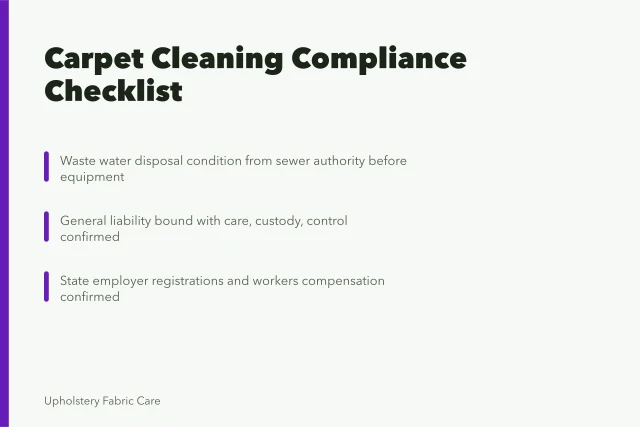
- The discharge answer decides which machine you can run. Get it before you buy a truck-mount.
- State rules split. California lists upholstery and carpet cleaning as D-63, a limited specialty contractor classification. Texas has no carpet cleaning licence, but mold remediation over 25 square feet needs a Texas Department of Licensing and Regulation licence.
- A certificate on the van, such as an IICRC Water Restoration Technician card, proves a technician was trained. It proves no registration, no insurance and no discharge permission.
- Write down the office, the person, the date and the exact question. That record is what a commercial customer asks to see.
The licences, by name
General business licence. The city or county where the business sits issues it. Los Angeles calls it a Business Tax Registration Certificate and issues it through the Office of Finance. Florida retired the old occupational licence in 2007 and now issues a Local Business Tax Receipt through each city or county. Work in a second town often needs a second licence.
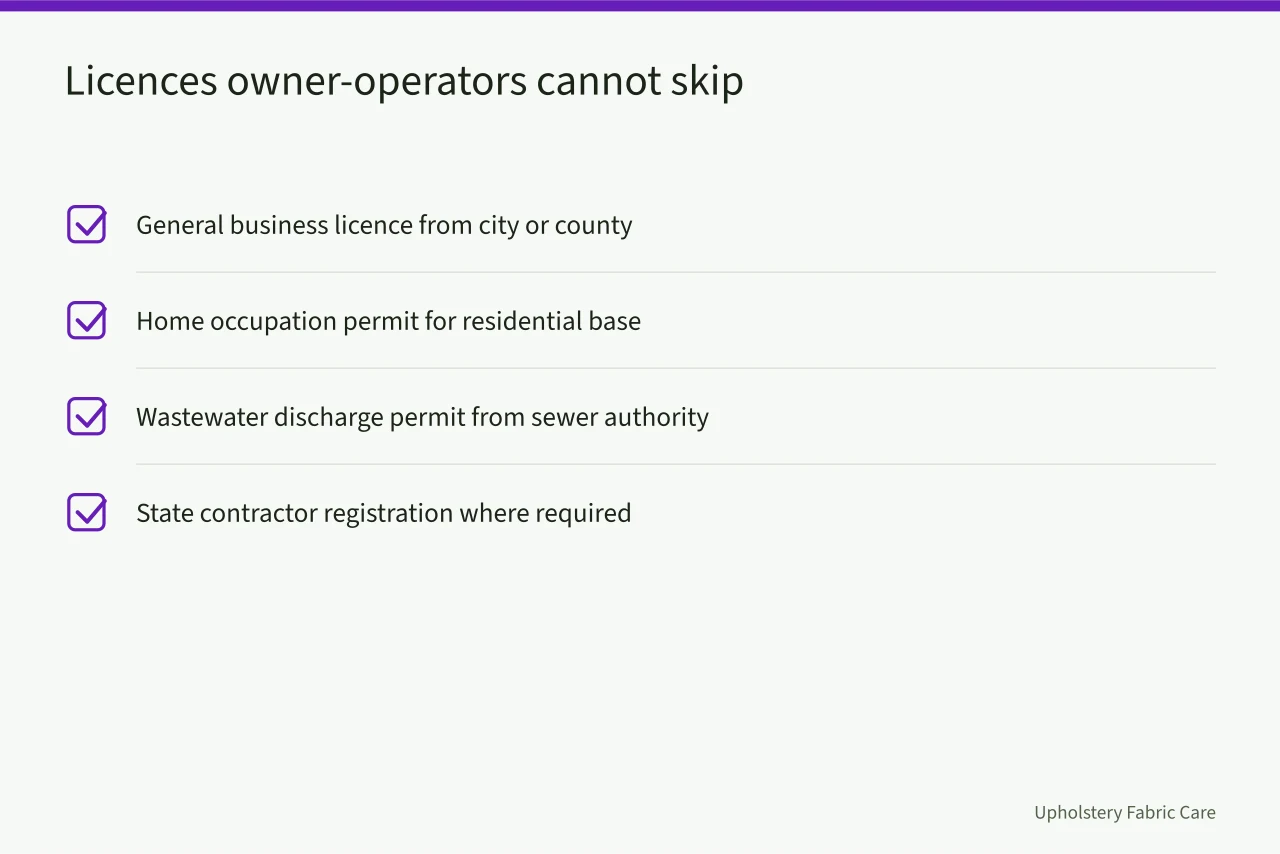
Home occupation permit. A separate approval from the same city or county, required when the van and the chemicals sit at a residence. Most home occupation rules cap employees and vehicles, and bar outdoor storage of chemicals. Ask before you sign a lease on a shop you did not need.
Wastewater discharge permit or condition. Issued by the sewer authority that treats your water, under the National Pretreatment Program at 40 CFR 403. It says whether carpet cleaning waste may enter the sanitary sewer, at what point, and under what condition. Los Angeles handles it through the Industrial Waste Management Division of the Bureau of Sanitation. New owners skip this one.
State contractor registration. California requires a contractor licence for jobs over $500 and lists upholstery and carpet cleaning as D-63, a limited specialty classification from the Contractors State License Board. Texas registers no carpet cleaner at all, so state paperwork there stops at tax registration. Where a board does exist, ask whether upholstery and rug work carry separate registrations.
State tax registration. A sales tax or gross receipts account from the state revenue department. Texas issues a Sales and Use Tax Permit through the Comptroller. Florida taxes nonresidential cleaning services under NAICS 561720 at 6% plus county surtax, and leaves residential cleaning untaxed.
Employer account. The Employer Identification Number from the IRS is free and usually comes first. Once you hire, the state labor department opens the employer account, and it tells you which workplace notices must be posted. Most states want new hires reported within 20 days.
Stormwater or pretreatment approval. Some municipalities require it before any wash water leaves the property, including water that reaches a curb or a storm drain. The Clean Water Act's MS4 program pushes that rule down to cities. The sewer authority knows whether your town has one.
Ask a closed question
A closed question names the activity, the equipment and the place, then asks for a yes or a no. "I clean carpet and upholstery in customers' homes with a truck-mounted extractor and I need to dispose of the waste water. May I discharge it to the sanitary sewer, and at what point?" gets an answer you can file.
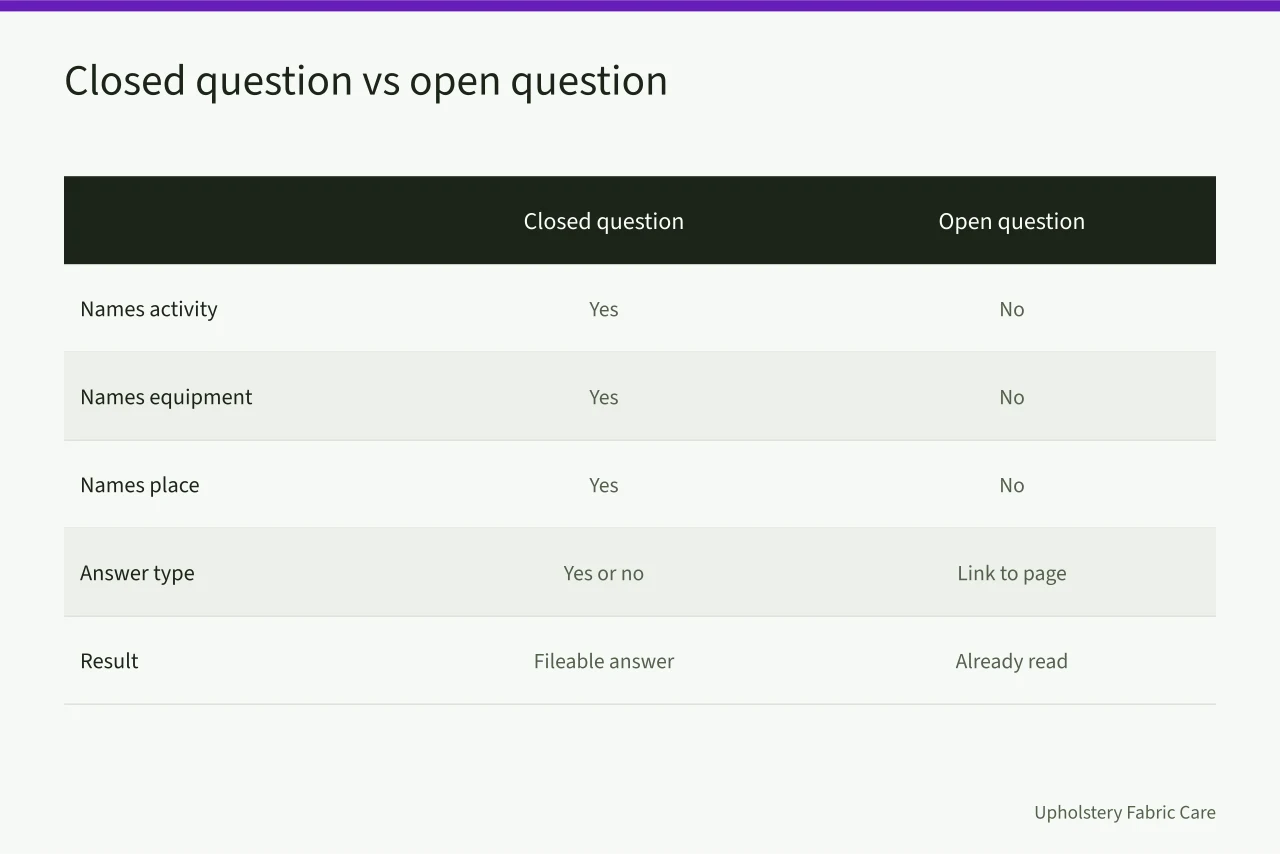
"What do I need to start a cleaning business?" gets a link to a page you have already read. The desks that answer usefully are the city licence counter, the sewer authority's industrial waste or pretreatment office, and the state contractor board's licensing line.
Name the activity, name the machine, name where the work happens. Where the person on the line cannot answer, ask who can, and ask for that person's extension before you hang up.
The record to keep
| Field | Why it matters later |
|---|---|
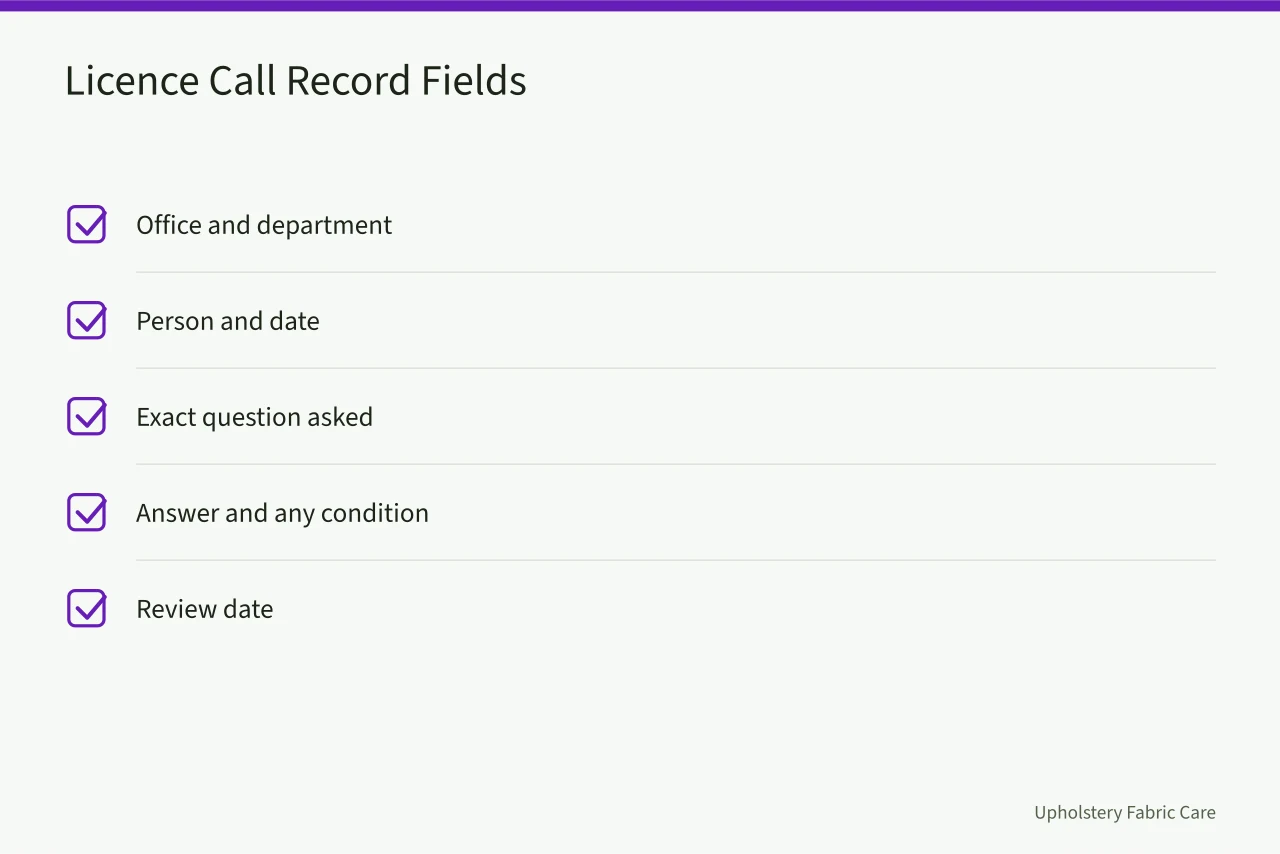
| Office and department | Tells you where to re-ask when a rule changes |
| Person and date | Turns a phone answer into something you can cite |
| Exact question asked | Stops a later answer being compared against a different question |
| Answer and any condition | The part a commercial customer asks to see |
| Review date | The only thing that stops the file going stale |
Keep it in one folder, paper or digital, and put the review date in a calendar. When a customer asks whether you are licensed, you are handing over a page, not a story.
What the discharge answer changes
A condition that bars wash water from the sanitary sewer rules out any method that puts large volumes of water into the building. That is a machine decision before it is a paperwork decision, which is why this call belongs ahead of the purchase list in the equipment and setup guide.
Where discharge is allowed, utilities often require a lint trap, a filter or a settling tank, and a set discharge point such as a cleanout. Portable extraction with those fittings is the usual fit.
It also decides the fit-out. A van carrying cleaning products has to store and label them as the product label directs, and that storage is one line in the equipment checklist for new owners.
Product handling, labeling and worker training duties are set out in the OSHA hazard communication standard. Physical hazards of the work appear in the OSHA cleaning industry guidance.
What is not a licence
Trade certifications, association memberships and manufacturer training are worth having and prove none of the above. The IICRC certifies technicians, not companies. Its Water Restoration Technician card says a person was trained. It does not say a business is registered, insured or permitted to discharge anything.
Vendor onboarding behaves like a licence without being one. A commercial building may require insurance limits, background checks or badge conditions before you may work there. Those come from the contract, and the marketing and growth guide treats them as part of the cost of winning commercial work.
Employer duties start with the first hire, not the first job. What a new technician must do before working alone is covered in the hiring and training guide.
Which authority owns which question, state by state, is mapped in the licensing and compliance guide.
Common questions
Do I need a licence specifically called a carpet cleaning licence?
Usually no. Most owner-operators hold a general business licence from their city or county, plus a discharge condition from their sewer authority. A handful of states add a contractor registration, and California is one: D-63 covers upholstery and carpet cleaning. The state occupational or contractor board can confirm whether yours is one of them.
I work in six municipalities. Do I call all six?
Call your own first, then the ones where you work regularly. Registration usually follows where the business is based. Permits and discharge conditions usually follow where the work happens. Where the two answers disagree, follow the stricter one.
Does an online formation service handle this?
It handles the state filing and nothing else. Formation services do not call your sewer authority, and they do not know what your county requires of a mobile service based at a residence. Treat the filing as one line on the list, not the list.
Do I need to be accessible to customers with disabilities?
Federal obligations apply to places of public accommodation and to how services are offered, and the ADA guide for small businesses is the starting point. State law may add more. If you operate any premises the public visits, read it before you sign a lease.