Guides
Carpet cleaning insurance costs and the cover behind them for new owners
Carpet cleaning business insurance turns on one clause most owners have never read, and on the certificate a commercial customer asks for before you start.
What to take away
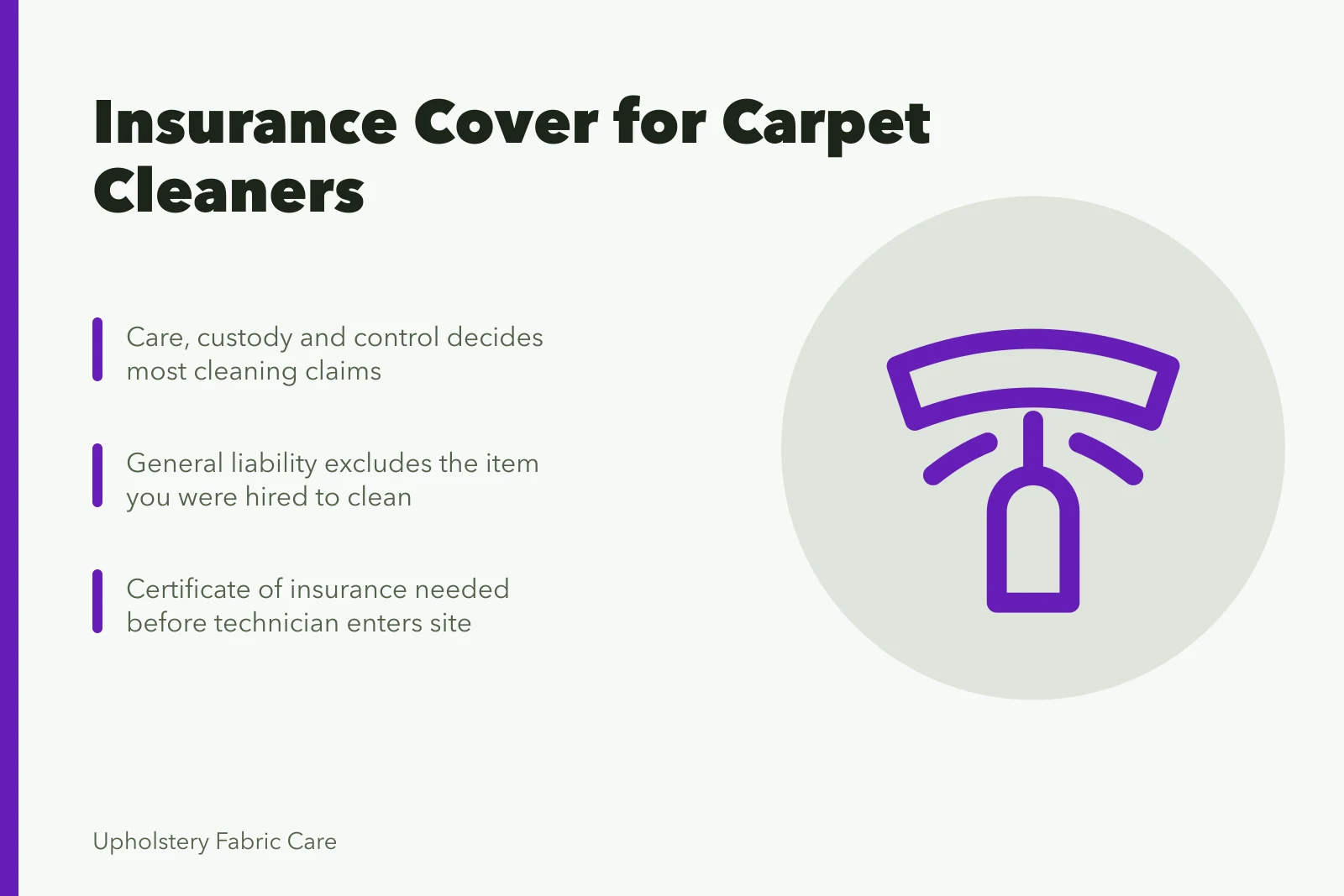
- The clause that decides most cleaning claims is care, custody and control. It responds when the damaged item is the thing you were working on.
- General liability alone does not answer a ruined sofa. Ask your broker in those words.
- Carpet cleaning business insurance premiums are quoted to your operation, not to the trade, so no figure printed anywhere is yours. Get three quotes on the same stated exposure. As of 2026, a sole operator commonly pays $500 to $1,500 a year for general liability alone.
- A certificate is a document a customer reads before you arrive. Know how fast yours can be issued and amended. Issuing one is normally free.
The coverage lines a cleaner actually meets
General liability answers third-party bodily injury and damage to property that is not in your care. A hose that marks a hallway wall is the classic example.
A sole operator buying $1 million per occurrence and $2 million aggregate typically pays $500 to $1,500 a year as of 2026. Raising limits to $2 million per occurrence often pushes the premium past $1,200.
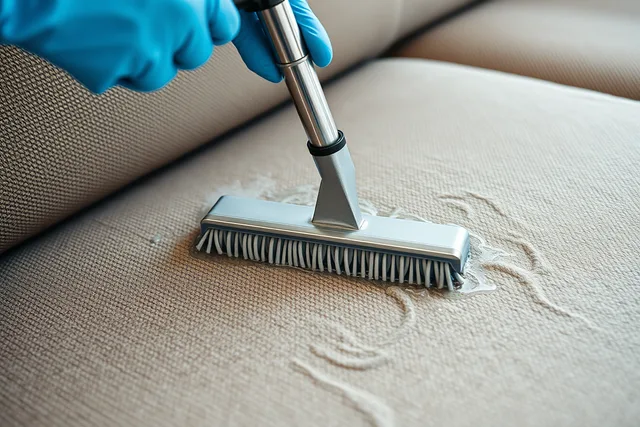
Care, custody and control is the exclusion that removes cover for damage to the very item you were hired to work on. A sofa that bleeds dye during cleaning is not a hallway wall. Ask your broker how your policy treats it and what endorsement changes the answer.
Written back as an endorsement, that cover usually costs $250 to $600 a year, often with a per-item cap near $10,000.
Commercial vehicle cover follows the van, and personal auto policies generally exclude business use. Confirm it rather than assume it. One van typically costs $1,200 to $2,800 a year, set by driver records, daily radius and the van's replacement value.
Equipment cover follows the machine, whether owned or financed. A finance agreement usually requires it in stated terms. Scheduled tools commonly run $150 to $400 a year for $20,000 of equipment value.
Workers compensation is a state question and follows the first employee. Requirements and thresholds are set by your state, and your state labor department is the authority.
Janitorial and carpet cleaning work is commonly rated at $1 to $4 per $100 of payroll, so a $35,000 employee costs roughly $350 to $1,400 a year. Ohio, Washington, North Dakota and Wyoming sell workers compensation only through a state fund.
A $1 million umbrella above your other limits usually adds $200 to $500 a year. Commercial customers with large buildings often require it.
What a broker needs from you
An accurate quote needs an accurate description of the work. Vague answers produce quotes that differ for reasons nobody can see.
- The methods you own, and whether you carry more than one product family
- The fibers and fabrics you accept, refer and refuse
- Whether you work in occupied commercial buildings, and after hours
- Whether you work above ground level, and whether hose runs pass through common areas
- The highest value item you would agree to clean in place
- Whether you subcontract anything, and to whom
Give the same six answers to every broker you approach. Comparing quotes written against different exposures tells you nothing.
Expect a minimum premium of $500 to $750 on many small policies. Installment plans add 3% to 10% in fees, so paying the annual premium in full is cheaper when the cash is there.
What carpet cleaning insurance costs in 2026
| Line of cover | Typical annual cost, 2026 | What sets the number |
|---|---|---|
| General liability, $1M per occurrence / $2M aggregate | $500 to $1,500 | Revenue, accepted work, claim history |
| Care, custody and control endorsement | $250 to $600 | Highest value item you accept, per-item cap |
| Commercial auto, one van | $1,200 to $2,800 | Drivers, radius, van value |
| Equipment, scheduled inland marine | $150 to $400 per $20,000 | Replacement value on the schedule |
| Workers compensation | $1 to $4 per $100 of payroll | State rate, class code, payroll |
| Umbrella, $1M | $200 to $500 | Underlying limits |
| Surety bond, $10,000 | $100 to $300 | Credit history, bond amount |
Those are typical ranges across most US markets, not quotes. Your stated exposure moves every line.
| Driver | Why it moves the premium | What you can change |
|---|---|---|
| Stated exposure | A wider scope of accepted work is a wider set of possible claims | Narrow the written scope and mean it |
| Claim history | Past claims price future ones | Document pre-inspection so disputes do not become claims |
| Limits and endorsements | Higher limits and added cover cost more | Match limits to what contracts actually require |
| Payroll and headcount | Employee exposure differs from a sole operator | Nothing, once you have hired |
| Vehicle and equipment values | Replacement cost drives the property side | Keep the schedule current, in both directions |
| Installment plans and fees | Monthly payments add 3% to 10% | Pay in full when cash allows |
Substitute your own quotes into a simple expression rather than a benchmark. Annual insurance cost divided by expected jobs per year gives the per-job insurance load, and that figure belongs in the cost lines in your carpet cleaning business plan. At $1,800 a year across 400 jobs, the load is $4.50 a job.
The certificate, which is the part customers see
Commercial customers ask for a certificate of insurance, often naming them as an additional insured, before a technician is allowed on site. Find out from your broker how quickly one can be issued and what it costs to amend.
Issuing a certificate is normally free. Naming an additional insured costs nothing when the policy carries a blanket endorsement, and $50 to $150 per certificate when it does not. A required $10,000 surety bond typically costs $100 to $300 a year.
Read what the contract requires before you promise it. A property manager's standard vendor agreement may specify limits or endorsements your policy does not carry, and discovering that on the morning of the first visit costs the job.
What insurance does not fix
It does not remove the pre-inspection. A documented condition report, with fiber, code and test result recorded before work begins, is what turns an argument into a claim rather than a loss.
It does not remove the safety program. The employer duties attached to the products on your van are set out in the OSHA hazard communication standard, and the physical hazards of the work are described in the OSHA cleaning industry guidance.
It does not remove registration. Which office answers which question is mapped in the licensing and compliance guide, and the call list for a new operation is in the what licenses a carpet cleaning business needs piece.
And it does not make an unsuitable machine suitable. What each machine commits you to is set out in the equipment and setup guide, and the testing supplies that prevent the most common claims are in the equipment checklist for new owners.
General guidance on getting a new business ready to answer questions like these is collected in the SBA business guide.
Common questions
When should cover be bound?
Before the first paid job, not before the first commercial job. The first sofa does not wait for a contract.
What should year one cost?
A sole operator with one van, $20,000 of scheduled equipment and $1M/$2M general liability commonly budgets $2,500 to $5,000 a year as of 2026. Hiring a first employee and adding workers compensation often takes the total to $4,000 to $8,000.
Does a certificate prove I am covered for a specific job?
It proves a policy existed on the date it was issued. It does not prove that a particular activity is within scope. Where a job sits at the edge of your stated work, ask the broker in writing first.
Should limits match what my largest customer asks for?
Match them to your real exposure and to contracts you intend to sign. Carrying limits nobody requires costs money every month. Carrying less than a contract requires costs the contract.
What is the cheapest way to reduce premium honestly?
Narrow the written scope of accepted work and keep it narrow. An operation that refuses viscose, antique rugs and water damage response in writing is describing a smaller set of possible claims, and that is a real difference rather than a presentation one.