Guides
Carpet cleaning equipment, reviewed against real use
Carpet cleaning equipment decides which jobs you can accept, not how well you clean. Here is what each machine choice commits you to, and what it rules out.
What to take away
- Carpet cleaning equipment is a job-selection decision. It settles which buildings you can work in before it settles anything about quality.
- Truck-mount and portable are not better and worse. They are two different sets of accessible addresses.
- Water in and water out are separate problems, and the second is local: your municipality decides where waste water may go.
- A second method is what usually turns a residential operation into one that can hold commercial work.
- The vehicle is a workspace. Time lost to a badly packed van is unbillable in the way drive time is.
- Budget is part of the same decision. A new truck-mount typically lists from $20,000 to $35,000 installed, and a capable portable from $1,500 to $5,000.
Equipment conversations usually start with production rate and end with price. Both are the wrong opening. A machine answers which of the jobs in your territory you can physically reach, and what you have to do with the water afterwards.
What a machine actually decides
Write down the twenty jobs you most want next year. Real addresses, real buildings, real floors. Then read your machine choice against that list.
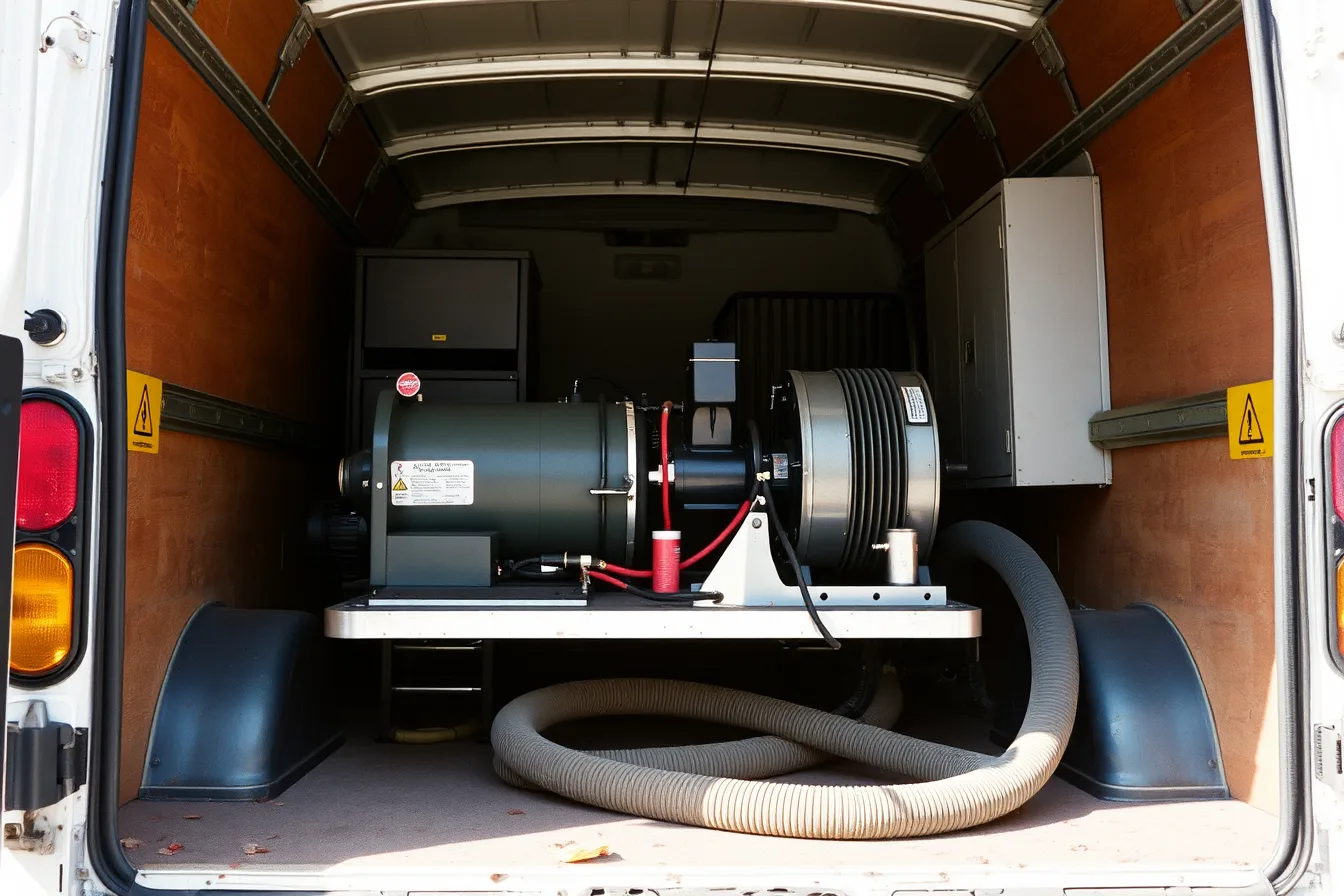
A truck-mount carries its heat, vacuum and pump in the vehicle. Units such as the Prochem Everest 650, the HydraMaster Boxxer 421 and the Butler System drive all three from an engine in the van. Detached homes, ground-floor commercial suites and anywhere you can park close become efficient.
A fourteenth-floor condo at the far end of a corridor becomes slow at best. Some buildings will not permit the hose run at all, and no amount of machine capacity changes that.
A portable reaches upper floors, secured buildings and units with no vehicle access. The Mytee LTD5 Speedster and the EDIC Galaxy pair high-pressure pumps with onboard heating, and both trade production rate for address range. Expect more trips to fill and dump, and more physical work per job.
Neither answer is wrong. Choosing before writing the list is. An operator who buys for the jobs they imagine, rather than the jobs on their street, spends a year discovering the mismatch.
The service list this capability supports is covered in the services and packages guide, and the wider first-year decisions sit in the startup and market guide.
Truck-mount and portable, set against the work
| Criterion | Truck-mounted system | Portable system |
|---|---|---|
| Named examples | Prochem Everest 650, HydraMaster Boxxer 421, Butler System | Mytee LTD5 Speedster, EDIC Galaxy, Powr-Flite Midsize |
| Typical new price | $20,000 to $35,000 installed | $1,500 to $5,000 |
| Power source | Gasoline or diesel engine in the van | Electric motors on a building circuit |
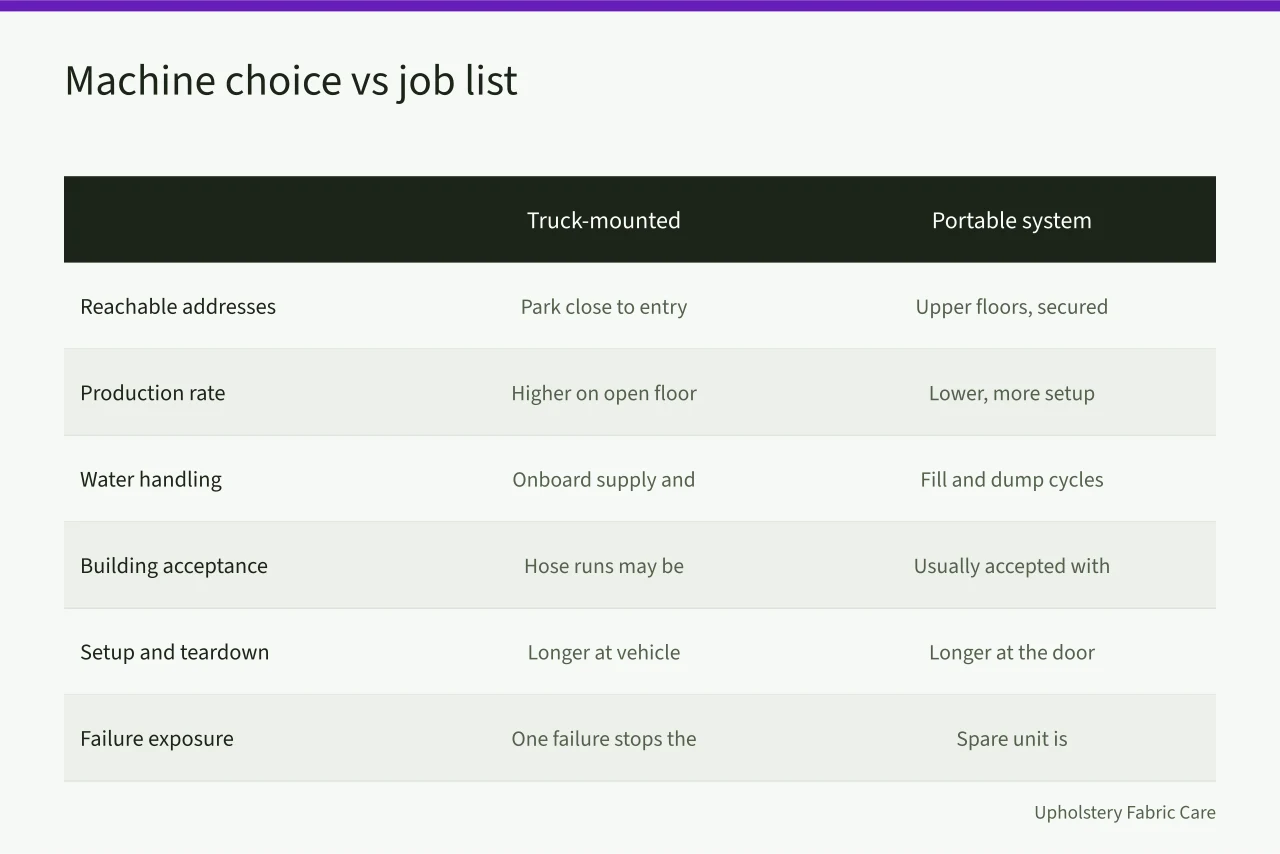
| Reachable addresses | Best where you can park close to the entry | Reaches upper floors and secured buildings |
| Production rate | Higher on open floor area | Lower, with more setup per job |
| Water handling | Onboard supply and recovery | Fill and dump cycles during the job |
| Building acceptance | Hose runs and parking may be refused | Usually accepted where a cart can travel |
| Setup and teardown | Longer at the vehicle, shorter at the door | Shorter at the vehicle, longer at the door |
| Failure exposure | One failure stops the day | A spare unit is a realistic contingency |
A single truck-mount is a single point of failure for an entire schedule. The plan for the day it does not start is usually a rental relationship arranged before it is needed. A second portable on the shelf covers a residential day, but it does not cover a truck-mount route.
Water in, water out
Water supply is the easy half: a tap, a tank, a hose, and a plan for the property that has neither.
Recovery and disposal are the half that gets businesses in trouble. Waste water from cleaning carries soil and product, and the sewer authority or municipality decides where it may be discharged. Many pretreatment programs require a designated dump point, a solids interceptor, or a holding tank emptied at a treatment facility, and those rules change from city to city.
The federal permitting framework behind many local rules is described in the EPA discharge permit basics. The answer that binds you comes from your own utility. Ask, write it down, keep the note.
The disposal point is part of route planning, because a trip to it is unbillable time. A technician also needs a stated rule for the day disposal is not available. A rule made at the tailgate at six in the evening is not a rule.
Wands, hand tools and the equipment behind the result
The wand is where technique lives. Over-wetting is a wand problem before it is a machine problem, and dry stroke discipline is the difference between a carpet that is damp and one that is wet. A technician fighting the tool at four in the afternoon is not producing the result they produced at nine.
Most wands come from PMF or Westpak in two-jet and four-jet versions. The Rotovac 360i rotary extractor, typically under $1,500, trades the side-to-side stroke for a spinning head that suits large open areas.
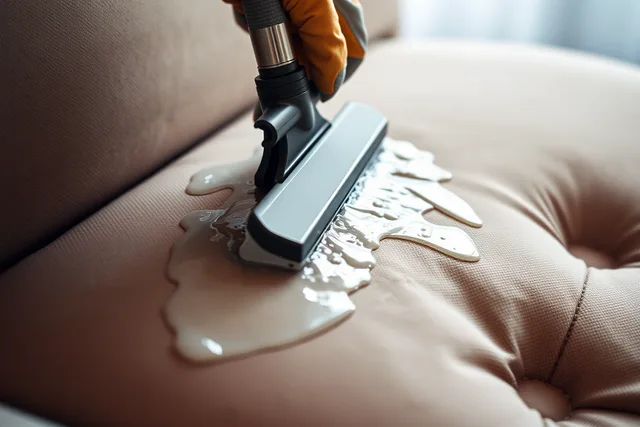
Hand tools decide whether upholstery and stairs are profitable or merely possible. PMF and Westpak both sell low-flow upholstery tools, and the choice runs against the fabric families you accept. The cleaning code on a piece of furniture decides which product family may be used on it, not which tool is convenient.
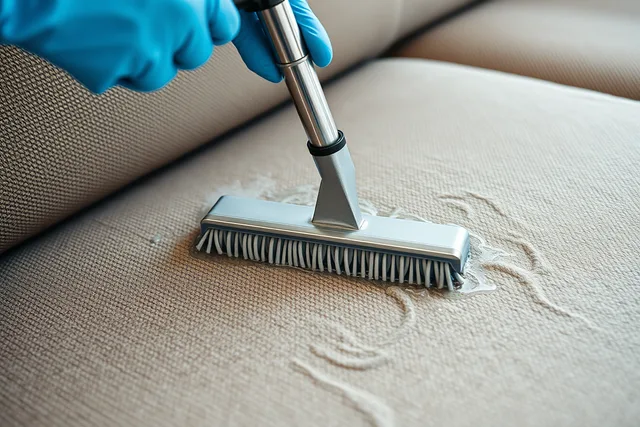
Grooming tools are routinely skipped. Grooming redistributes pile and helps the drying phase behave, which is where wicking and browning are either prevented or invited.
Air movers are equipment, not accessories. Drying is part of what you sold, and airflow is how you deliver it. The Dri-Eaz Velo and the Phoenix AirMax are the common axial and centrifugal choices, typically $350 to $600. The XPOWER P-800 covers the same job for around $200.
Vacuums are the least glamorous purchase and the one that most changes results. Dry soil removed before solution is applied never has to be extracted. A ProTeam Super CoachVac HEPA runs about $800, and the ProTeam ProVac FS6 sits near $500.
Low-moisture and dry compound: Cimex, Host and Whittaker
Low-moisture encapsulation needs an applicator and a counter-rotating brush machine or equivalent agitation. The Cimex CR38, typically $4,000 to $5,000, and the Whittaker System 7 CRB, near $3,000, work with encapsulants from Releasit and VacAway. The method opens interim maintenance in occupied commercial space, where a wet method would take the area out of service.
Dry compound work needs the medium, agitation and thorough vacuum recovery. Host machines, including the Freestyle and the Liberator at roughly $3,000 to $5,000, spread and recover the compound in one pass and open moisture-sensitive installations and occupied offices.
Both change the closeout conversation, because the result appears differently and the follow-up vacuuming matters. Neither replaces restorative extraction on heavily soiled cut pile.
Products for any method are prepared and used according to the manufacturer's instructions. The employer duties that come with keeping chemicals on a vehicle, including labeling, safety data sheets and worker training, are set out in the OSHA hazard communication standard.
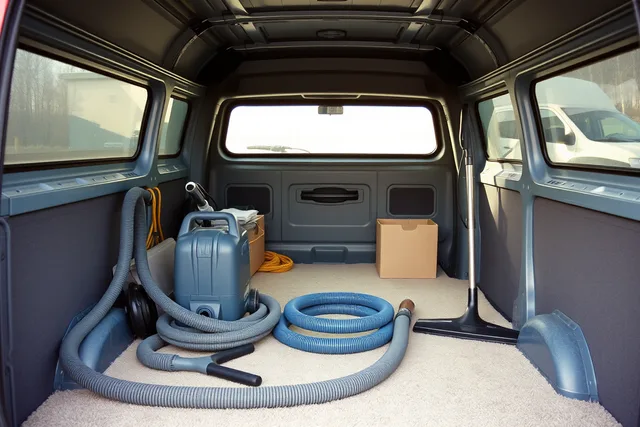
Setting up the vehicle as a workspace
The van is where minutes are lost invisibly.
Fixed positions. A technician looking for a tool is being paid to look for a tool.
Weight and access. Frequently used items at hand height near the door. Rarely used items deeper in.
Chemical storage. Secured, upright, labeled, and separated from anything that should not be near it, following the label and the safety data sheet.
Waste and clean water separation. Physically obvious, so a tired technician cannot confuse them.
Documentation. Somewhere to write the pre-inspection result, the fiber and code found, and the test result, on the job rather than from memory that evening.
A van packed for the job you do most often will save more hours in a year than any single upgrade to the machine.
Common questions
Should a new owner buy one machine or two?
One, plus an arranged fallback. Buy the second when a breakdown would cost real revenue, or when a second method opens work you are turning away.
How do I compare production rates between machines?
On your own work. Published rates are measured under conditions that rarely match a furnished living room with stairs. Ask a dealer to demonstrate on a floor like the ones you clean, and time it yourself.
What maintenance schedule should I follow?
The manufacturer's, in the manual, recorded each time. It keeps a warranty alive and it is what a buyer asks to see if you ever sell the machine.
Is heat necessary?
It depends on the method, the product and the fiber, and the product label carries the guidance for a given solution. Heat is one variable governed by the manufacturer's instructions, not a general good.
What is the first upgrade that pays for itself?
For most one-truck operators it is airflow, because drying is the part of the promise customers judge after you leave. A Dri-Eaz Velo or a Phoenix AirMax is the usual first purchase. The second is usually a better vacuum, such as the ProTeam Super CoachVac. Both shorten callbacks.