Guides
How to bundle carpet cleaning services for first-year owners
Carpet cleaning services are defined by fiber, soil, method and room, not by a name on a menu. Here is how to build a service list you can actually staff.
What to take away
- Every service on a cleaning menu is four facts wearing a name: a fiber, a soil condition, a method and a room.
- The fiber decides more about the job than the room does, and viscose decides more than any other fiber.
- The code on an upholstery tag is the furniture manufacturer's instruction about its own product, not a rule you may reinterpret.
- A menu you cannot staff is a list of complaints waiting to be scheduled, so build the list from capability outward.
- Add-ons are worth offering only when they are separate work with a separate outcome the customer can see.
A service menu is the most public document a cleaning business owns, and it is usually written last and copied from somebody else. That is backwards. The menu promises what your equipment, products and technicians can do on somebody's floor next Tuesday.
A service is four facts, not a name
Write any service you offer as four fields before you give it a name.
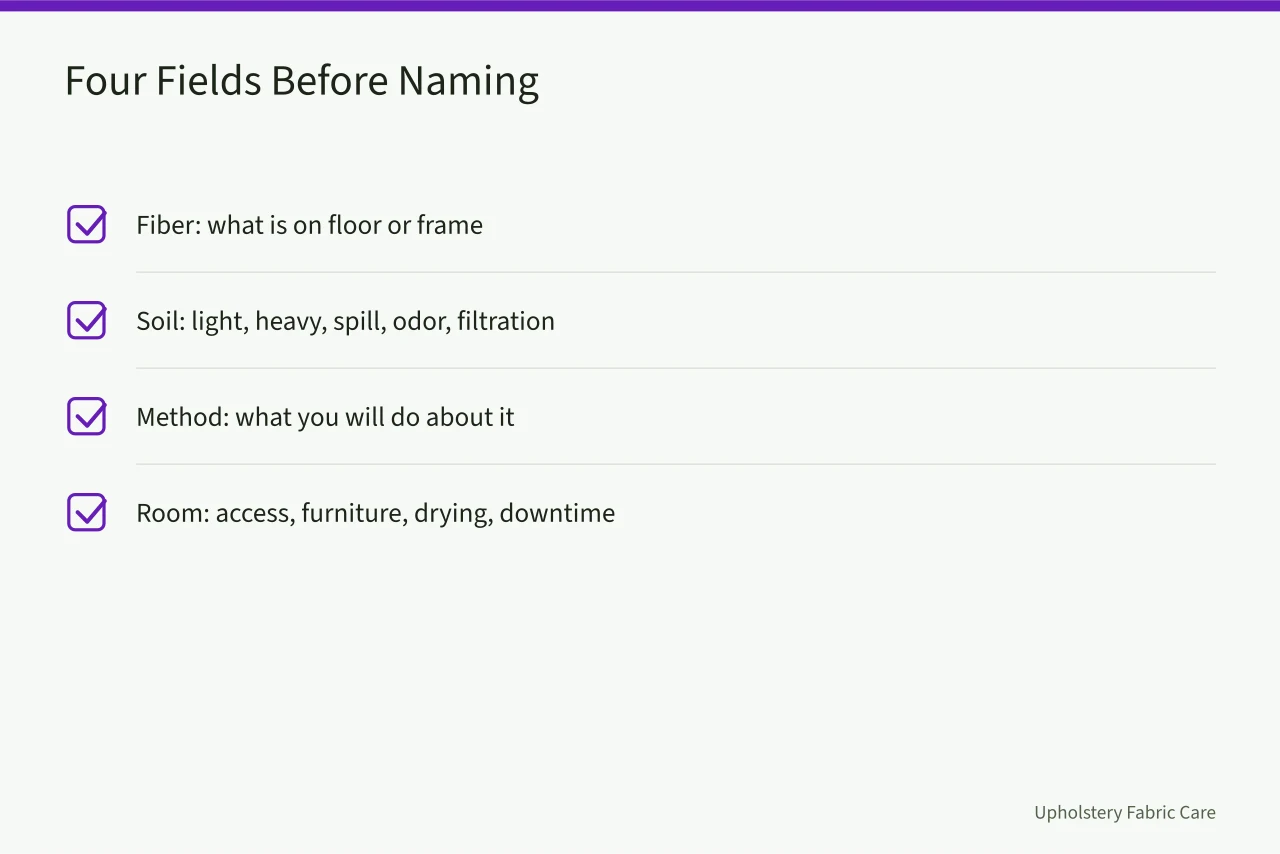
The fiber is what is on the floor or the frame. The soil condition is what is in it: light maintenance soiling, heavy traffic soiling, a spill, an odor complaint, or filtration lines along baseboards. The method is what you will do about it. The room decides access, furniture, drying and how long the space is out of use.
A residential cut pile nylon living room with light soil and a commercial glue-down loop pile corridor with heavy traffic soil are both sold as carpet cleaning. They share almost nothing operationally.
Settle the four fields at intake, before a price is spoken. The route from intake to invoice sits in the wider startup and market guide, which treats capability as the thing that decides the menu.
The fiber decides more than the room
Nylon is the workhorse of residential broadloom. It responds well to hot water extraction and it takes protector.
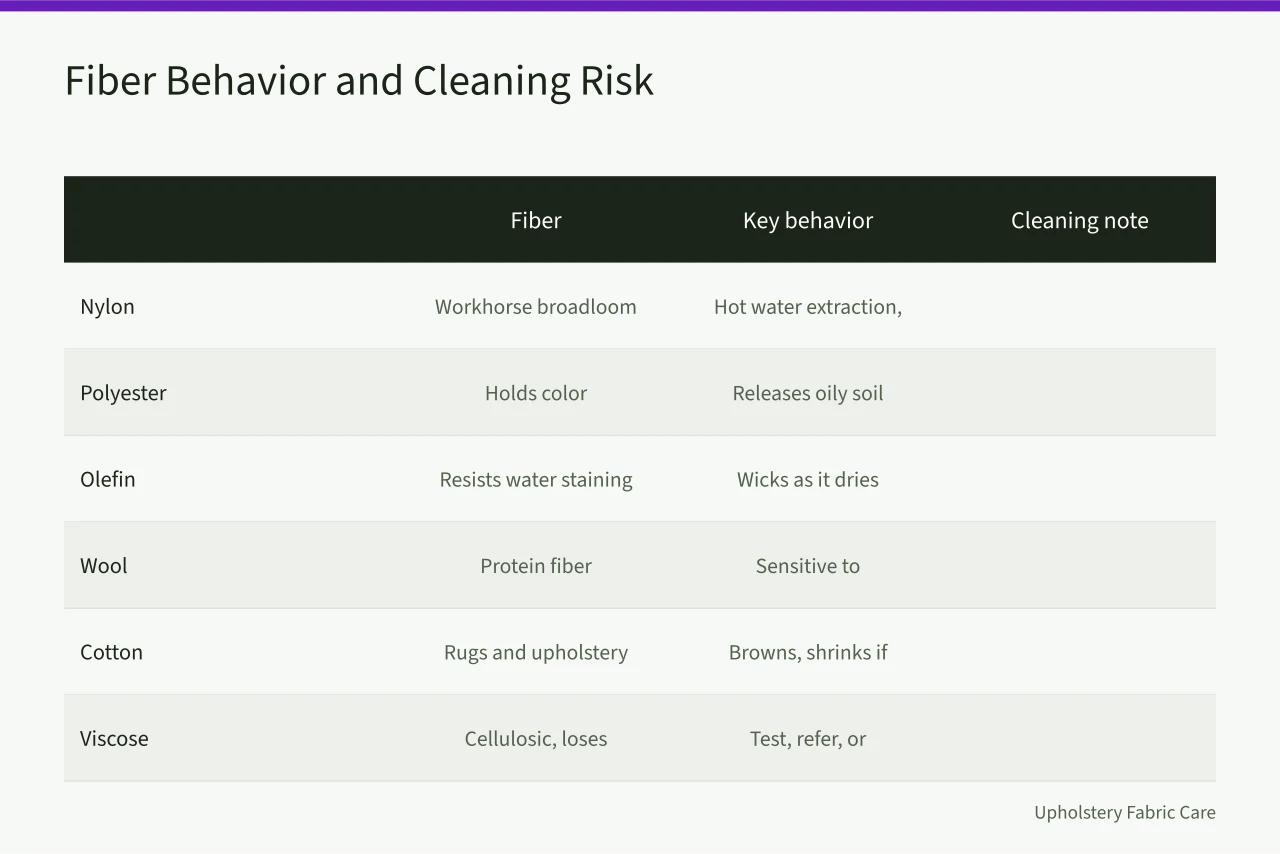
Polyester holds color well and releases oily soil less readily, which changes the pre-spray and dwell decision but not the method.
Olefin, also sold as polypropylene, resists water-based staining and shows wicking as it dries, because soil in the backing travels back to the tip. It is common in loop pile and outdoor-rated goods.
Wool is a protein fiber, sensitive to high alkalinity and aggressive agitation. Products intended for wool say so on the label, and the label is the authority.
Cotton, in rugs and upholstery, browns readily and shrinks if over-wetted.
Viscose, sold as art silk, bamboo silk or rayon, is the one that changes the job. It is a cellulosic fiber that loses strength when wet, and ordinary water can distort its texture, cause yellowing and leave permanent marks. Decide before you meet it: test, refer, or decline.
Where the label does not identify the fiber, a burn test on a hidden sample and a feel test are what a technician has. Where neither settles it, say so and proceed only on a documented test result.
Codes on the tag are instructions, not law
Upholstery carries a cleaning code, usually on a tag under a cushion or stapled to the frame rail.
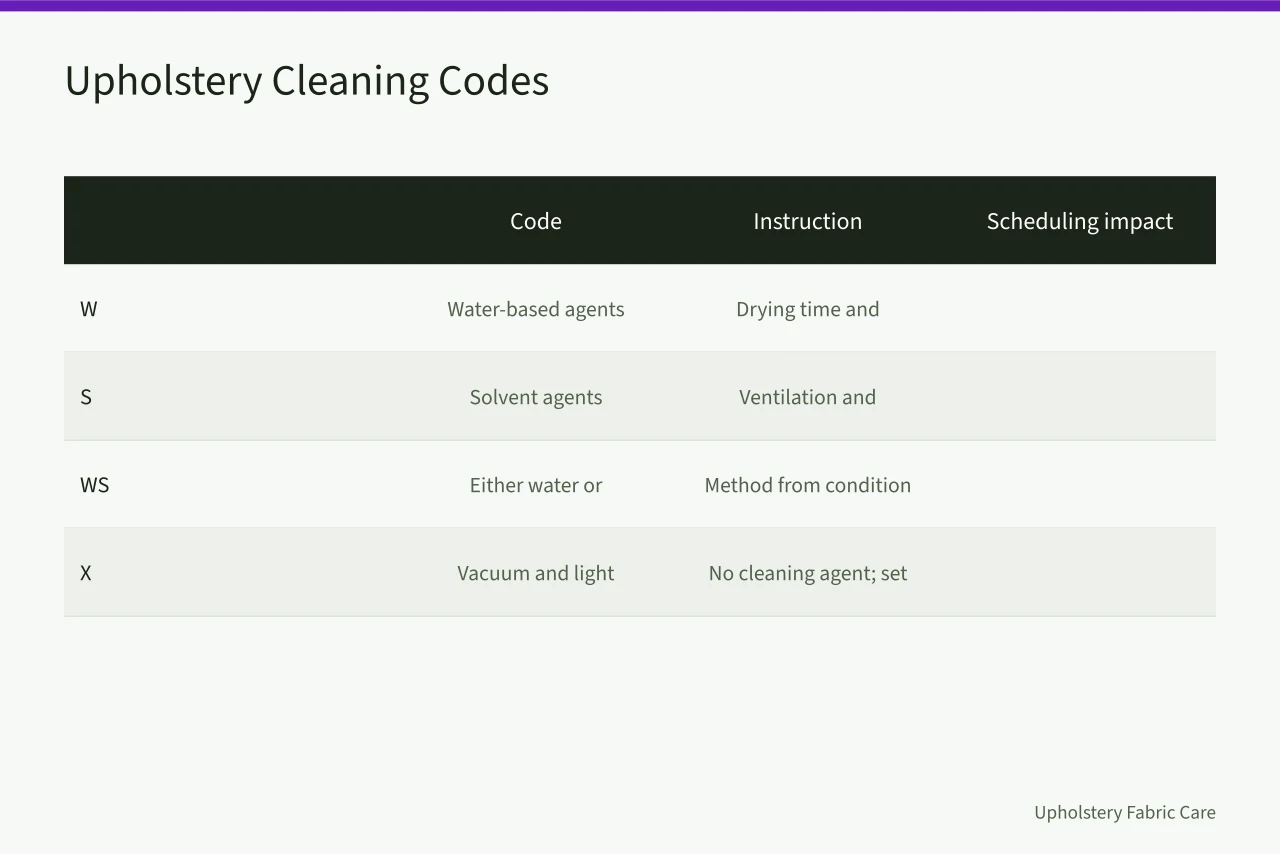
| Code | What the manufacturer is instructing | What it means for scheduling |
|---|---|---|
| W | Water-based cleaning agents | Wet method possible, drying time and airflow become part of the job |
| S | Solvent cleaning agents | Ventilation and product handling govern the job; water is not the route |
| WS | Either water-based or solvent agents | Method chosen from fabric condition and test results |
| X | Vacuum and light brushing only | No cleaning agent; set expectations before quoting |
The code belongs to the furniture manufacturer, so a missing or unreadable tag is a question for the manufacturer, not the customer.
It names which agent family is acceptable and says nothing about whether this dye will hold, so testing is still required. An X code is a real answer, and it belongs in the quote, not the technician's apology.
Record the code you found, or record that you could not find one. That record is what protects both sides later.
Method families and what each one commits you to
Hot water extraction applies solution, agitates, dwells for the period the label states, then flushes and recovers. It commits you to water supply, waste recovery, drying time and a closeout conversation about airflow.
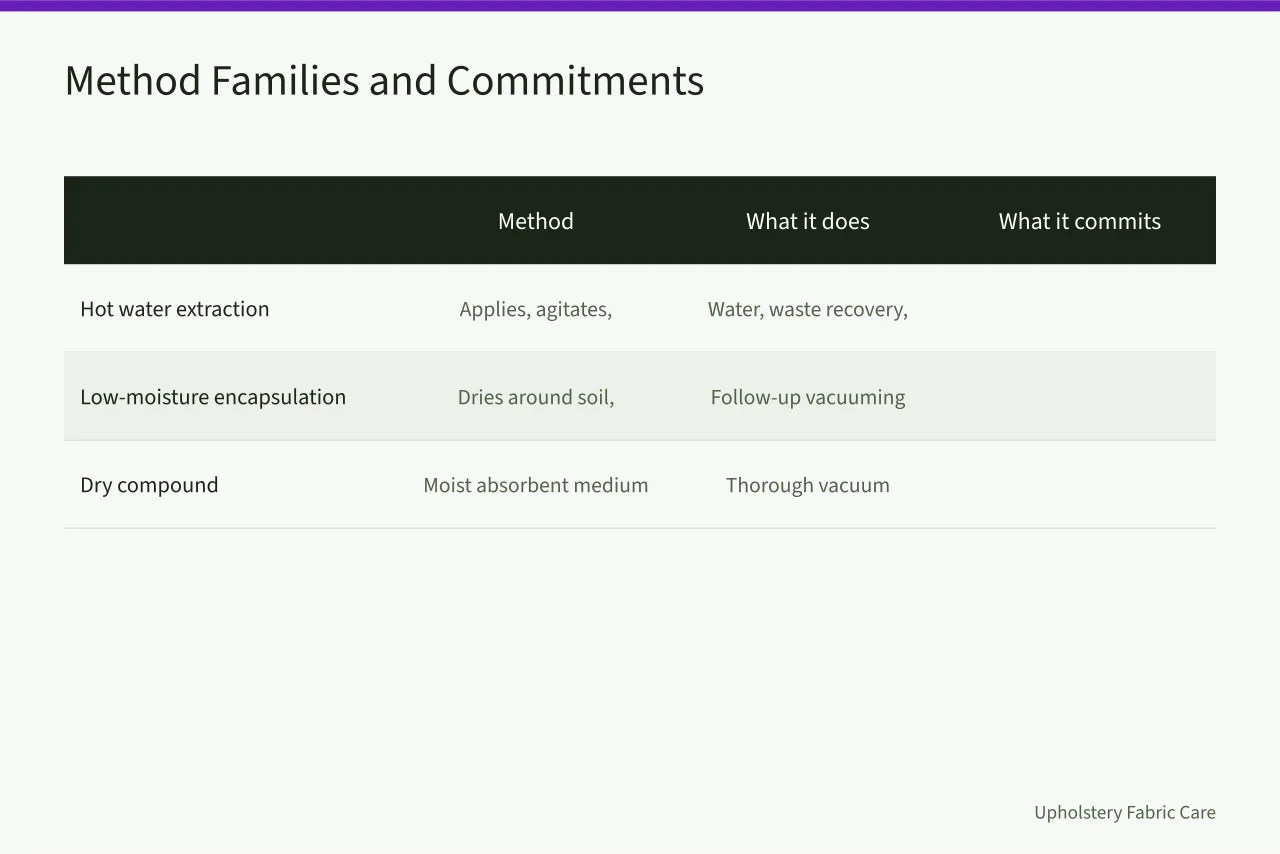
Low-moisture encapsulation applies a product that dries around soil so it can be vacuumed later, with mechanical agitation doing the work. It commits you to a follow-up vacuuming regime and to a customer who understands that the result appears over the following days.
Dry compound work uses a moist absorbent medium, worked in and vacuumed out. It commits you to thorough vacuum recovery and suits spaces that cannot be taken out of use.
None is a grade of the others. Each is chosen from fiber, soil, room and how quickly the space must return to service.
Two steps sit inside all three and are most often shortened: pre-vacuuming, which removes dry soil no wet process can remove later.
Pre-spray dwell is a timed step, and the time is on the product label; follow it and record it. Manufacturer's instructions and employer duties in the OSHA hazard communication standard govern product preparation, handling and worker training.
Building a menu you can staff
Every line on a menu has to be deliverable by whoever is working on an ordinary Thursday.
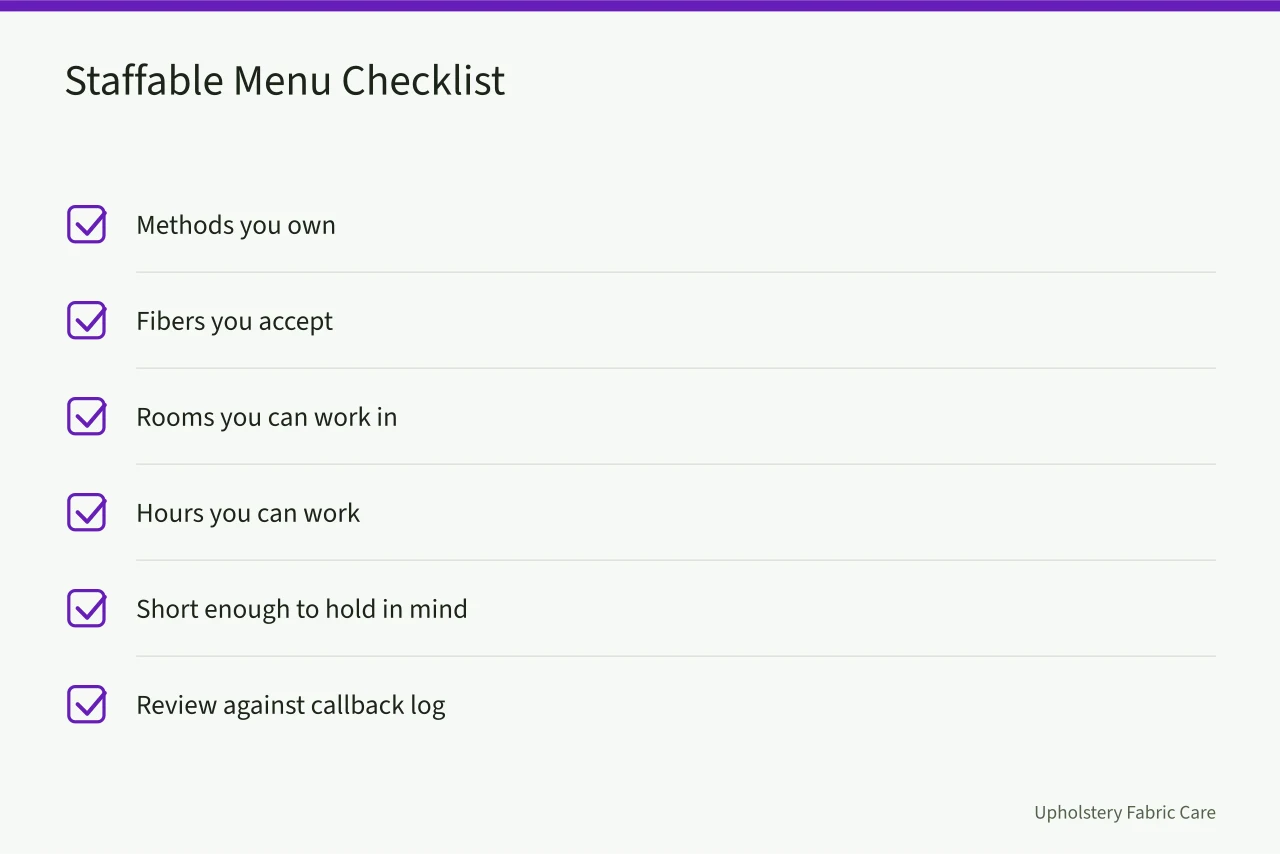
Start from the capability list: methods you own, fibers you accept, rooms you can work in, hours you can work. Write only services inside all four. A line that needs a technician you do not have, or a method nobody is trained on, is an aspiration on a price list.
Keep the menu short enough that a technician can hold it in mind. Long menus produce quoting errors, and quoting errors produce the jobs that lose money.
Review it against the callback log. A service that generates repeat visits is mispriced, mis-scoped or beyond current capability.
Add-ons that are real work and add-ons that are padding
An add-on earns its place when it is separate work with a separate outcome the customer can perceive.
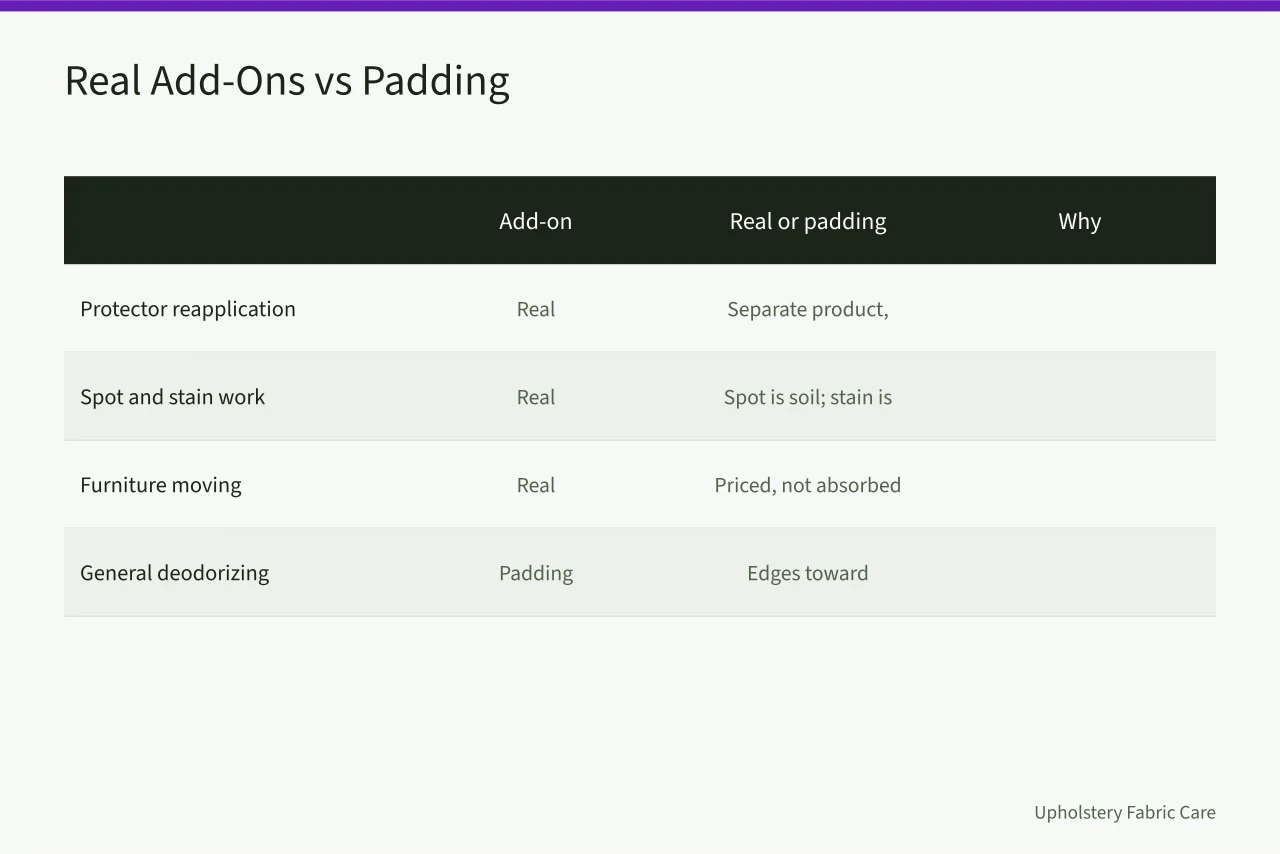
Protector reapplication is real. It is a separate product applied after cleaning, it takes time, and it buys a future spill more time before it becomes a stain. Follow the label on coverage and cure.
Spot and stain work is real, and the distinction belongs at intake: a spot is soil that can be removed, a stain is a change to the fiber or its dye that may not be. Quoting them as one thing is the most common source of residential dispute.
Furniture moving is real work and belongs priced, not absorbed.
Deodorizing sold as a general improvement is where a menu goes wrong. It edges toward health and air claims a cleaner cannot substantiate.
Describe the work: source removal and cleaning. Leave health to physicians. Objective claims in advertising must be substantiated before they are made, as the FTC advertising guidance for small business sets out.
Common questions
Should protector be offered on every job?
Offer it where the fiber and the product label support it, and where the customer understands what it is for. It is not a guarantee and not a substitute for prompt attention to spills. Where the manufacturer does not recommend it, do not apply it.
What do I do when the customer names a service I do not offer?
Say so, say what you do offer, and refer the rest. A referral costs one job. Work accepted outside your capability costs the job, the repair and the review.
How do I price a service that combines methods?
Price it as the two jobs it is. A room cleaned by extraction and a stairway done by hand are different production rates, and one number hides where the time went. Keep the line items separate even if the total is presented as one figure.
Can a menu include area rugs?
Only if you have decided where they are cleaned. In-home and in-plant rug cleaning are different services with different equipment, and hand-knotted or antique rugs are usually a referral. Decide it before the rug is rolled up in your van.