Guides
What does a rural Manitoba or Saskatchewan service route really cost?
A rural carpet cleaning route in Manitoba or Saskatchewan is priced by drive time, fuel surcharges and minimum job size, not by the number of rooms you clean.
What to take away
- A rural route is a fixed-cost business. The van, the insurance and the day cost the same whether you clean one farmhouse or four.
- Drive time is the cost that decides whether a rural job pays. Price it as its own line, never inside the cleaning price.
- Set the minimum job size in dollars, not rooms, so it covers the drive, the fuel and the crew hours.
- Winter is capacity planning, not bad luck. Hold one day a week open from November to March for jobs the weather pushes.
- Register in the province where you operate and confirm payroll, overtime and safety obligations before the first rural hire.
The day you are actually selling
A van leaves Brandon at 8 a.m. and reaches the first farmhouse at 9:30. The cleaning takes three hours. The second stop is a hall 20 kilometres further on. The van is back at the shop at 6 p.m.
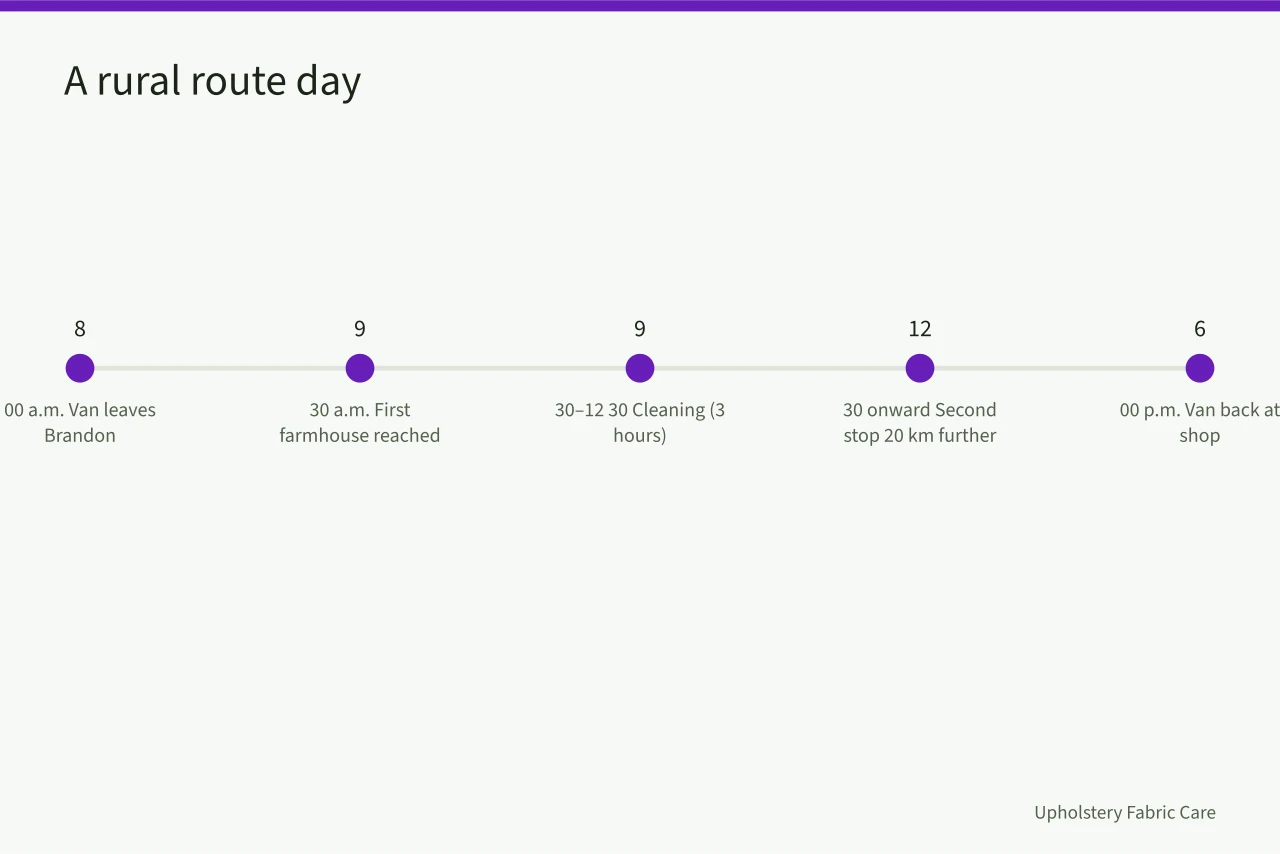
That is a ten-hour day sold as five hours of cleaning. The other five hours are the product too, and the customer is paying for all of them whether the invoice says so or not.
Rural work is not city work with a longer drive bolted on. It is a different cost structure. In town, a second job is ten minutes away and fills the gap between appointments. On a prairie route, the gap is the job.
Everything below is about pricing that gap honestly. For how jobs move through a week once the numbers are set, see carpet cleaning operations.
The five cost lines on a prairie route
Drive time. Two technicians at $25 an hour is $50 an hour of crew cost before the wand runs. A 90-minute drive each way is three hours, or $150, spent on the road. Substitute your own wage in place of $25 and your own drive time in place of 90 minutes. The structure holds.
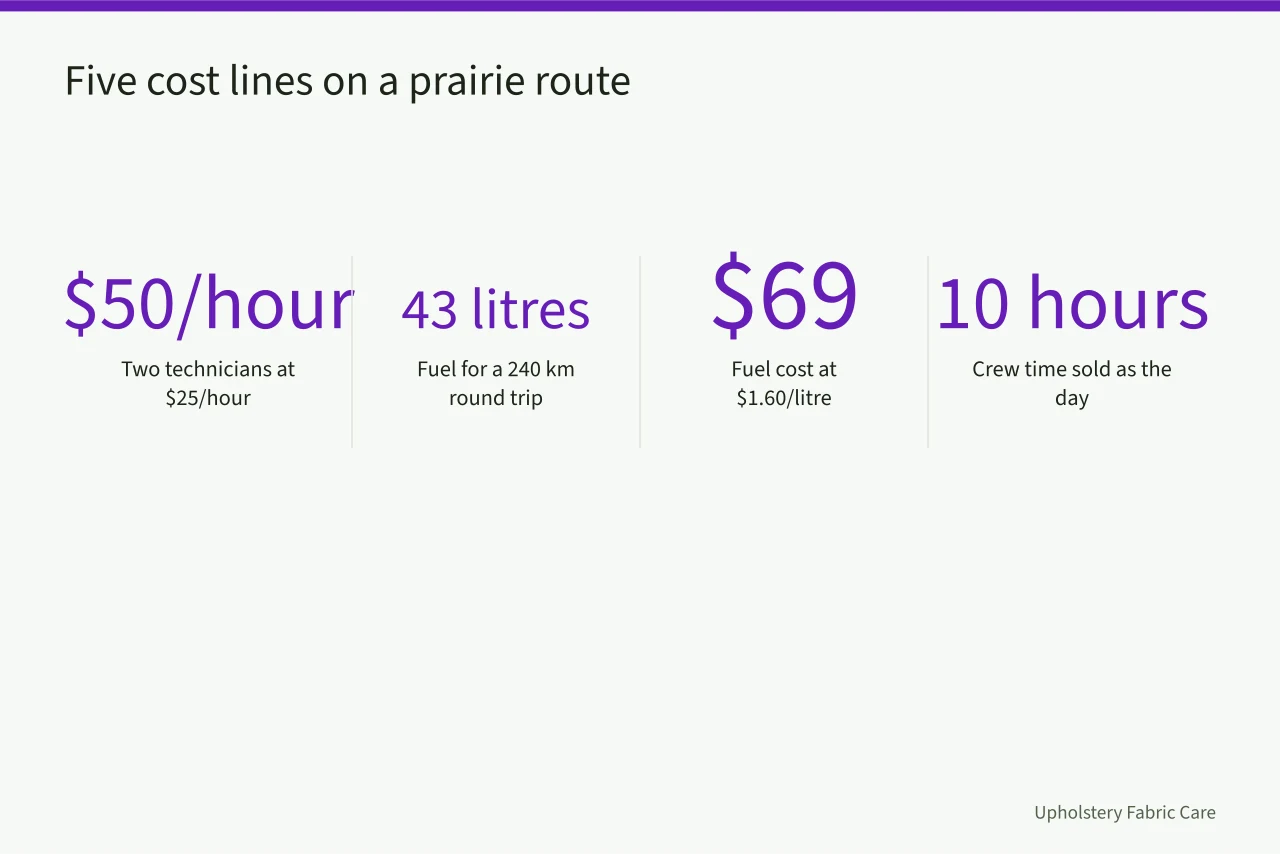
Fuel. A cargo van pulling a trailer on grid roads runs about 18 litres per 100 kilometres. A 240-kilometre round trip is roughly 43 litres. At $1.60 a litre that is about $69 for one job. Gravel, washboard and winter idling all push that number up, not down.
Maintenance. Gravel shortens tire and suspension life. Budget a maintenance reserve per kilometre and add it to the drive, not to the cleaning. A city van and a rural van do not share a service schedule.
Insurance. Commercial auto coverage has to name the actual territory, and general liability has to follow you onto farmyards and acreages. Tell the broker where the van goes, then put that premium into the route cost.
The day itself. Ten hours of crew time is the unit you are selling. If the invoice only covers the five cleaning hours, the other five come out of your margin.
What a travel charge looks like in dollars
There is no single prairie standard, so set your own and publish it. The structure that survives is a free zone, then a per-kilometre charge beyond it, quoted as a separate line on the estimate.
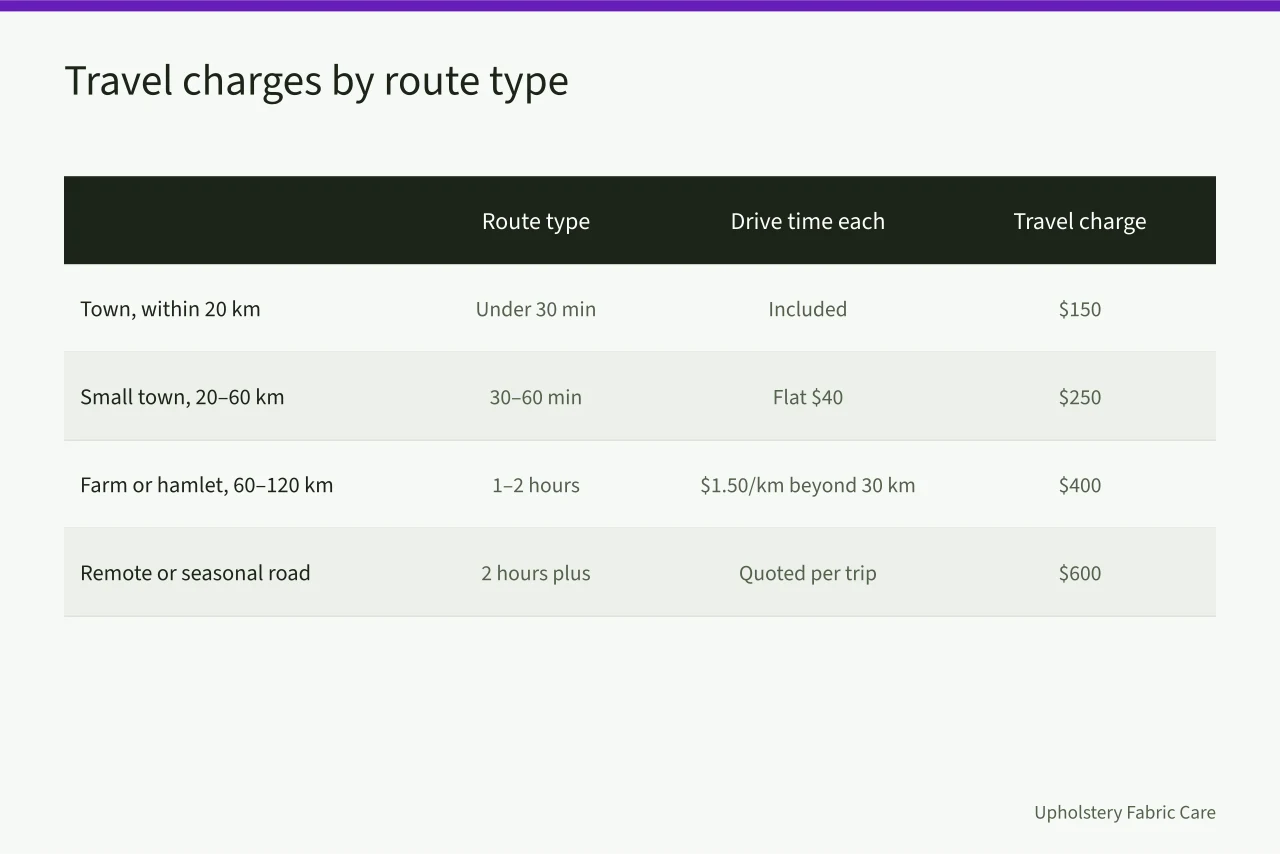
Illustrative figures, not market rates. A 30-kilometre free radius. Then $1.50 per kilometre beyond it. A farmhouse 90 kilometres out is 60 kilometres past the zone, so $90 of travel on the invoice.
Check that against the cost. The same trip burns about $69 in fuel alone, plus three hours of crew time at $150. The $90 does not cover it.
That is the arithmetic most new owners skip. The travel charge is not a profit centre. It is a partial recovery, and the minimum job size is what closes the rest of the gap.
Show the numbers
| Town, within 20 km | $150 |
|---|---|
| Small town, 20 to 60 km | $250 |
| Farm or hamlet, 60 to 120 km | $400 |
| Remote or seasonal road | $600 |
Every figure in that table is illustrative. Replace them with your own fuel price, your own wage and your own drive times before you publish anything.
Setting the minimum job size
Set the minimum in dollars so it scales with your real cost. Rooms do not scale. A three-room farmhouse with a set of stairs and a hallway takes longer than three rooms in a town bungalow.
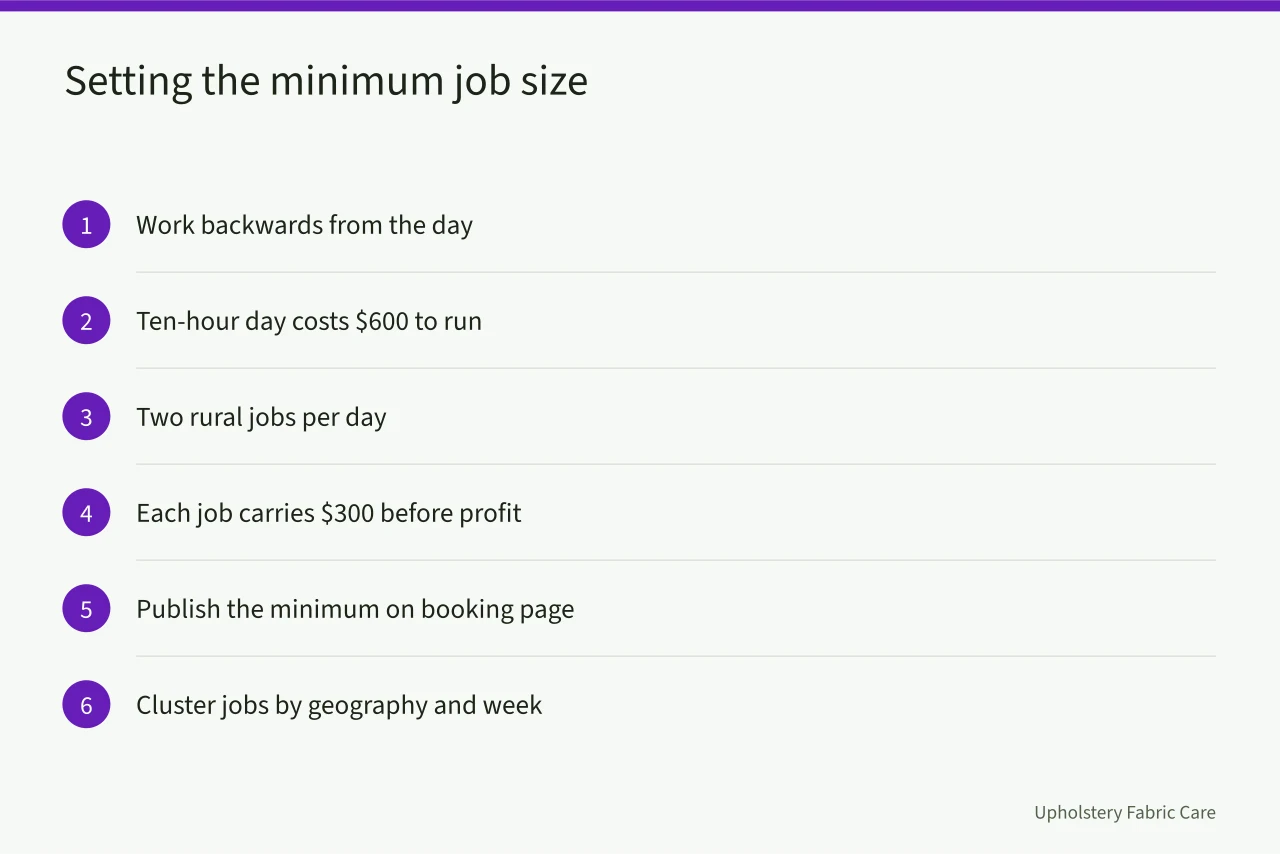
Work backwards from the day. If a ten-hour day costs $600 to run, and you can complete two rural jobs in that day, each job has to carry $300 before you earn anything. That is your floor, not your price.
A minimum job size means you will not send a crew two hours for a single armchair. Say so on the booking page. Rural customers accept distance. They resist a surprise on the invoice.
Clustering is the other half. Two jobs 20 kilometres apart share one drive. Group bookings by geography and by week, and the same ten hours carries three jobs instead of two.
That discipline is the same one described in carpet cleaning scheduling.
Winter, mud season and the days you lose
Prairie winter does not slow a route. It cancels it. A January blizzard closes the Trans-Canada and turns a booked day into a zero.
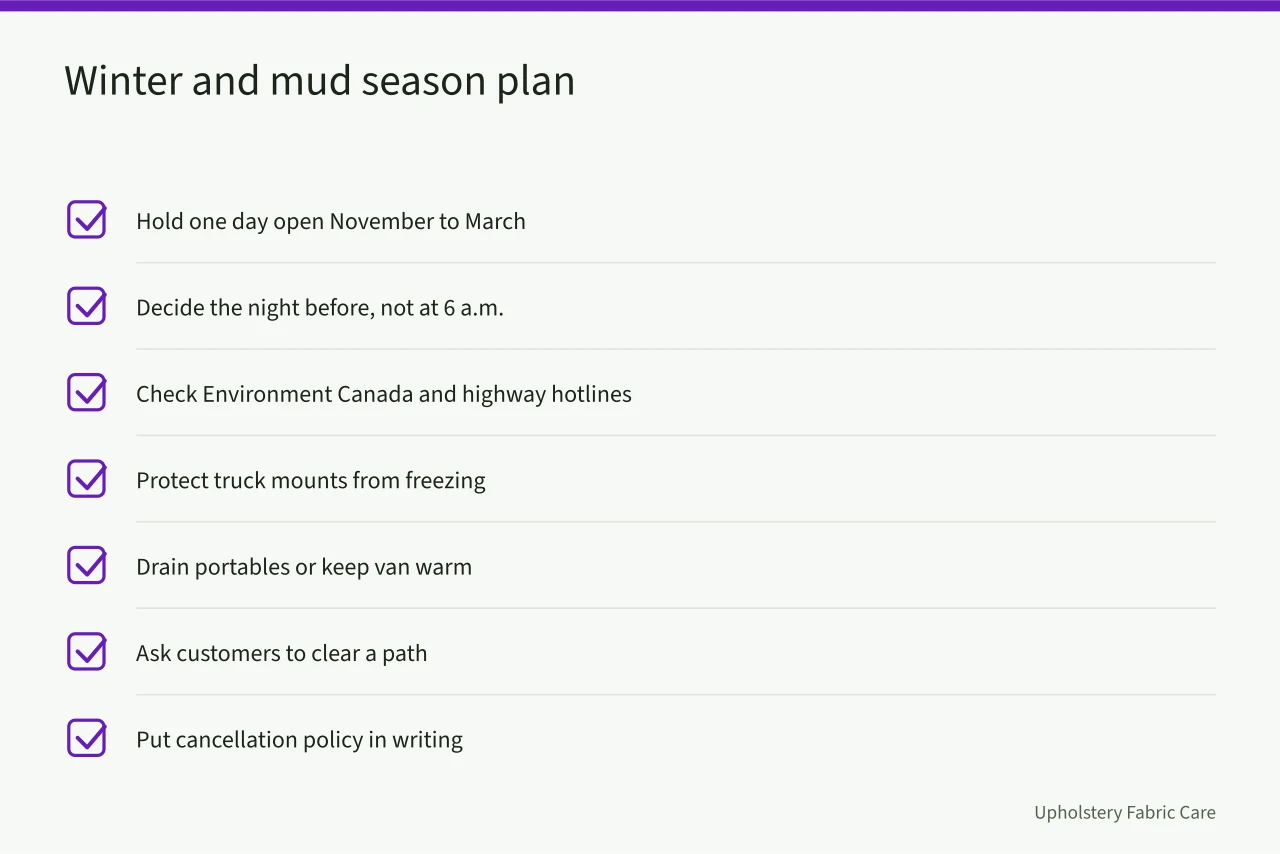
Plan for it as capacity, not as bad luck. Do not book a rural week at full capacity from November to March. Hold one day open for the jobs the weather pushes.
Decide the night before, not at 6 a.m. Environment Canada warnings and the provincial highway hotlines tell you when to pull a route. A crew sitting on a closed highway is a crew not earning.
Cold breaks equipment. Water freezes in lines and tanks, so truck mounts need freeze protection and portables need draining or a warm van overnight. A machine that froze is a lost morning and a repair bill.
Access changes too. Farm lanes drift, acreage driveways ice, and a van with a trailer gets stuck in places a car would not. Ask customers to clear a path and carry traction aids.
Spring is its own problem. Thaw turns grid roads to gumbo, and a route that was fine in February is impassable in April. Mud season belongs in the same plan as snow.
Put the cancellation policy in writing. State how you rebook a weather loss and whether the travel charge still applies to a cancelled trip.
Equipment that decides which jobs you can take
Equipment choices on a rural route start with water. Town work can use a customer tap. A farmhouse on a dugout or a cistern often cannot supply a truck mount for three hours.
A larger fresh tank and a matching waste tank let you clean several jobs without refilling. That capacity is what decides whether you can chain two rural stops into one day.
Heat matters on long days. A truck mount gives sustained heat and suction and suits a multi-stop route. A high-flow portable is lighter and cheaper but slower, and it needs power and water at every stop.
Many rural sites have limited outlets or none outdoors. A generator or a heavy-duty cord set solves it, but the load has to be planned before the van is loaded.
Carry spares. There is no supplier run mid-job at a farmhouse 90 kilometres out. Belts, jets, quick connects, hoses and a spare vacuum motor belong on the van.
Match the machine to the route, not to the brochure. If most of your work is single-family homes spread over 100 kilometres, reliability and freeze protection beat a bigger, heavier unit. For how capacity fits a growing business, see carpet cleaning expansion.
Registering and staffing the operation
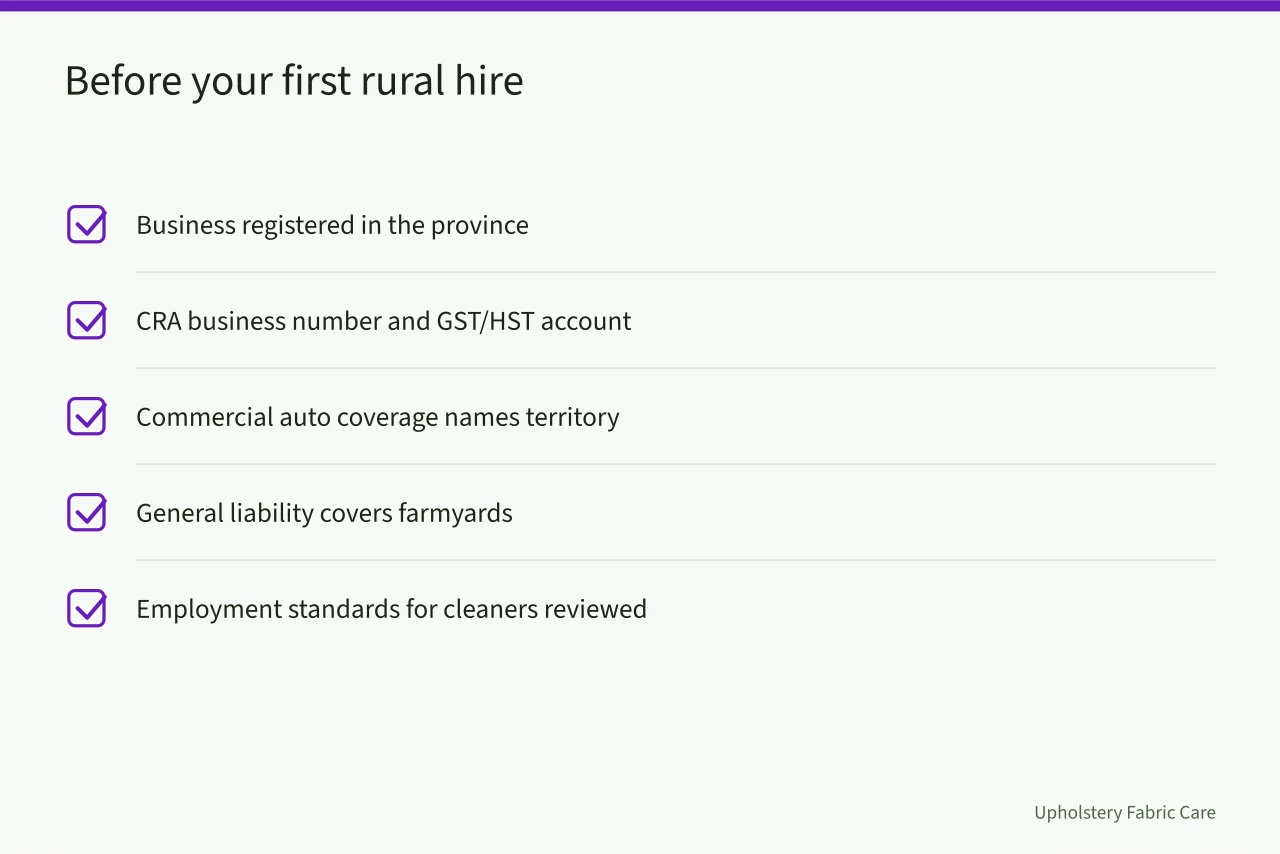
Sort out the legal floor before the first invoice. In Manitoba, business registration, legal and licensing run through the province, and a rural operation registers the same way as a city one. The Manitoba registration guidance sets out the steps.
Tax follows registration. You need a Canada Revenue Agency business number and you charge GST or HST as required. Input credits and small-business treatment change your real margin, so the province's tax information for business is the starting point for costing a route.
Hiring brings employment law. Saskatchewan employment standards set minimum pay, hours, overtime and leave for the cleaners on your rural routes. The Saskatchewan employment standards page is the reference for scheduling and paying staff.
In Manitoba, hiring cleaners means payroll, workplace safety and record keeping. The province's human resources guidance for employers covers the obligations that come with staff.
Run this list before your first rural hire.
Drive time is work time. Pay it, schedule it and price it. A route that treats the drive as free will not last a prairie winter. For the money side of starting out, see carpet cleaning startup costs.
Common questions
How do I set a travel charge for rural carpet cleaning in Manitoba or Saskatchewan?
Pick a free radius, then charge per kilometre beyond it, quoted as a separate line on the estimate. Check the charge against your fuel and crew cost for the same trip before you publish it. Review the number every season as fuel and insurance move.
What is a sensible minimum job size on a rural route?
Work backwards from the cost of a day, then divide by the number of jobs that day can hold. A common shape is a higher minimum for jobs beyond 60 kilometres. Set it in dollars, because rooms do not scale with drive time.
Can I refuse a job because of weather?
Yes, and a written policy makes it easier. State how you rebook a weather loss and whether the travel charge still applies to a cancelled trip. Rebooking beats risking a closed highway or a stuck van.
Do I need a truck mount for remote prairie work?
Not always. A high-flow portable works where you have water and power at the site. A truck mount suits multi-stop routes and long days, and it needs freeze protection through the winter.
For the wider market picture before you commit, see markets for carpet cleaning.