Guides
Carpet cleaning cash flow basics for owners who hate spreadsheets, explained
Carpet cleaning cash flow turns on when money leaves and when it arrives, so track job cost, drive time and receivables against a real week.
What to take away
- Cash leaves on job day and arrives when the invoice clears, so a full schedule can still starve the account that pays wages.
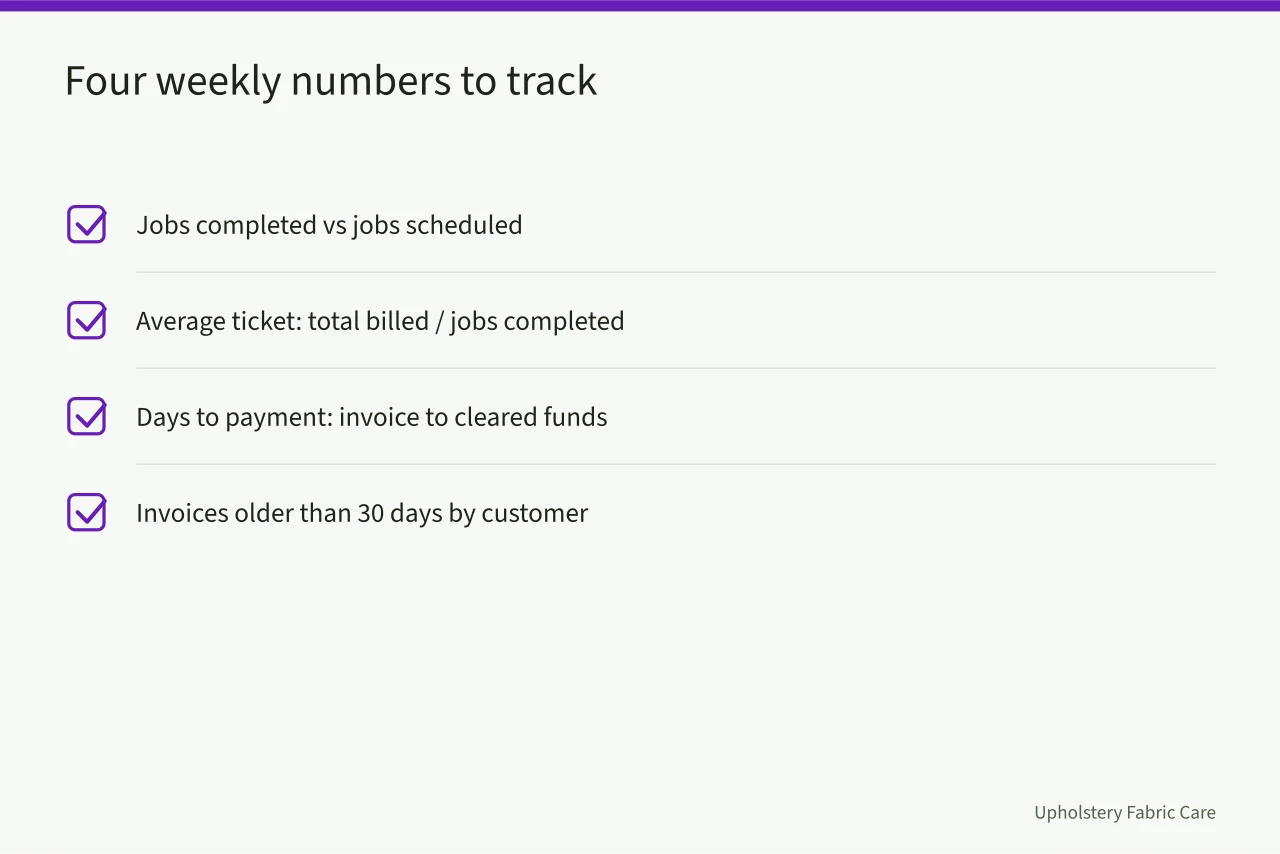
- Track four numbers weekly: jobs completed, average ticket, days to payment, and unpaid invoices over thirty days.
- Drive time is a cost, not a gap between jobs. Route density decides how many paid hours a day can hold.
- A minimum charge exists to stop a small job from costing more in setup and travel than it bills.
- The IRS recordkeeping guidance sets what has to be kept and for how long, not what software to buy.
Why a busy week can still be a broke week
A carpet cleaner pays for fuel, chemicals, wages and machine wear on the day of the job. The customer pays later. Between those two dates sits the whole cash problem.
Wet carpet also caps the day. Hot water extraction leaves fiber damp, so drying time and airflow decide when the next room can be walked on. A crew that books back-to-back jobs with no drying window turns a good day into a callback.
The four numbers worth a weekly look
- Jobs completed this week against jobs scheduled.
- Average ticket, meaning total billed divided by jobs completed.
- Days to payment, measured from invoice date to cleared funds.
- Invoices older than thirty days, listed by customer.
Write them on one page. A trend matters more than any single week.
| Cost line | How it moves | What to watch |
|---|---|---|
| Fuel and drive time | Rises with every extra stop | Jobs booked far outside the route |
| Chemicals and pre-spray | Steady per job, easy to overuse | Dwell time skipped, so more product used |
| Truck-mount or portable | Fixed cost of the machine | Portable jobs that pay less than the drive |
| Wages | Fixed on the day, not on the invoice | Overtime before a holiday |
| Protector and consumables | Small per job, invisible per month | Not billed as a line item |
Route density decides the day
A truck-mounted unit needs the vehicle near the door and a water source. A portable goes where the truck cannot, which often means stairs, upper floors and commercial suites. Each machine sets what jobs you can accept, so it also sets which jobs you should refuse.
Two jobs ten minutes apart are worth more than three spread across a county, even when the three bill higher. Drive time is unpaid. Count it in the schedule, not around it.
The small-job problem
Every job carries setup. Park and run the hose. Pre-spray, dwell, extract, set airflow, then pack. On a single chair or a stair runner, setup can outlast the cleaning.
A minimum charge is the honest answer. Set it from your own numbers: add fuel, product, and the paid hours the job consumes, then compare that to what you would bill. The best markets for a carpet cleaning business piece covers how territory changes those figures.
Records that survive a review
Keep invoices, bank deposits, supplier receipts, payroll records and machine purchase or lease documents. The IRS guidance on records a business should keep explains which documents support income and expenses and how long to hold them. Your accountant decides the rest.
If your scheduling and invoicing run on software, the numbers come out of it. The carpet cleaning software and KPI guide covers which exports to pull and how often.
Customer names, addresses and payment details are business records with a security duty attached. The NIST small business quick-start guides and the CISA guidance for small and midsize businesses both give plain starting points for protecting them.
Common questions
Should I bill a minimum charge on every small job?
Yes, if the job cannot cover its own setup, fuel and paid hours. Set the figure from your costs, not from what a competitor charges, and state it before you book.
How do I price a job I have never done before?
Estimate the paid hours, add drive time both ways, add product and machine cost, then compare the total to your minimum charge. If the two are close, the job is a minimum-charge job.
What if a customer pays late every time?
List them by days to payment and decide before the next booking. Options include a deposit, a card on file, or declining the work. Your contract terms and your state's rules govern what you can charge.
Does cleaning remove allergens or improve indoor air?
Do not claim that. Fiber care comes from the carpet or furniture manufacturer and the cleaning code on the item, and licensing and wastewater disposal vary by state and municipality. Confirm with the maker and your state or local authority.