Guides
The monthly numbers a carpet cleaning business owner should watch for 2027
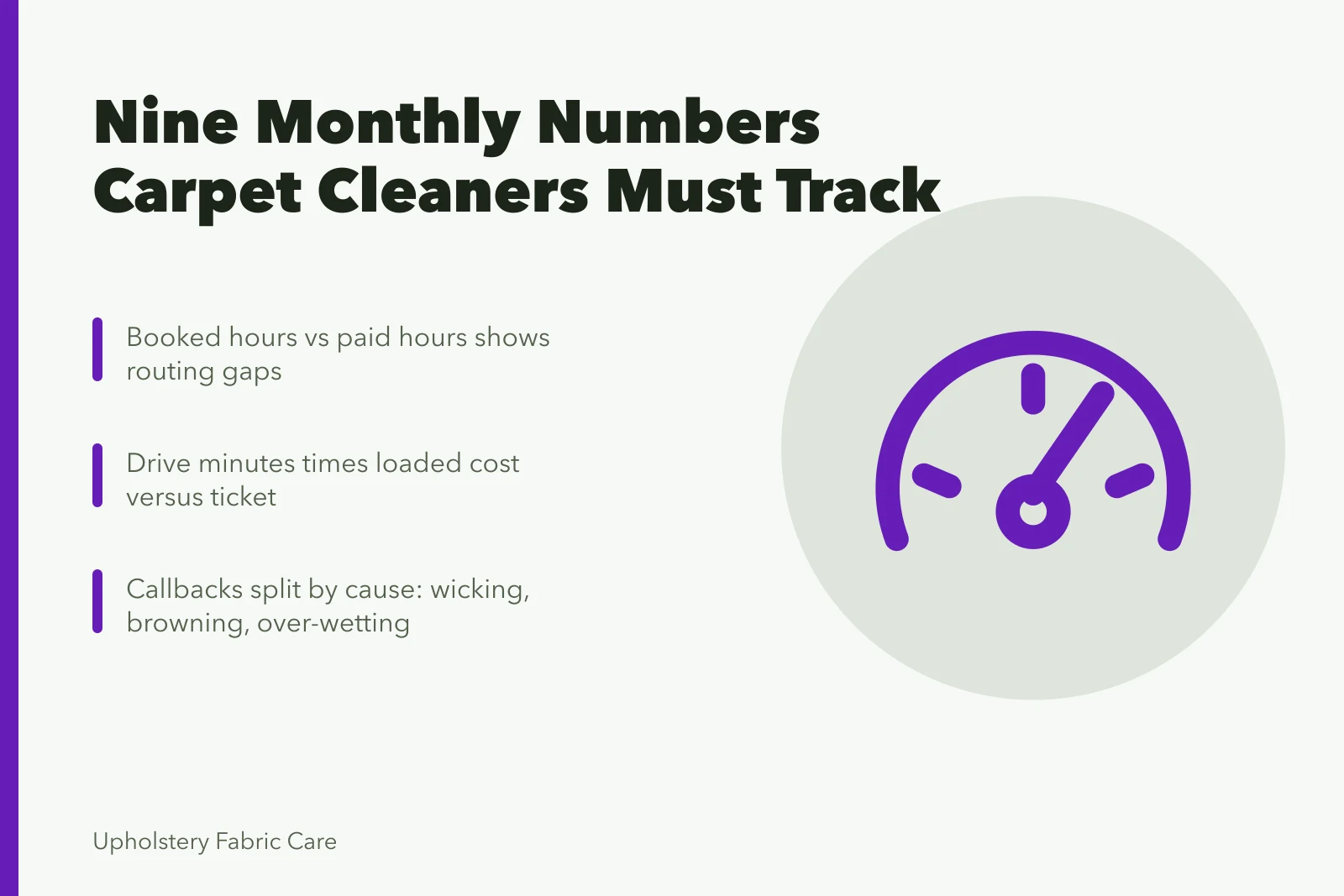
Nine monthly figures a carpet cleaning owner can pull from the schedule and the invoices, and what each one changes about pricing and routing.
What to take away
- Pull nine numbers on the same day each month: booked hours against paid hours, drive time per job, average ticket, callback count, repeat rate, receivables age, protector attach rate, and jobs turned down.
- Track booked hours against paid hours. A full calendar with unpaid gaps between jobs is a routing problem, not a demand problem.
- Count callbacks by cause, not by total. Wicking, browning, over-wetting and protector complaints each point at a different fix.
- A number you cannot trace to a job record is a guess. The record is the pre-inspection form and the invoice.
The nine numbers
| Number | Where it comes from | What it changes |
|---|---|---|
| Booked hours vs paid hours | Schedule against invoices | Whether to add a van or tighten the route |
| Drive time per job | Arrival and departure times | Minimum charge and territory |
| Average ticket | Invoice total per job | Whether small jobs pay for themselves |
| Callbacks | Job records, by cause | Pre-spray dwell, wand passes, drying setup |
| Repeat rate | Customer list, 12-month window | Whether the work holds up |
| Receivables age | Invoice dates against payments | Which commercial accounts to keep |
| Protector attach rate | Invoices with a protector line | Whether the upsell is being offered at all |
| Jobs turned down | Estimates not converted | Whether refusals are fiber, code or distance |
| Estimate-to-booked rate | Estimates against scheduled jobs | Where prospects stall |
Drive time is the number owners skip
A truck-mount decides which jobs you can take: it needs parking close enough to run hose, so a fourth-floor walk-up may be a portable job or a refusal. Portables trade speed for access.
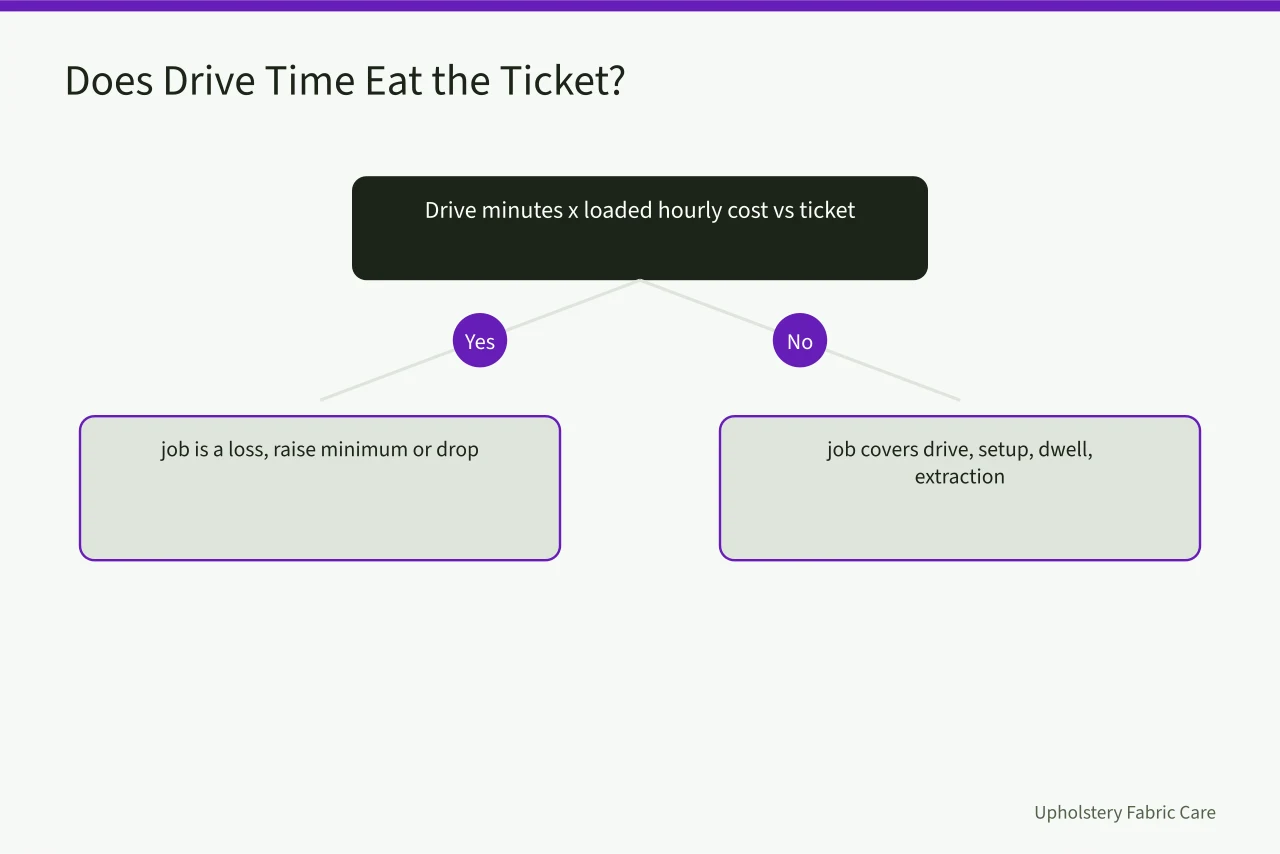
Route density is the arithmetic that matters. Take your drive minutes between jobs, multiply by your loaded hourly cost, and compare that to the ticket. If the drive eats the ticket, the job is a loss no matter how clean the carpet is.
Route density and drive minutes set carpet cleaning pricing, so the minimum charge follows from them.
Set a minimum charge from that sum, not from what a competitor advertises. The minimum is the point where a job covers drive time, setup, dwell, extraction and pack-down.
Callbacks are the quality number
A callback is a return trip with a trailer, and it is the most expensive line on this list. Split the count by cause.
Wicking is soil drawn back up the backing as the carpet dries, and it shows at seams and edges. Browning is the same movement with a different residue, common on lighter fibers. Both usually trace to over-wetting or to a drying setup that never got airflow moving.
Viscose is the fiber that changes the job. It loses strength when wet, so a W or WS code on a viscose blend does not mean wet-clean it the same way as nylon. Test colorfastness on a hidden area before any wet method, and record the result on the pre-inspection form.
Dwell time is a documented step. Note the product, the label's stated dwell, and the actual minutes. A callback review that cannot see those three lines is guessing.
Where the numbers land
The figures feed a plan, and the plan decides what you buy next. A carpet cleaning business plan that lists capacity, territory and minimum charge turns a bad month into a decision instead of a mood.
Software earns its place when it produces these numbers without you rebuilding them in a spreadsheet. What to look for is in the carpet cleaning software and KPI guide.
Recordkeeping has a floor set by someone else. The IRS guidance on business records describes what has to be kept and for how long. If the schedule and invoices live on a computer, the NIST small business quick-start guides and the CISA small business guidance cover backups and account access.
Common questions
How often should I review these numbers?
Monthly, on the same date, so the comparison is honest. A weekly look at callbacks is worth it during a run of wicking complaints, because the cause is usually one technician or one drying setup.
What if my average ticket is rising but profit is not?
Check drive time per job first. Ticket growth from longer trips raises revenue and eats it in the same month. Then check protector attach rate, which is margin without a second visit.
Do I need software to track nine numbers?
No. A schedule and an invoice book will produce all nine. Software pays for itself when the manual version costs you an evening a month, or when you cannot answer a callback question without digging through paper.
Which number should a new owner watch first?
Booked hours against paid hours. It is the fastest read on whether the business has a demand problem or a routing problem, and the two need opposite responses.