
Guides
Winter salt and slush, a Canadian carpet care calendar
Winter carpet care in Canada follows a salt and slush cycle, so extraction and protectant timing shift by region from November through April.
What to take away
- Road salt arrives in four stages, dry crystals in November, brine in December, heavy slush at the January thaw, then wicking residue in March, and each stage needs a different method.
- Prairie salt stays crystalline longer and abrades pile; central Canada carries the heaviest slush volume; the Maritimes stay wet and dry slowest.
- Vacuum dry salt before any moisture touches it. Wetting crystals turns them into brine that sinks past the pile.
- Apply protectant before the first salt, top up high-traffic lanes after the January thaw, and reapply fully once the pile is dry.
- Book winter work as a season, not a series of emergency calls, so route density survives cold starts and short daylight.
The salt cycle, month by month
Canadian carpet soil is a sequence, not one problem. Each stage responds to different chemistry and different equipment.
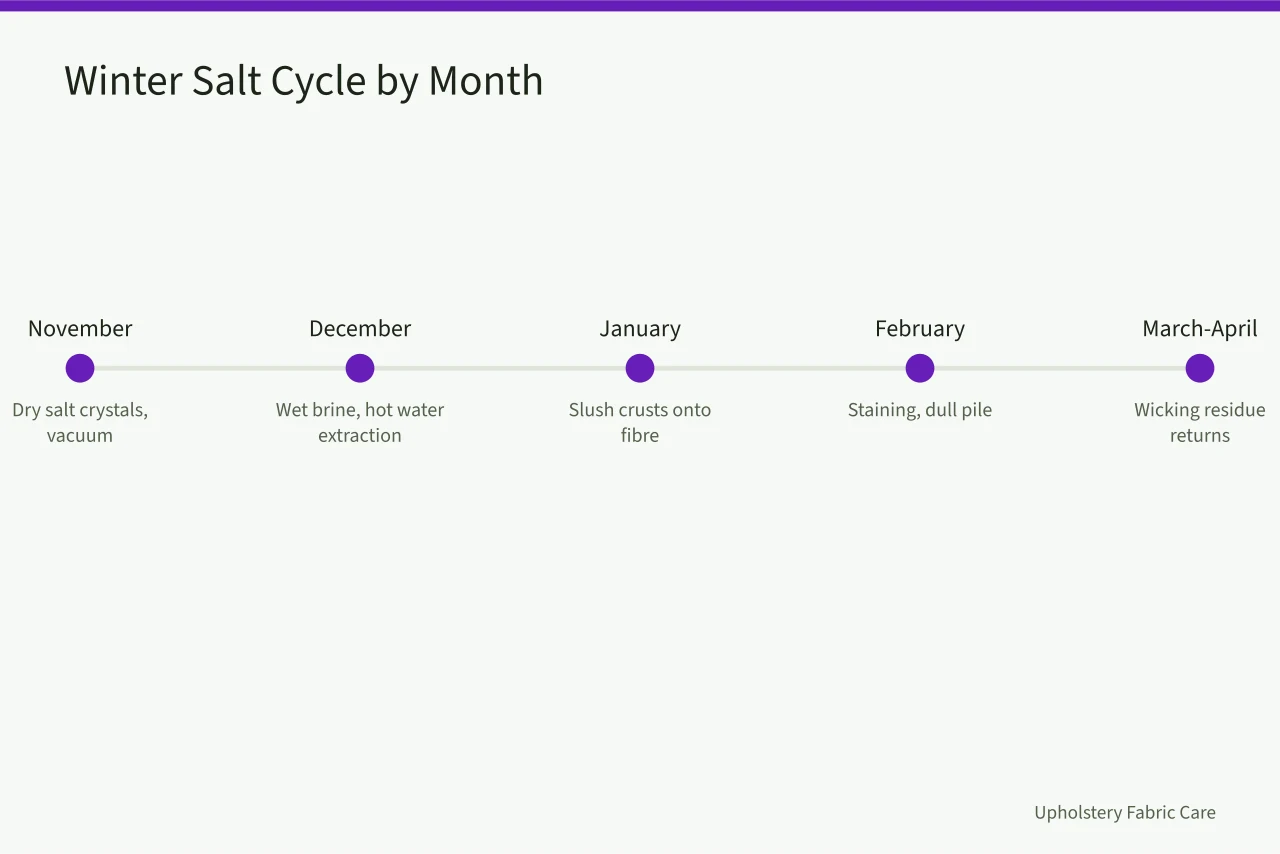
November is the dry phase. Road salt arrives as crystals, gets walked in, and grinds into the pile. Vacuuming removes most of it, and this is the cheapest intervention of the winter.
December adds moisture. Entrances stay wet, salt dissolves, and the first brine lines appear along traffic lanes. Extraction now lifts salt that vacuuming cannot reach.
January brings the thaw. Slush travels further into a building than dry salt ever does, then dries into a crusted white residue bonded to fibre.
February is the staining phase. Repeated wetting and drying drives salt and fine grit deeper, and the pile looks dull even where it is clean.
March and April are the wicking phase. Residue pushed to the base of the pile migrates back up as floors dry, and complaints arrive about carpets that looked fine in February.
That sequence explains why one spring clean rarely satisfies anyone. The salt was never one deposit. It was four months of deposits, each bonding harder than the last.
| Month | Dominant soil | Best response | Protectant note |
|---|---|---|---|
| November | Dry road salt crystals | Thorough vacuuming, entry matting | Apply before first salt |
| December | Wet brine, first slush | Hot water extraction on entries | Top up high-traffic lanes |
| January | Heavy slush, thaw cycles | Extract after each thaw event | Reapply where pile feels rough |
| February | Bonded salt and grit | Agitate, extract, then dry | Reapply on main walkways |
| March | Wicking residue | Full extraction, slower drying | Reapply after full dry |
| April | Residual staining | Spot work and final protectant | Confirm even coverage |
Prairie winters: dry soil, road salt and freeze-thaw
Alberta, Saskatchewan and Manitoba run a dry cold that changes what salt does. Humidity sits low, indoor air is drier still, and salt crystals stay crystalline far longer than they do in Ontario.
That helps vacuuming and hurts fibre. Dry crystals under foot act like sandpaper on wool and on loop pile, and the damage shows up as fuzzing along traffic lanes rather than as a stain.
Freeze-thaw is the second prairie factor. Chinooks and warm spells melt entryway slush, which refreezes overnight and gets tracked in as a wet, gritty paste the next morning.
Extraction timing on the prairies follows the melt, not the calendar. When a warm spell hits, book entryway extraction within a day or two, because the slush load peaks and then dries hard.
Drying is faster here, which helps. Low indoor humidity means extracted carpet dries quickly with airflow, and the risk of over-wetting a sealed building is lower than in coastal markets. The CCOHS guidance on industrial ventilation is a sensible reference when you set airflow for winter extraction in enclosed commercial spaces.
Apply protectant early and apply it dry. A fluorochemical protectant laid on damp pile in a dry building can leave uneven coverage, so schedule reapplication after full dry-down. Getting that sequencing right belongs in your carpet cleaning sop checklist.
Central Canadian winters: Ontario and Quebec slush loads
Southern Ontario and the St Lawrence valley produce the heaviest slush volumes in the country. Salt goes down generously, temperatures hover near freezing, and entries stay wet for weeks rather than days.
That combination pushes salt deep into buildings. In a Toronto or Montreal condo tower, the lobby carpet can carry salt forty metres from the door, and the elevator cab carries it to every floor above.
Commercial clients in these markets often need entryway extraction on a two to three week cycle through January and February, with full-floor work in March. Skipping the midwinter visit means the spring clean takes twice as long.
Residential demand in central Canada is driven partly by rental turnover. Purpose-built rental completions and condo rentals shape how many unit turns happen in winter, and the 2025 Rental Market Report from CMHC is a reasonable input when you forecast turnover volume for the coming season.
Quebec adds a billing detail that catches new operators. GST and QST both apply, registration and filing run through the Canada Revenue Agency and Revenu Quebec respectively, and a quote that omits one tax line creates a dispute in February.
Maritime winters: wet salt through Nova Scotia and Newfoundland entries
Nova Scotia, New Brunswick, Prince Edward Island and Newfoundland and Labrador deal with a wetter winter than anywhere else in the country. Rain, freezing rain and wet snow arrive in rotation, and salt stays in solution.
Wet salt is the hardest version to remove. It soaks into backing and underlay, dries slowly in humid coastal air, and keeps releasing residue for weeks. Extraction that leaves too much moisture simply resets the clock.
Drying is the bottleneck. Coastal humidity in January can sit high enough that a carpet extracted on Tuesday is still damp on Friday, and that is where odour and delamination complaints begin.
Maritime operators should build drying time into the schedule rather than treating it as a variable. Air movers, controlled heat and ventilation all matter, and the ventilation guidance published by the Canadian Centre for Occupational Health and Safety is the reference to follow in enclosed commercial spaces where windows stay shut all winter.
Protectant reapplication in the Maritimes needs to be more frequent, not stronger. Wet tracking wears a protectant film faster than dry tracking, so a high-traffic entry may need a top-up in January as well as the autumn application.
Newfoundland entries add wind-driven rain, which drives salt further inside than a normal doorway. Matting systems pay for themselves quickly in those buildings.
Extraction timing and protectant windows
Extraction timing is a decision about salt chemistry, not about appearance. Salt is most mobile when wet and most damaging when it dries bonded to fibre, so the window sits between those two states.
Use this sequence for a winter entryway job:

Protectant timing follows the same logic. Apply in late October or early November, before the first salt. Top up high-traffic lanes after the January thaw. Reapply fully once the pile is dry in March or April.
Pricing these visits is easier when the numbers move with the season. Indexing winter surcharges against the Consumer Price Index data published by Statistics Canada keeps a quote defensible when a client questions a January increase.
Worked example. A Halifax property manager books a 400 square metre lobby with four entry vestibules. November: vacuum plus protectant, half a day. December and January: two extraction visits covering entryways and twenty metres of traffic lane, one day each. February: full extraction, one and a half days. March: protectant reapplication after dry-down, half a day. Four visits across five months, priced as a seasonal contract rather than four separate calls.
Building a winter calendar for your routes
A winter calendar is a routing document. Salt arrives on a schedule set by weather, and your vans should arrive on a schedule set by salt.
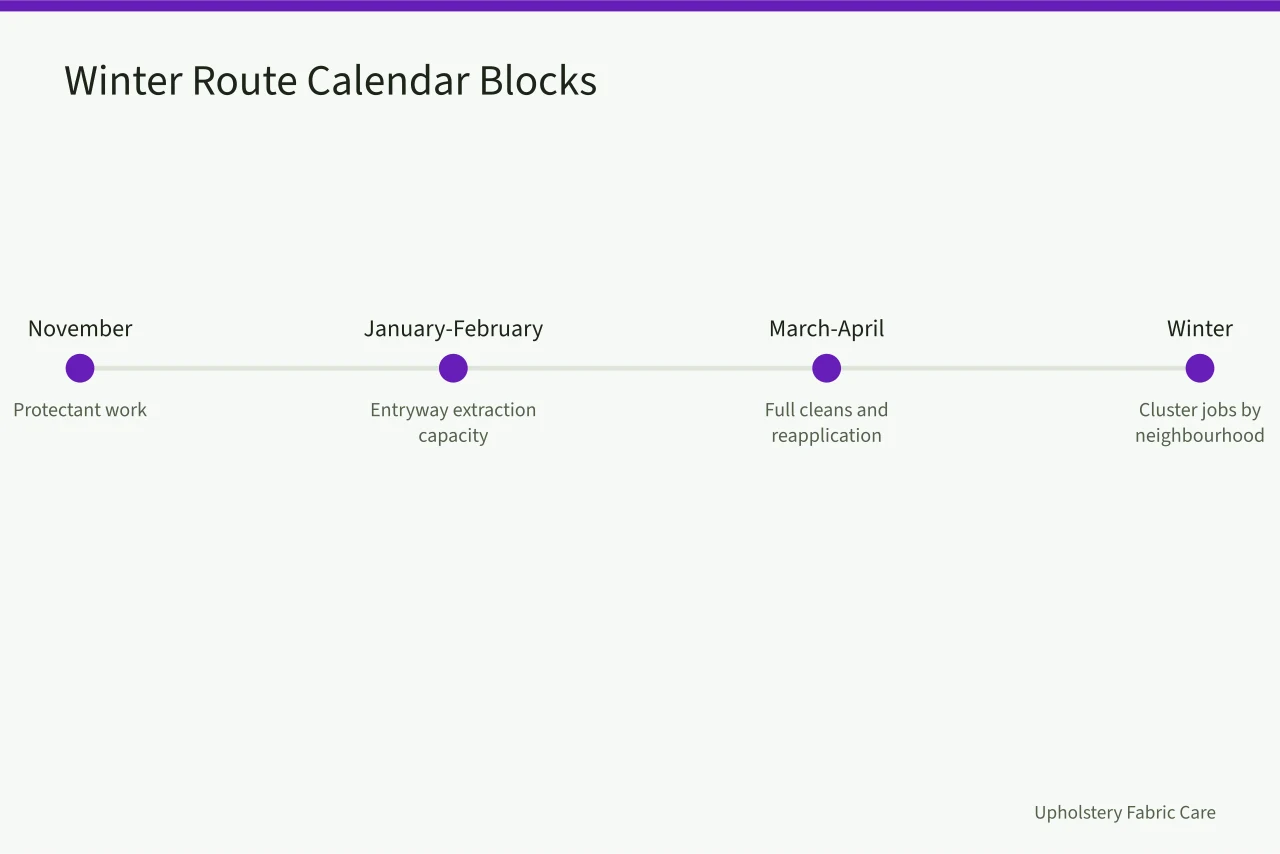
The practical version: block November for protectant work, hold January and February capacity for entryway extraction, and reserve March and April for full cleans and reapplication. Commercial contracts fill the middle. Residential work fills the edges.
Route density matters more in winter than in summer. Cold starts, slower drying and shorter daylight all cut productivity, so grouping jobs by neighbourhood protects margin. The principles in this guide to carpet cleaning scheduling apply directly when you cluster winter work.
Demand forecasting should lean on local construction and rental data. New completions generate first-time cleans, and the Housing Market Outlook from CMHC is a usable input for deciding where to add route capacity in a given winter.
Staffing is a winter problem of its own. Cold weather means more sick days, and the obligations sit with WorkSafeBC and the WCB in Alberta, WSIB in Ontario, and the employment standards act in each province. Plan coverage before January, not during it.
Product handling has a winter dimension too. Health Canada labelling requirements govern the protectants and pre-sprays you carry, and a Safety Data Sheet should travel with the van.
Package winter work so clients buy a season rather than a series of calls. Bundling entryway extraction, protectant reapplication and a spring clean into one contract smooths cash flow, and the structure in these carpet cleaning services examples adapts well to a November-to-April term.
Good winter operators treat the season as a workflow, not a run of emergencies. The same discipline that keeps a route moving in July keeps it moving in February, and the operational habits in this carpet cleaning operations overview are worth revisiting before the first snowfall.
Watching which carpet cleaning equipment brands hold up under winter salt loads helps you decide which winter services stay on the menu.
Common questions
When should protectant be reapplied in a Canadian winter?
Apply before the first road salt in late October or early November, top up high-traffic lanes after the January thaw, and reapply fully once the pile is dry in March or April. Three passes cover a normal season.
How often should entryway carpet be extracted in a prairie winter?
Follow the melt rather than the calendar. Book extraction within a day or two of each warm spell, when the slush load peaks and before it dries hard into the pile.
Why does Maritime carpet stay wet so long after extraction?
Coastal humidity in January slows evaporation, so airflow and ventilation matter more than they do inland. Build extra dry-down time into the job rather than assuming an overnight dry.
Does road salt damage carpet permanently?
Repeated wetting and drying drives salt and grit to the base of the pile, where it abrades fibre and causes wicking stains. Regular extraction limits the damage; leaving it until spring usually does not.