Guides
Sample carpet cleaning quotes and the template behind them for first-year owners
A quote template for carpet cleaning holds fiber, cleaning code and test results, so the price you name matches the method you can actually use.
What to take away
- The template's job is to record what you inspected, not to look complete. A quote without fiber and cleaning code is a guess with a number on it.
- Ask for the cleaning code before you name a method. A W code and an S code can be the same square footage and two different prices.
- Test for colorfastness on every job where a wet method is planned, and write the result on the quote.
- Price the small job against your minimum charge, not against the room count, or the drive eats the margin.
- Keep the quote, the test result and the product record together. That file is what defends the invoice later.
What the template has to hold
A carpet cleaning quote is a method decision written down. Before any number, the template needs the fiber, the cleaning code, the colorfastness test result, and the soil condition you saw at the walkthrough.
Fiber identification comes first because it decides what you can safely do, and wool, nylon, polyester and olefin tolerate different amounts of heat and moisture.
Viscose, sold as rayon or art silk, can lose strength when wet and can brown or distort. A viscose rug or viscose-blend upholstery panel often moves to a low-moisture method or gets referred out. Write the fiber on the quote, not in your head.
The cleaning code sits on a tag under the cushion or on the frame. The four codes are W (water-based), S (solvent), WS (either) and X (vacuum or light brush only).
The code is the manufacturer's instruction, so it outranks your preference. If the tag is missing, call the manufacturer, and put the answer on the quote.
Colorfastness is the test that prevents the callback. Test an inconspicuous spot with the product you intend to use, blot it, and check for dye transfer onto the cloth. Bleed shows up on the cloth before it shows up on the customer's sofa. Record the spot you tested and the result.
Choosing the method
Three methods cover most residential work, and the fiber and code pick between them.
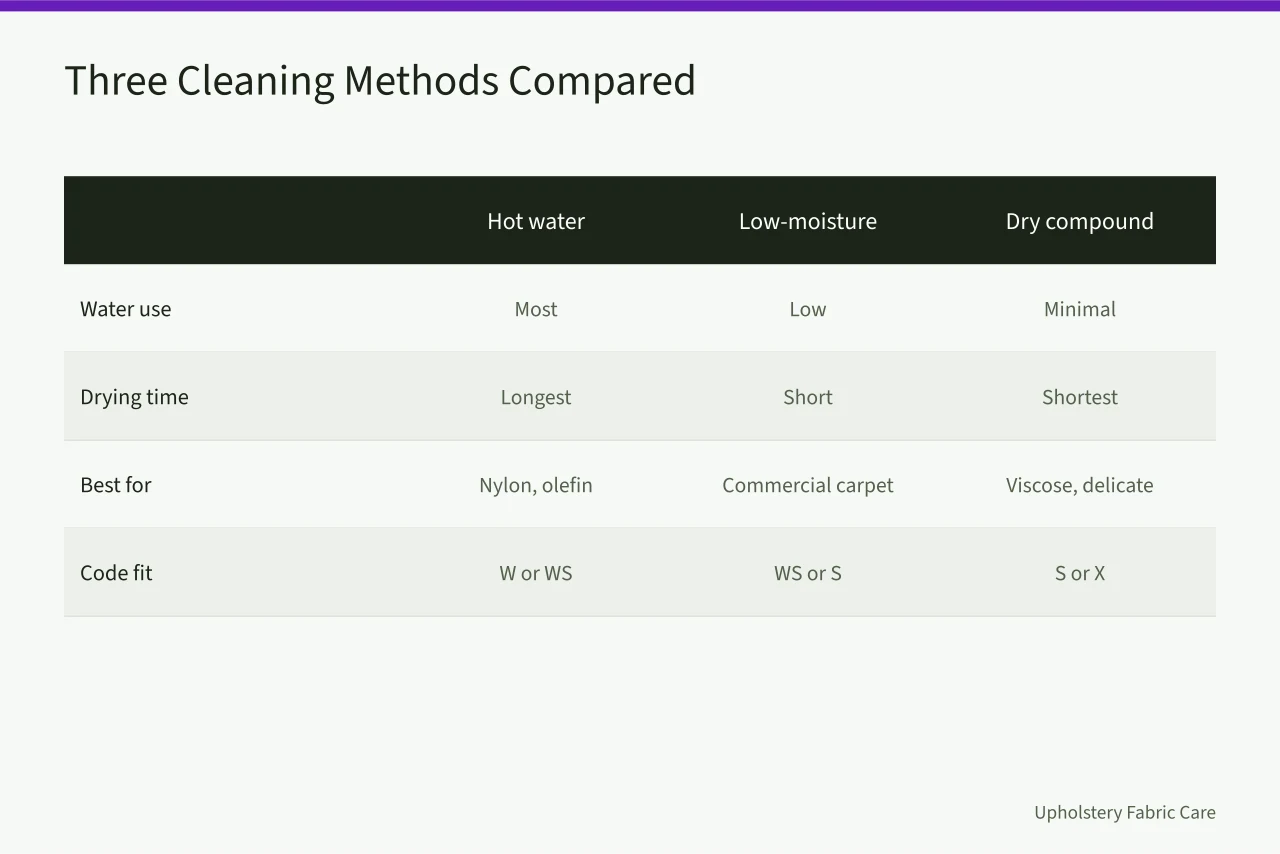
- Hot water extraction. The deepest clean, the most water, the longest dry. Suits nylon and most olefin carpet with a W or WS code.
- Low-moisture encapsulation. A polymer that crystallizes and vacuums away. Suits commercial carpet and any job where drying time is the constraint.
- Dry compound. Minimal moisture, good for viscose, for delicate upholstery, and for a customer who cannot have the room out of use.
Pre-spray dwell time is a step, not a pause. Follow the label's dwell and note that you followed it on the job sheet. Wand technique decides how much water stays behind: slow passes, overlapping, dry strokes at the end.
Over-wetting is the most common cause of the two callbacks that follow: browning and wicking. Dwell time, wand passes and drying control are the same steps a daily operations checklist records on every job.
Drying, browning and wicking
Browning is the brown stain that appears as a wet carpet dries, usually on a jute backing or a cellulosic fiber. Wicking is soil travelling up the fiber tuft to the surface as it dries, so a spot you removed reappears a day later.
Both are drying problems. Air movers and open airflow cut drying time, and the quote should say who provides them. A customer who turns the air conditioning off overnight has just extended the dry.
Protector reapplication belongs on the quote as a line item with its own approval, because it is a separate product with its own label. Apply it after the carpet is dry, per the label.
What decides the price
Truck-mount or portable decides which jobs you can accept, not just how fast you work. A truck-mount reaches further and dries faster; a portable gets you into a high-rise with no parking. That choice shows up in the service packages you can offer and in which jobs you decline.
Route density is the quiet margin. Two jobs in one suburb on one afternoon cost less in drive time than two jobs across the city, so the markets worth building a route in matter as much as the rate.
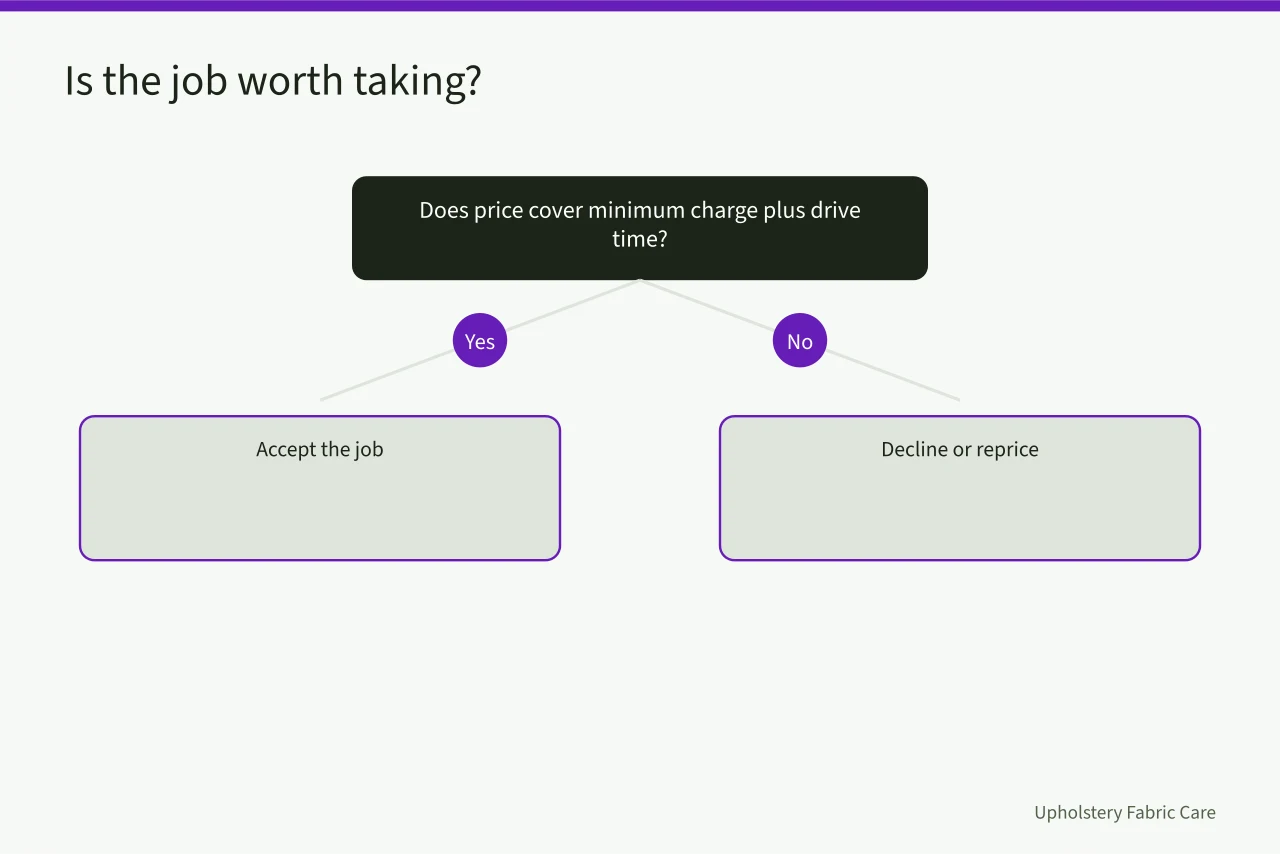
The small-job problem is arithmetic with your own numbers. Let M be your minimum charge, D your drive time, T your on-site time.
A job is worth taking when the price covers M plus the drive. Room count alone will not tell you that. The pricing method behind a fair margin sets that floor.
Keeping the record
The quote, test result and product record are one file. The IRS guidance on business records covers what supports income and expenses.
Advertising claims about the method or result must be substantiated, as the FTC advertising guide sets out. For technician pay in your area, the BLS wage tables are one input among several.
| Quote line | Why it is there |
|---|---|
| Fiber and cleaning code | Decides which method is legal to use |
| Colorfastness test result | Shows bleed was checked before wet work |
| Method and dwell time | Ties the price to a documented process |
| Drying arrangement | Names who supplies airflow and for how long |
| Protector, if sold | Separate product, separate approval |
Common questions
What if the customer refuses the colorfastness test?
Decline the wet method and offer a low-moisture or dry option, or refer the job. Cleaning without testing transfers the risk of a bleed to you, and the price will not cover it.
Can I quote over the phone?
You can quote a range. You cannot quote a method, because fiber and code are not visible over the phone. Say the price is subject to inspection and put that sentence on the written quote.
How long is a quote good for?
Set your own expiry and print it. Product costs and fuel move, and an open-ended quote is a promise to absorb that.
Does the template replace a contract?
No. It records scope and method. Terms, liability and payment belong in the agreement the customer signs, and licensing and wastewater disposal rules vary by state and municipality, so confirm those with the office that decides them.