Guides
Carpet cleaning pricing and profit guide
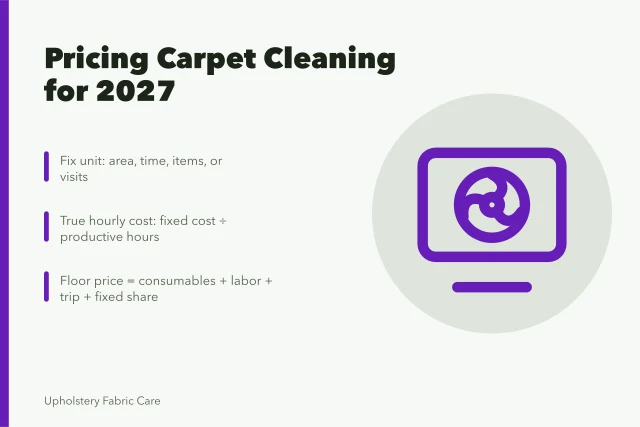
Carpet cleaning pricing starts with the unit you sell in. Choose it wrong and every quote after it argues with the customer about what a room is.
What to take away
- The pricing unit is the decision. Everything else is arithmetic performed inside it.
- A price has to clear four things before it is a price: solution, labor, the trip, and the share of fixed cost the job owes.
- Drive time is the cost line that never appears on an invoice and decides which jobs are worth taking.
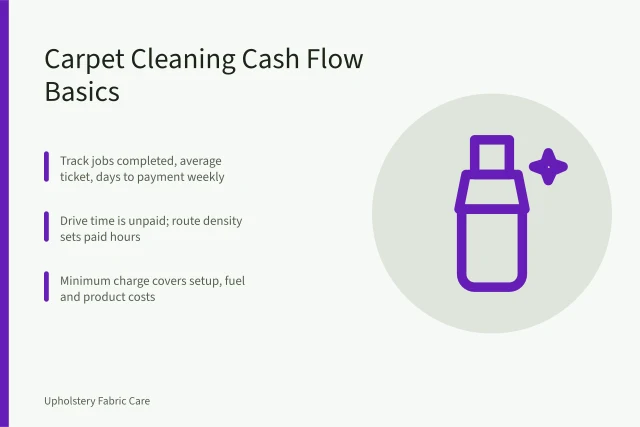
- A minimum charge is not a rounding rule. It is the smallest job that pays for the trip, and it should be calculated rather than copied.
No national figure can tell you what to charge. Your fixed cost, your drive times and your job durations are the inputs, and none of them travels between businesses. What travels is the structure.
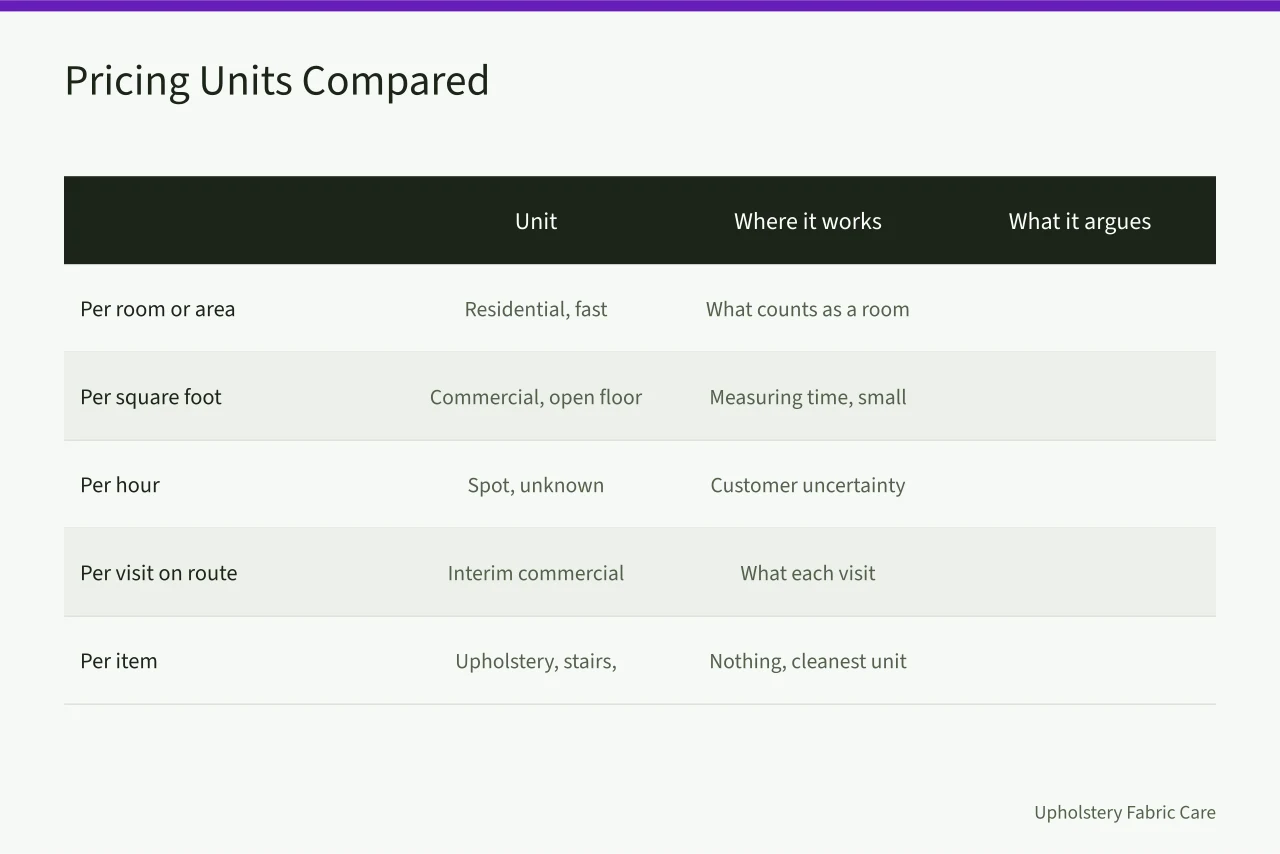
Choose the unit before the number
| Unit | Where it works | What it argues about |
|---|---|---|
| Per room or area | Standard residential layouts, fast quoting over the phone | What counts as a room, and what a large room does to your hour |
| Per square foot or square metre | Commercial work, open floor, measured properties | Measuring time, and small jobs that price below the trip |
| Per hour | Spot work, unknown condition, restorative jobs | Customer uncertainty about the total |
| Per visit on a route | Interim commercial maintenance | What each visit includes and what carries between visits |
| Per item | Upholstery, stairs, rugs | Nothing, which is why it is the cleanest unit in the trade |
Most residential operations end up selling area units with per-item add-ons. Most commercial route work ends up per visit. Mixing units inside one quote is fine. Mixing them inside one line is where disputes start.
The four things a price has to clear
Write these as variables and fill them with your own figures.
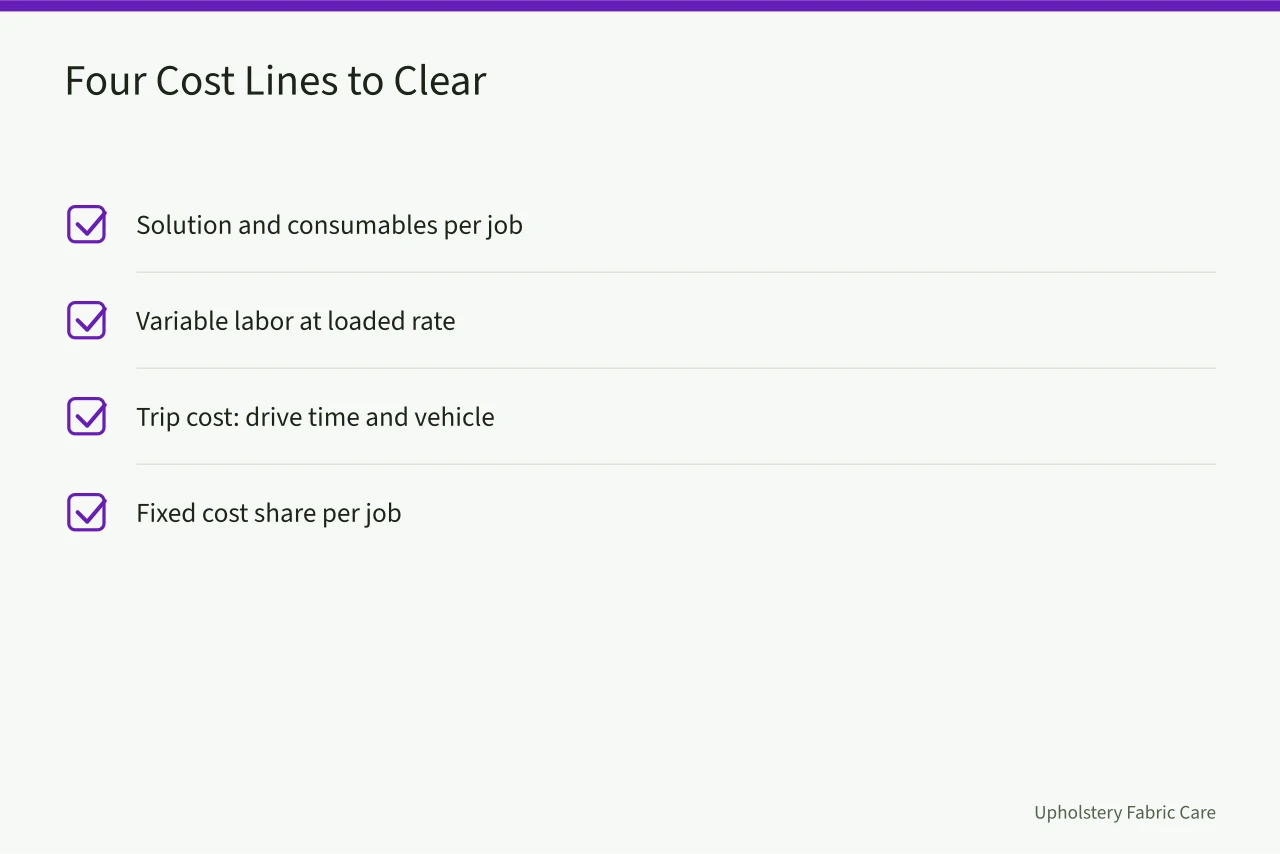
A price above the first two and below the sum of all four looks profitable per job and loses money per month. That gap is where most one-truck businesses live without knowing it.
Contribution per job is what remains after the first two and the trip. Use it to decide whether to accept a marginal job. Use the full four to decide what the standard price should be.
Drive time is a price input
A job forty minutes away consumes the same hour of your day as a job you clean. Attribute it or your prices will quietly subsidize your worst addresses.
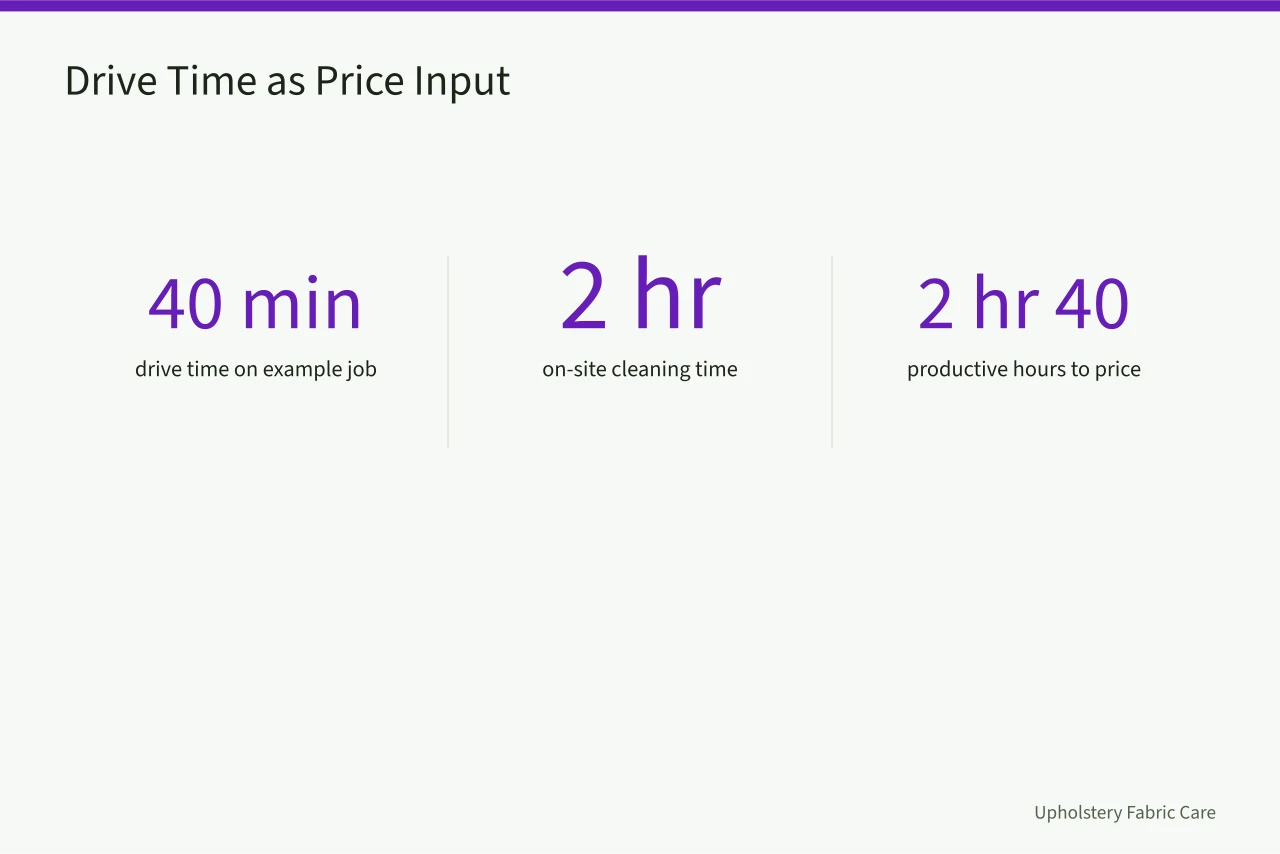
The simplest honest approach is to price on productive hours rather than on-site hours. Productive hours equals on-site hours plus attributed drive time. A job that takes two hours on site and forty minutes of driving is a two hour forty job, and the rate has to clear the four lines across all of it.
That is also why route density changes profitability more than price does, and why territory decisions belong upstream in the startup and market guide.
Setting a minimum charge
The minimum charge is the smallest job that still clears the trip. Calculate it: minimum charge equals trip cost plus minimum on-site labor plus consumables plus the fixed cost share of one job.
Then decide what happens when a customer wants less than that. The options are to hold the minimum and explain it, to convert the visit into something larger, or to schedule it beside an existing job so the trip is already paid for. All three are defensible. Discounting below the minimum because the customer sounded disappointed is not.
What raises a price honestly
Method, fiber and access all move real cost, and each is explainable at the door.
Stairs are hand work with a production rate unlike open floor. Upholstery is per item and per code. Heavily soiled restorative work takes pre-vacuum time, dwell time and drying time that light maintenance does not. Access without parking or an elevator adds setup. An after-hours commercial visit adds an hour nobody sees.
The method you own also caps what you can charge for, because you cannot price work you cannot reach, which the equipment and setup guide treats as a purchase constraint. The service definitions underneath every line item come from the services and packages guide.
What you may say about the price
Advertising a price is a claim. Conditions that change it have to be visible before the customer books, not discovered when a technician arrives. The same substantiation obligation that applies to cleaning results applies to price advertising, and registration or trade practice rules in your state may add more, which the licensing and compliance guide covers.
The federal position on advertising claims is set out in the FTC advertising guidance for small business.
Where your input numbers come from
Labor rates come from published area data, not what you want to pay, and area wage tables are in the BLS occupational employment statistics.
Fixed cost comes from your own books, and what a small business must keep is in the IRS small business recordkeeping guidance.
General preparation guidance for a new operation is in the SBA business guide.
Common questions
Should I publish prices on my website?
Publish the unit and the minimum, and publish what changes the figure. That answers the caller's real question, which is whether you are in their range, without committing you to a scope you have not seen.
How do I raise prices on existing customers?
With notice, in writing, on a date, and with the same figure for everyone in that segment. Piecemeal increases applied to whoever complains least are the ones that get discovered.
Is matching a competitor's price ever right?
Only if your cost structure matches theirs, which you cannot know. A price that clears your four lines is defensible. A price that clears theirs may not clear yours.
What is the most common pricing mistake in this trade?
Pricing the second job of the day and the fifth job of the day identically when one of them carries forty minutes of driving and the other carries five.