Guides
6 details of carpet cleaning startup people miss
Carpet cleaning startup planning turns on four choices: the fibers you accept, the method you own, the drive time you serve, and who signs the invoice.
What to take away
- A cleaning business is defined by the fibers and fabrics it agrees to touch, long before it is defined by its territory.
- The method you own decides which buildings you can work in. That is a different question from which method cleans best.
- Drive time is inventory. A territory is worth its minutes between stops, not its square miles.
- Residential and commercial work share equipment and almost nothing else, including who decides and who pays.
- A first-year record of fibers met, methods used and jobs that came back is the only market study you will own.
Most advice for a new cleaner starts with a market, the wrong end. A cleaner sells a small set of physical capabilities, and until those are settled, no market question can be answered.
An operator with a portable machine and no dry method cannot honestly bid on a high-rise condo with a viscose rug in the entry, whatever demographics say.
The four decisions that set your ceiling
The first is fiber scope: nylon and polyester broadloom in a suburban house is one job. Wool in a hallway runner is a second, while viscose is a third that ends careers early.
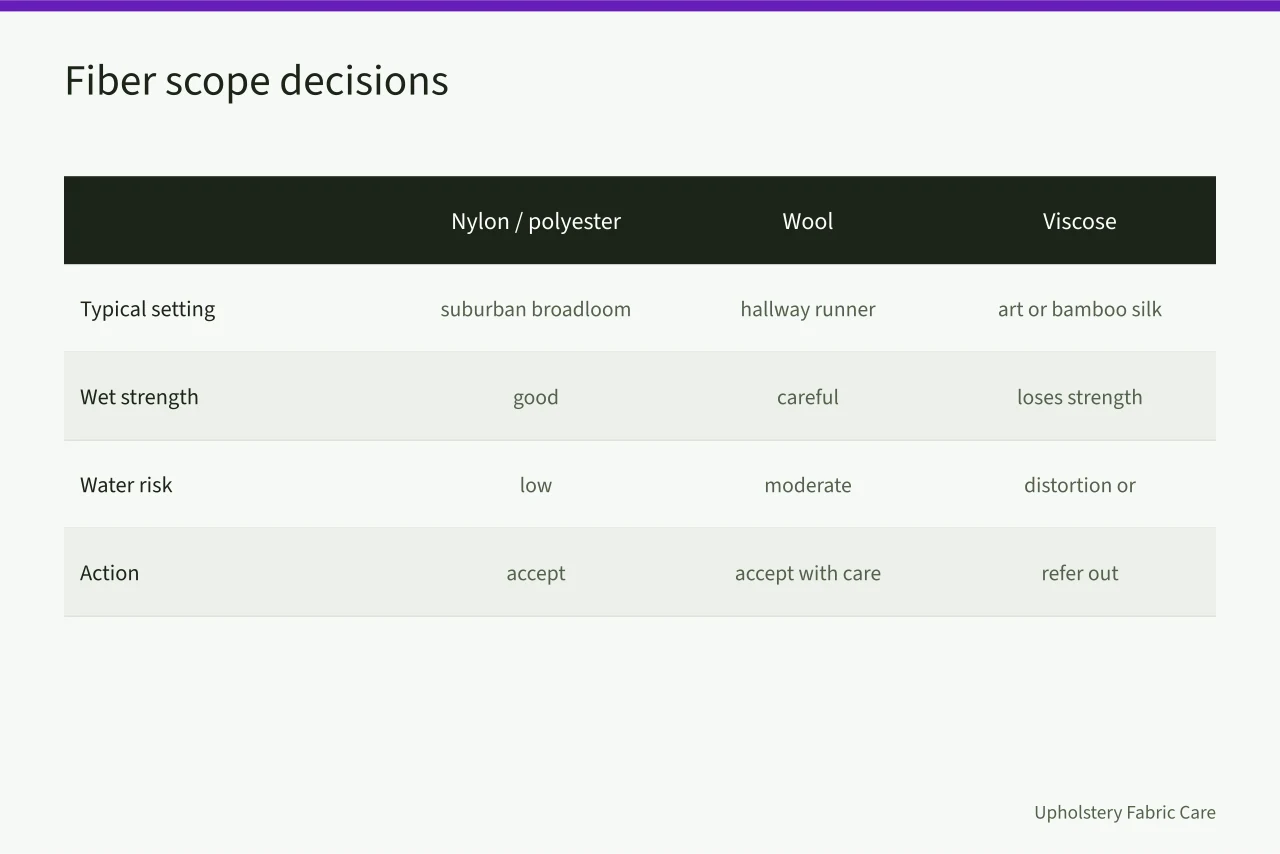
Sold as art silk or bamboo silk, it loses strength when wet, and ordinary water can distort its texture or leave it yellowed. Decide in advance which you accept and which you refer out.
The second is method ownership. Hot water extraction, low-moisture encapsulation and dry compound are not three grades of one service. They are three jobs with different water loads and different drying behavior.
The third is territory, expressed as minutes rather than as a map.
The fourth is customer type. A homeowner decides and pays. A facility manager decides, a property company pays, and a tenant complains. Those are different businesses wearing the same uniform.
Reading the work before reading the market
Before a single flyer, walk the building stock you can reach and write down what is on the floor. Cut pile nylon in tract housing behaves differently from a loop-pile commercial glue-down, and both differ from the wool and blend rugs of older neighborhoods.
Then check the furniture. Manufacturers put a cleaning code on a tag, usually under a cushion or on the frame rail: W for water-based agents, S for solvent, WS for either, X for vacuuming and light brushing only.
That code is the manufacturer's instruction about its own product, not your opinion. If the tag is missing or unreadable, ask the manufacturer and record what you found.
Market research at this stage is a notebook with three columns: what was on the floor, what the tag said, and what the customer thought they wanted. Thirty visits will tell you more than a purchased report.
Method first, machine second
New owners reliably choose the machine first and the method second.
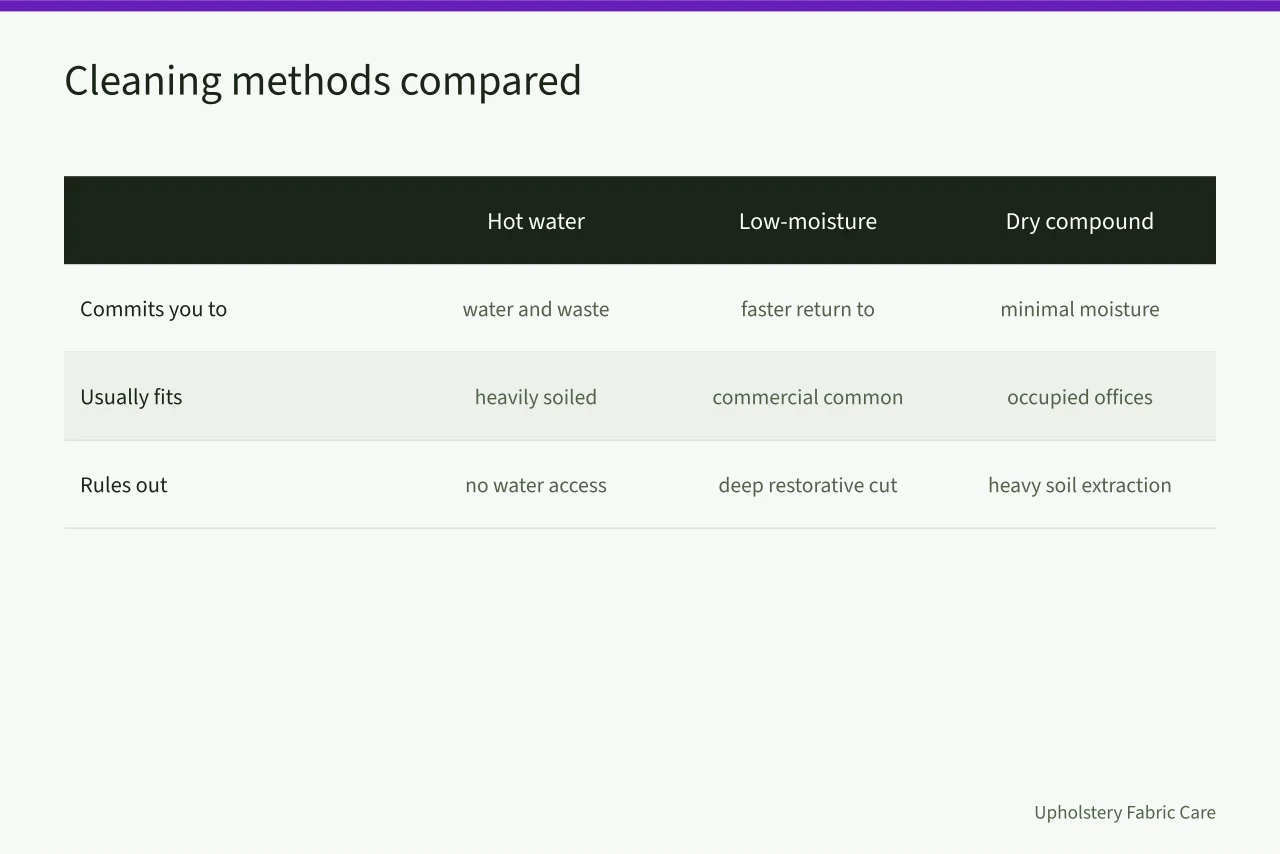
| Method | What it commits you to | Where it usually fits | What it rules out |
|---|---|---|---|
| Hot water extraction | Water supply, waste recovery, and a drying conversation at closeout | Heavily soiled residential broadloom, restorative work | Buildings with no water access or no tolerance for damp carpet |
| Low-moisture encapsulation | Faster return to service, a different soil-removal profile | Commercial common areas, interim maintenance on a route | Deep restorative cleaning of heavily soiled cut pile |
| Dry compound | Minimal moisture, mechanical agitation, vacuum recovery | Occupied offices, moisture-sensitive installations | Situations where the customer expects heavy soil extraction |
Owning extraction and nothing else means turning down occupied-office work that cannot be shut down overnight. Owning encapsulation and nothing else means turning down the restorative residential job that pays for the week.
Whichever you own, pre-spray dwell belongs in the written procedure with the product label as its authority. Manufacturer instructions govern how a product is prepared and how long it stays on the fiber, and what an employer owes workers in written program, labeling and training terms is set out in the OSHA hazard communication standard.
Territory as a time budget
A route is a time budget with a service inside it. Every mile between stops is unbillable, so the question about a territory is how many jobs it holds in a day without the last customer being visited at dusk.
Write the budget as an expression and fill it in with your own numbers:
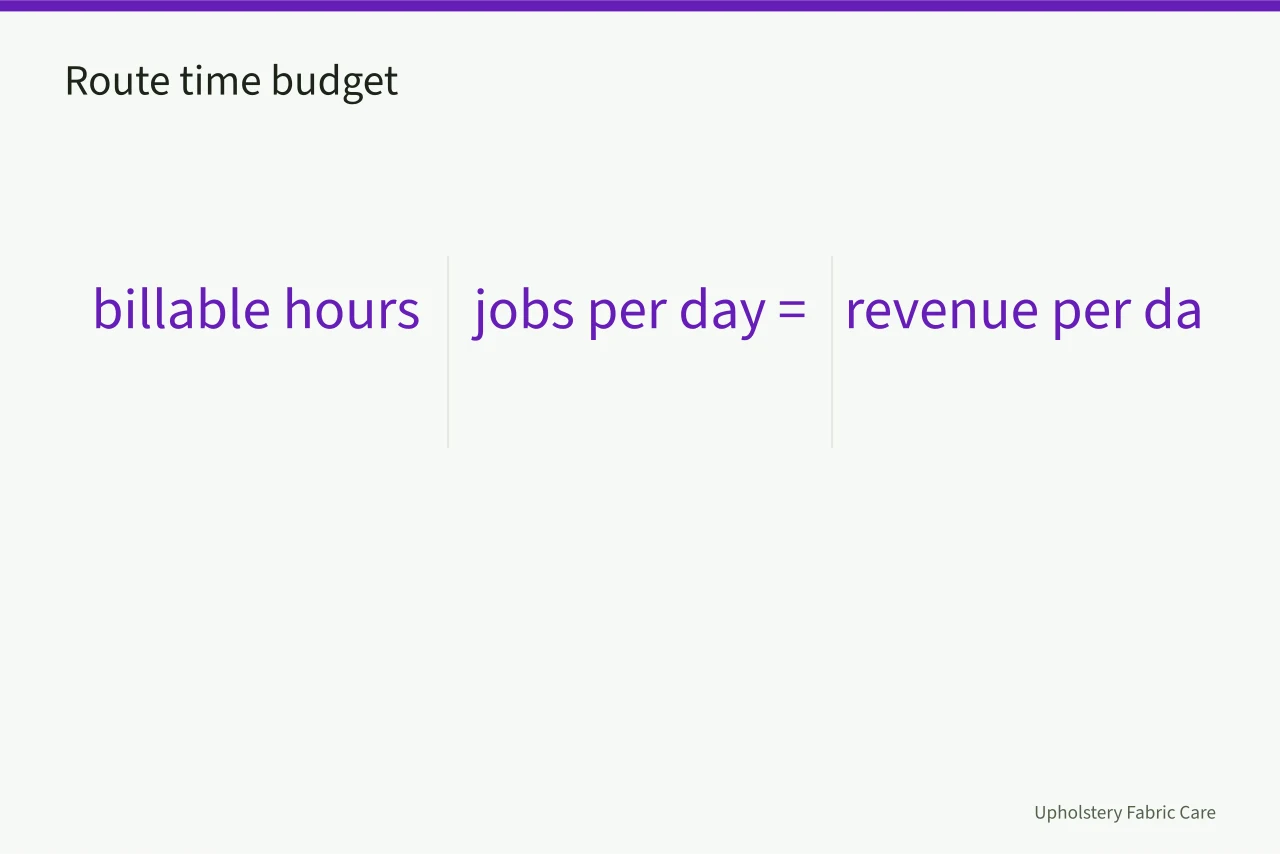
That arithmetic needs no benchmark, only your own drive times, measured on real roads at real hours, and your own job durations.
Density beats size. Three jobs within ten minutes of each other beat three jobs forty minutes apart at the same price, because the tight route sells more hours.
Residential and commercial are two businesses
Residential work is decided by the person who lives there, in daylight, with furniture to move and pets to consider, and it is paid at completion. The conversation is about appearance and how long the carpet stays damp.
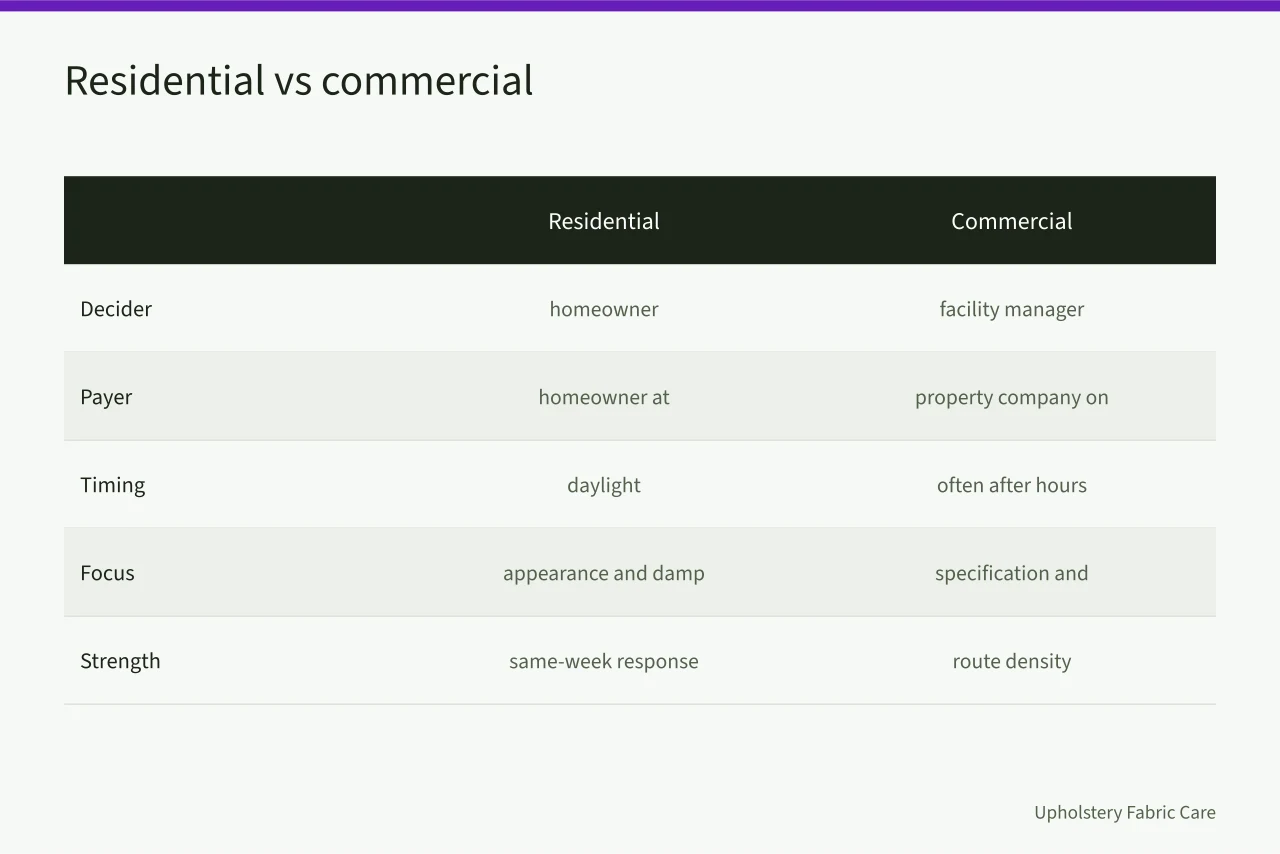
Commercial work is decided by a facility or property manager against a specification, often after hours, often with badge or escort requirements, and paid on terms. Insurance certificates and vendor onboarding paperwork arrive before any cleaning does.
A new business can serve both, but it should know which it is optimizing for. Route density and after-hours capacity are commercial strengths. Same-week response and furniture handling are residential ones.
What the first year should produce on paper
Treat the first year as data collection with revenue attached. Four documents come out of it.
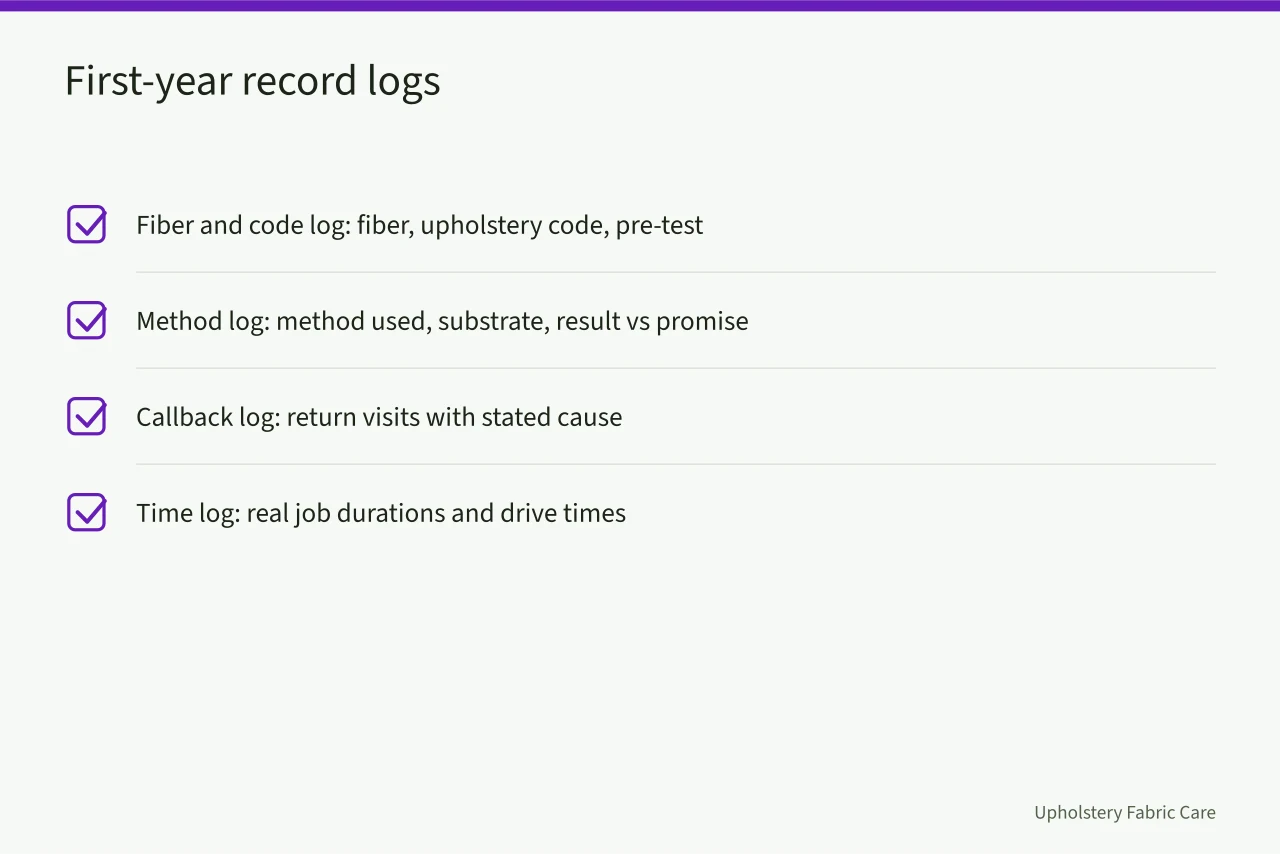
Federal guidance on the records a small business keeps is set out in the IRS small business recordkeeping guidance. Licensing, waste water disposal and local registration are decided by your state and your municipality. Confirm those with the offices that issue them before you open, and write down who you spoke to.
A first year that produces revenue and no records has to be repeated. A first year that produces both never has to be guessed at again.
Common questions
Should a new owner buy a truck-mount or start with a portable?
A job-selection question, not a budget question. A truck-mount serves detached homes and ground-floor commercial work efficiently, and makes long hose runs into high-rise units slow or impossible. A portable reaches condos and buildings with no vehicle access, at a lower production rate. Write down the twenty jobs you most want, then ask which machine reaches them.
How do I answer a customer who asks whether cleaning will help with allergies or air quality?
Describe what you can document and decline the rest. Soil removed, fiber condition before and after, method used, products used with their labels on file, drying conditions left behind. Health outcomes belong to a physician. Objective claims in advertising must be substantiated before they are made, which the FTC advertising guidance for small business explains.
What should I refuse in the first year?
Anything you cannot test, and anything you cannot recover from. Unidentified fiber with no tag and no test result. Antique or hand-knotted rugs, unless you have a plant to refer them to. Water damage response, a separate discipline with separate certification and equipment. Referring cleanly builds more reputation in a first year than accepting badly.
Is a franchise worth considering?
It changes the question rather than answering it. A franchise supplies a brand, a method and a set of obligations, and makes some of the decisions above for you. Read what it requires in territory, royalty and equipment terms, then price what those decisions would cost you alone. Have the agreement reviewed by an attorney in your state.