Guides
Which sequence gets a carpet cleaning operation open without stalling?
How to start a carpet cleaning business, in the order the work actually happens, with a way to check that each step finished before the next one begins.
What to take away
- Step order matters more than step content, because two steps here are expensive to redo once the one after them is finished.
- The step nobody sequences correctly is testing: fiber identification and a colorfastness check belong before the first wet job, not after the first complaint.
- Every step below has a finish condition. If you cannot say what would prove it finished, it has not.
- Registration, insurance and waste water questions are settled by your state and municipality, so the step is finding the office rather than reading a national answer.
Before the first dollar
You need a written scope: which fibers and fabrics you will accept, which you will refer, and which methods you own. Without it, every later decision is made under pressure at a customer's door.
You need somewhere to put water. Extraction produces waste water, and municipal sewer authorities set the discharge conditions. The federal permitting framework behind many of those local rules is described in the EPA discharge permit basics. Call your own utility, then write down the answer, the date and the name.
The sequence, in order
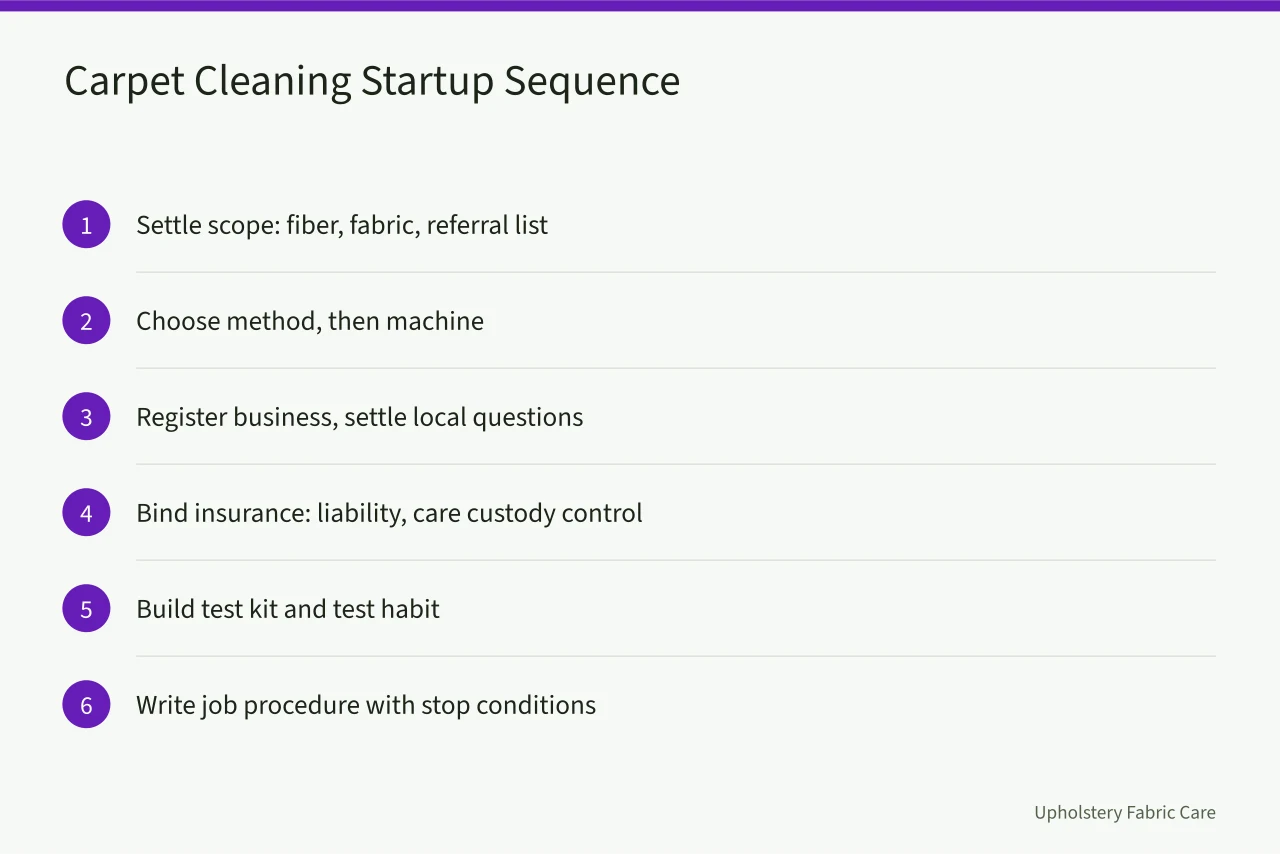
- Settle the scope. Write the fiber list, the fabric list and the referral list on one page. Finish condition: you can read it aloud to a customer without hedging.
- Choose the method, then the machine. The equipment and setup guide treats this as a job-selection decision rather than a purchase. Finish condition: you can name twenty jobs your machine can serve.
- Register the business and settle the local questions. Structure, tax registration, any occupational or contractor registration your state requires, and waste water. The licensing and compliance guide sets out which authority answers which question. Finish condition: a file with a document or a written note from each office.
- Bind insurance. General liability at minimum, and a conversation about care, custody and control, which is the coverage that responds when the damaged item is the thing you were working on. Finish condition: a certificate in hand, not a quote.
- Build the test kit and the test habit. Fiber identification materials, hidden-area colorfastness testing, a white cloth, and a form to record what you found. Finish condition: you have run the whole test procedure on your own furniture and it took you a known number of minutes.
- Write the job procedure. Pre-inspection, pre-vacuum, pre-spray with the label's stated dwell, agitation, extraction or encapsulation, grooming, drying setup, closeout. The operations and workflow guide covers the handoffs around it. Finish condition: a technician who has never met you could follow it.
- Price from your own arithmetic. Not from a competitor's website. Finish condition: you can explain any quote as labor, solution, vehicle and overhead.
- Do ten jobs at cost or below, on people who will tell you the truth. Finish condition: ten completed job records with photographs, method notes and a callback column.
- Open the phone and the listing. The marketing and growth guide covers what you may and may not promise. Finish condition: someone you do not know has booked a job.
- Hire only when the calendar is full and staying full. The hiring and training guide sets out the competence ladder. Finish condition: you have turned down work for two consecutive weeks.
Checks that a step actually finished
Two of the ten are worth checking twice.
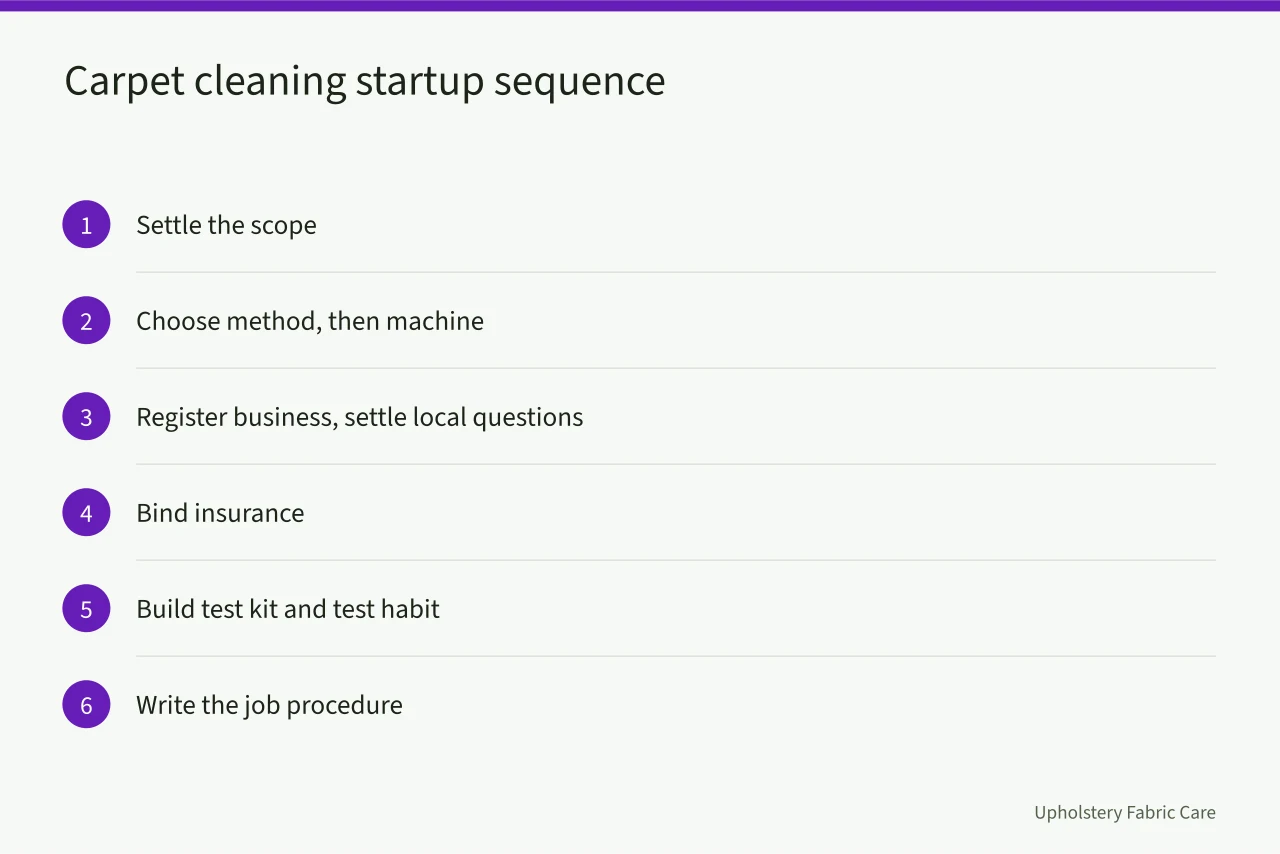
Step 5 finishes when the test procedure is a habit, not a card in a binder. On the next three jobs, does the paperwork carry a recorded test result before any wet method? A blank box means the step is not finished.
Step 6 finishes when the procedure names its own stop conditions. What does the technician do when the tag is missing, when the dye bleeds onto the test cloth, when the fiber cannot be identified? A procedure with no stop condition is a wish.
Where the sequence commonly stalls
The most common stall is between steps 2 and 3. An owner buys a machine, then discovers a local registration or disposal condition that changes what the machine can be used for. Doing 3 before 2 costs a few weeks and saves the purchase.
The second is at step 4. Insurance is treated as a formality until the first customer asks for a certificate naming them, or until the first damaged sofa. Bind it before the first paid job, and read what is excluded rather than what is included.
The third is at step 10. Hiring to create capacity, rather than to serve capacity you have, turns a profitable one-truck business into an unprofitable two-truck one within a season. Federal employer obligations are summarized in the EEOC small business guidance, which is worth reading before you write a job advertisement.
If a step has no finish condition, it is not a step. It is an intention, and intentions do not block the step after them.
Common questions
How long should the sequence take?
It depends on how fast your state and municipality answer, the one variable you do not control. Steps 1, 2 and 5 are yours and move quickly. Step 3 waits on offices. Start the waiting steps first and let the fast ones fill the wait.
Can I skip the ten practice jobs?
You can, and the cost appears later as callbacks. Browning, wicking and over-wetting are learned on somebody's carpet either way. The choice is whether it is a carpet where the outcome was agreed in advance to be a trial.
What is the smallest honest version of this business?
One person, one method, one vehicle, a tight territory, and a written scope narrow enough that nothing arrives you cannot handle. It stops being profitable the moment the scope widens faster than the capability behind it.