Guides
A carpet cleaning business plan lenders take seriously, explained
A carpet cleaning business plan has to prove capability before it forecasts revenue. Here is each section, and the evidence that makes it worth reading.
What to take away
- A plan for this trade is judged on whether it proves capability, not on whether its revenue line slopes upward.
- Each section owes a specific piece of evidence. A section with no evidence behind it is a paragraph, not a plan.
- The section owners skip is capacity: how many jobs a day the chosen method and territory physically allow.
- Assumptions belong in their own list, written as assumptions, so that the plan can be corrected rather than defended.
What a plan for this trade has to answer
A lender, a partner or your own future self asks four questions. What work will you accept? What can you physically deliver in a day? What does a day cost to run? What happens when a job goes wrong?
The startup and market guide works through the decisions behind them; this article is about writing them down in a form somebody else can check.
Section by section, and the evidence each one needs
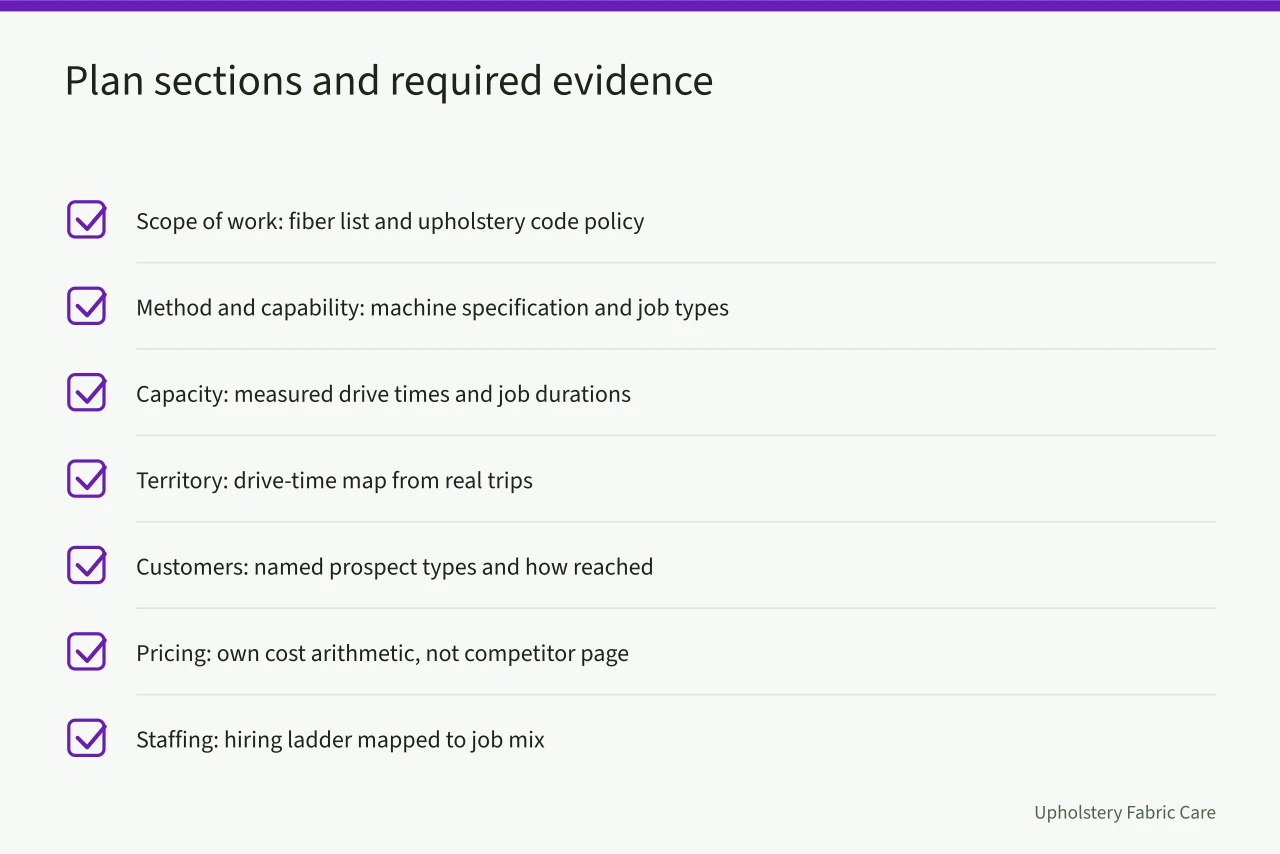
| Section | What it must state | Evidence that supports it |
|---|---|---|
| Scope of work | Fibers and fabrics accepted, referred and refused | Your written fiber list and upholstery code policy |
| Method and capability | Which cleaning methods you own and what each allows | Machine specification and the job types it can reach |
| Capacity | Jobs per day at your territory and job mix | Measured drive times and measured job durations |
| Territory | The service area expressed in minutes | A drive-time map built from real trips, not radius circles |
| Customers | Residential, commercial or both, and who signs | Named prospect types and how each is reached |
| Pricing | The unit you price in and the floor beneath it | Your own cost arithmetic, not a competitor's page |
| Staffing | What one person can do and when a second is needed | The hiring and training guide ladder, mapped to your job mix |
| Risk and recovery | What you do when a fabric bleeds or a carpet browns | A written stop condition and a recovery procedure |
| Compliance | Registration, insurance, waste water, chemical information | A file with the office, the date and the answer |
| Money | Startup outlay, running cost, and the break-even expression | Line items you can name, with sources |
The plan is finished when every right-hand cell points at something that exists.
The capacity section people skip
Capacity governs the revenue line, and it is the section that is usually thinnest.
Write it as an expression rather than a claim:
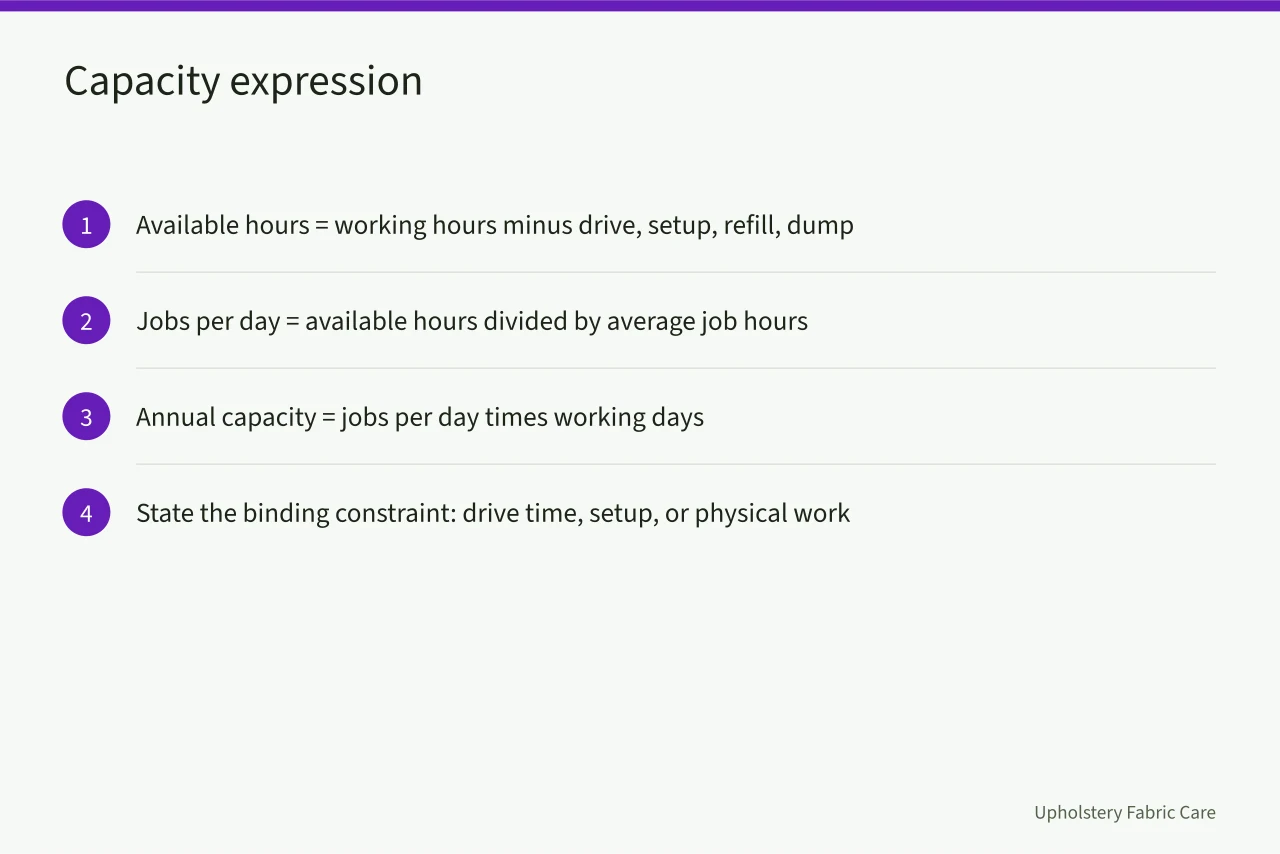
Then state the constraint that binds first. Drive time, for a truck-mount operator in a spread-out territory. Setup and hose runs, for a portable operator working upper floors. The physical work, for a one-person crew moving heavy furniture.
The equipment side of this belongs with the carpet cleaning equipment and setup decisions, because a machine choice sets the ceiling that this section is calculating against.
Assumptions to write down as assumptions
Listing what is not yet known turns the plan into something correctable.
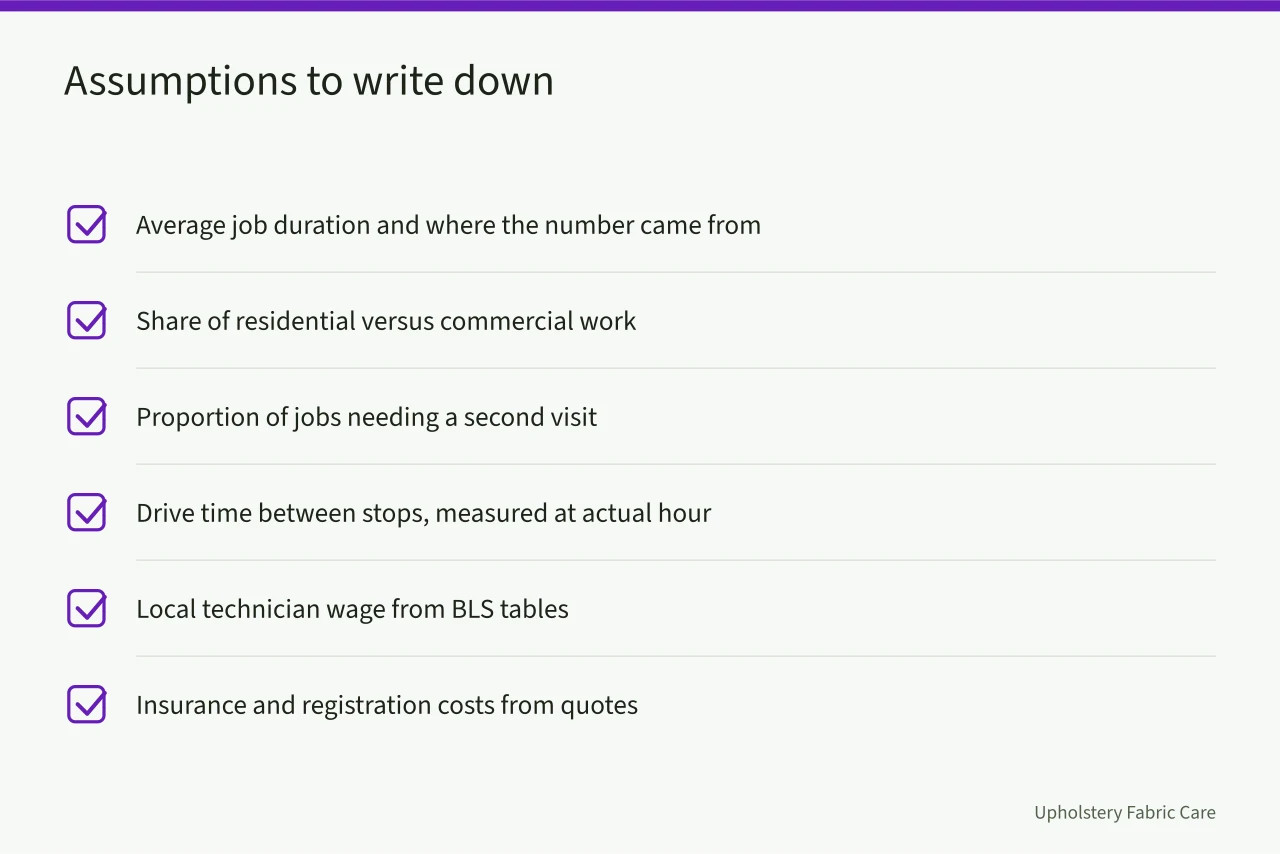
Date the list. Review it after the first fifty jobs. The gap between what you assumed and what happened is the most valuable page in the document.
How to test the plan against a real week
Take one ordinary week and run it on paper.
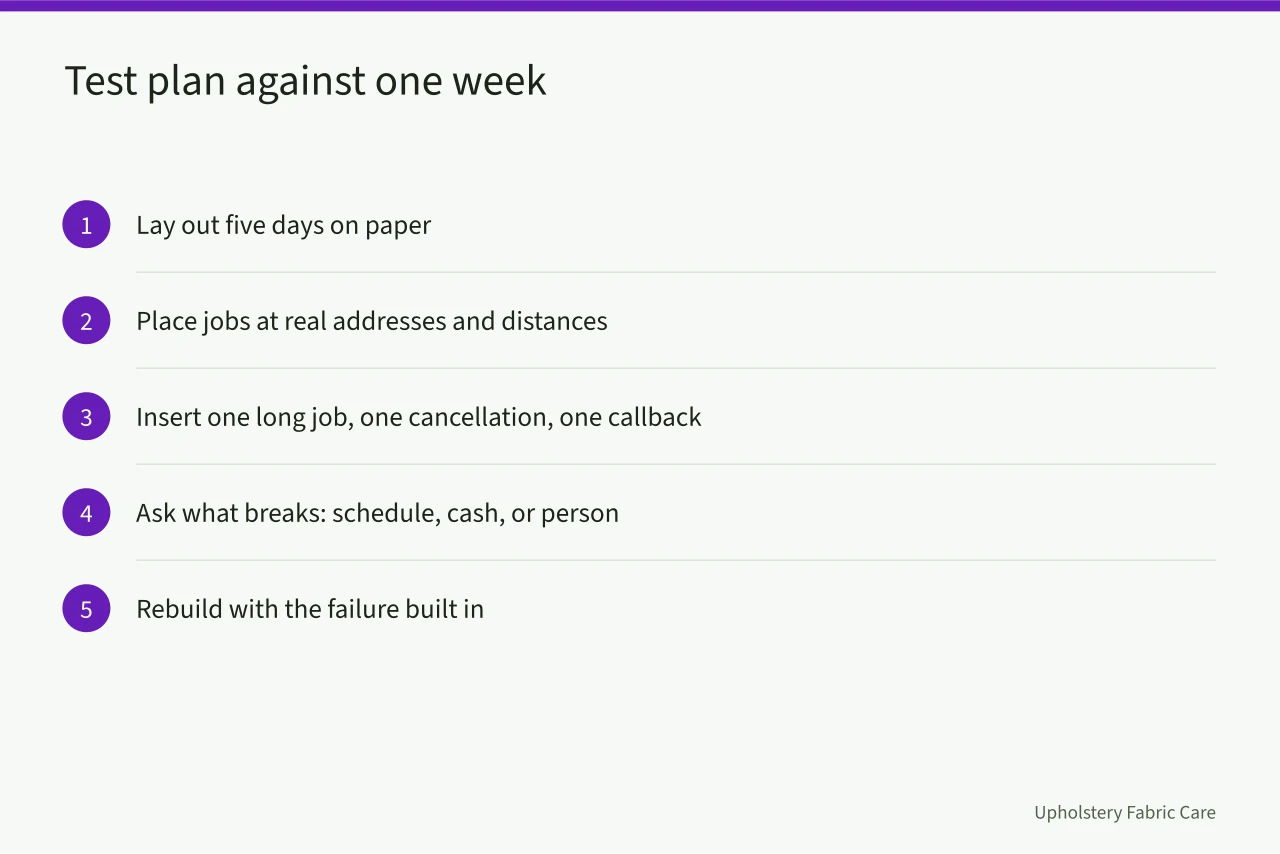
Lay out five days. Place the jobs your capacity expression says fit, at real addresses and real distances. Insert one job that runs long, one cancellation and one callback. Then ask what breaks: the schedule, the cash, or the person doing the work.
If the week only works when nothing goes wrong, the plan is describing a best case. Rebuild it with the failure built in. Growth planning belongs later, in the expansion and market guide, and it is much easier once one week is honest.
Common questions
Does a plan need a five year forecast?
Only if somebody is lending against one. For an owner the useful horizon is the first fifty jobs, because that is when the assumptions list gets corrected. A line drawn before them is arithmetic performed on guesses.
What do lenders actually read?
Ask them. Requirements differ by lender and by program, and general guidance on preparing to approach one is in the SBA business guide. Confirm the specifics with the institution.
Can the plan be one page?
It can, if the evidence behind it exists somewhere else. The point of the how to start a carpet cleaning business sequence is that each step leaves a document behind. A one-page plan that points at ten real documents is stronger than a thirty-page plan that points at none.