Guides
3 parts of carpet cleaning expansion, explained
Expansion in carpet cleaning turns on three things: what the fiber and cleaning code allow, what the truck and route can reach, and what the cash supports.
What to take away
- Expansion is a service decision before it is a business decision. What you can clean decides where you can grow.
- Viscose, wool, and other natural fibers set your method, your dry time, and your callback rate. A second truck that cannot run those jobs is not a second truck.
- A cleaning code of S or X changes the job on the ticket. Train the code system before you train a new market.
- Route density pays for the second van. Drive time between jobs decides whether a small job is worth taking.
- Model the added cash in named variables you fill with your own figures. No published benchmark covers your market.
The three parts
Expansion in this trade runs on three questions, and they are not the ones a general business guide asks.
What can you clean? Fiber and cleaning code decide the method, and the method decides which jobs you can sell.
What can you reach? A truck mount, a portable, and a route decide which addresses are worth the drive.
What can you afford? New capacity costs cash before it earns any, and the first months are the expensive ones.
Get the order wrong and you buy a van for work your technicians cannot safely take.
Part one: what the fiber lets you do
Fiber identification is the first step on every job, and it is the first constraint on growth.
Wool takes water carefully. It can brown, it can shrink, and it wants a technician who knows both. Nylon and polyester are the workhorses of residential carpet and tolerate hot water extraction well. Olefin is common in berber and in commercial loop, and it can wick. Cotton and viscose are the ones that change the plan.
Viscose decides whether you expand at all. It is rayon, common in area rugs and upholstery, and it loses strength when wet.
Cleaned with the same wand and water as a nylon carpet, a viscose rug can come back distorted. Many viscose pieces are dry-clean only, and the label is the authority.
That means a market of viscose rugs is a market of low-moisture work: encapsulation, dry compound, or dry cleaning. If your growth plan assumes two truck mounts running hot water extraction all day, viscose tells you which jobs you will turn down.
Part two: the cleaning code on the tag
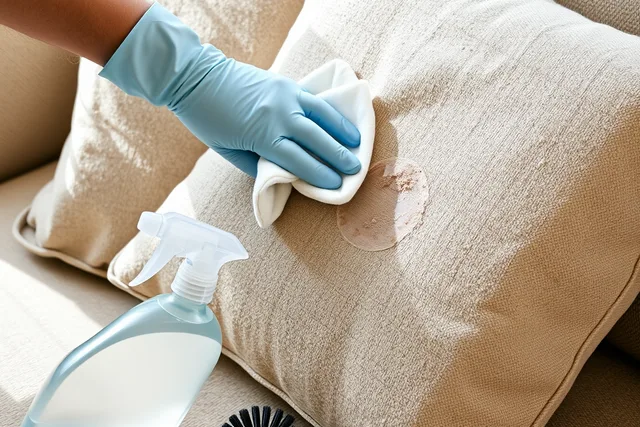
Every piece of upholstery carries a cleaning code, usually on a tag under the cushion or on the deck. The code is the manufacturer's instruction, and it outranks your method preference.
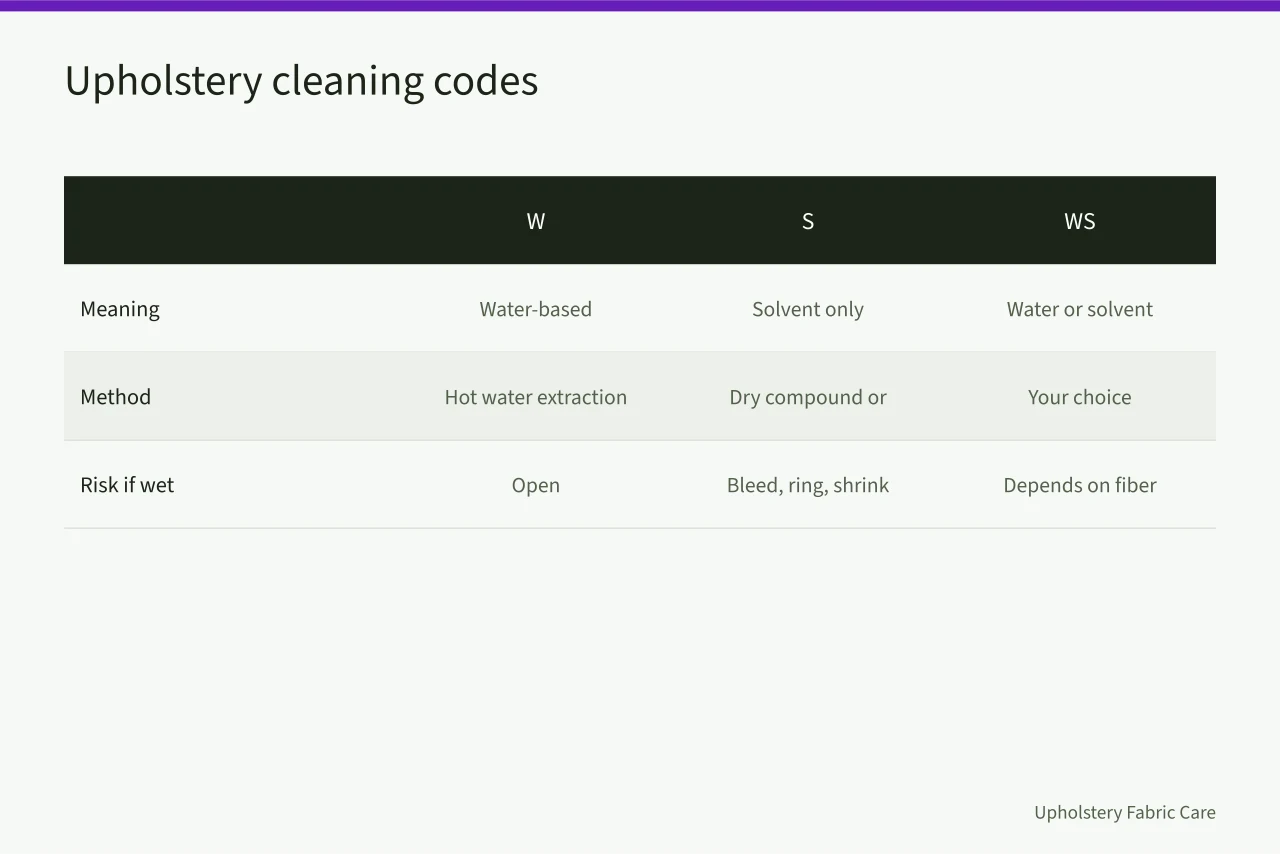
| Code | Meaning | What it decides |
|---|---|---|
| W | Water-based cleaners | Hot water extraction and most pre-sprays are open |
| S | Solvent-based cleaners only | Water is off the table. Dry compound or solvent |
| WS | Water or solvent | Your choice, based on soil and fiber |
| X | Vacuum only | No liquid cleaner. Professional dry method or decline |
The code is not a suggestion. A sofa marked S that gets a wet pass can bleed, ring, or shrink, and the customer will call back.
Colorfastness testing comes before any wet method, on every job, including the ones you have cleaned a hundred times. Test an inconspicuous spot, let it dry, and check for bleed and for fiber change. Record the result on the work order.
This is the part of expansion that gets skipped. A new technician in a new market will clean what the customer describes, not what the tag says, unless the code is a required field on the ticket.
Part three: the truck, the route, and the small job
A truck mount gives you heat, pressure, and recovery, and it decides your job selection. It needs the van close to the door, it needs a water source or a tank, and it needs the drive to be worth it.
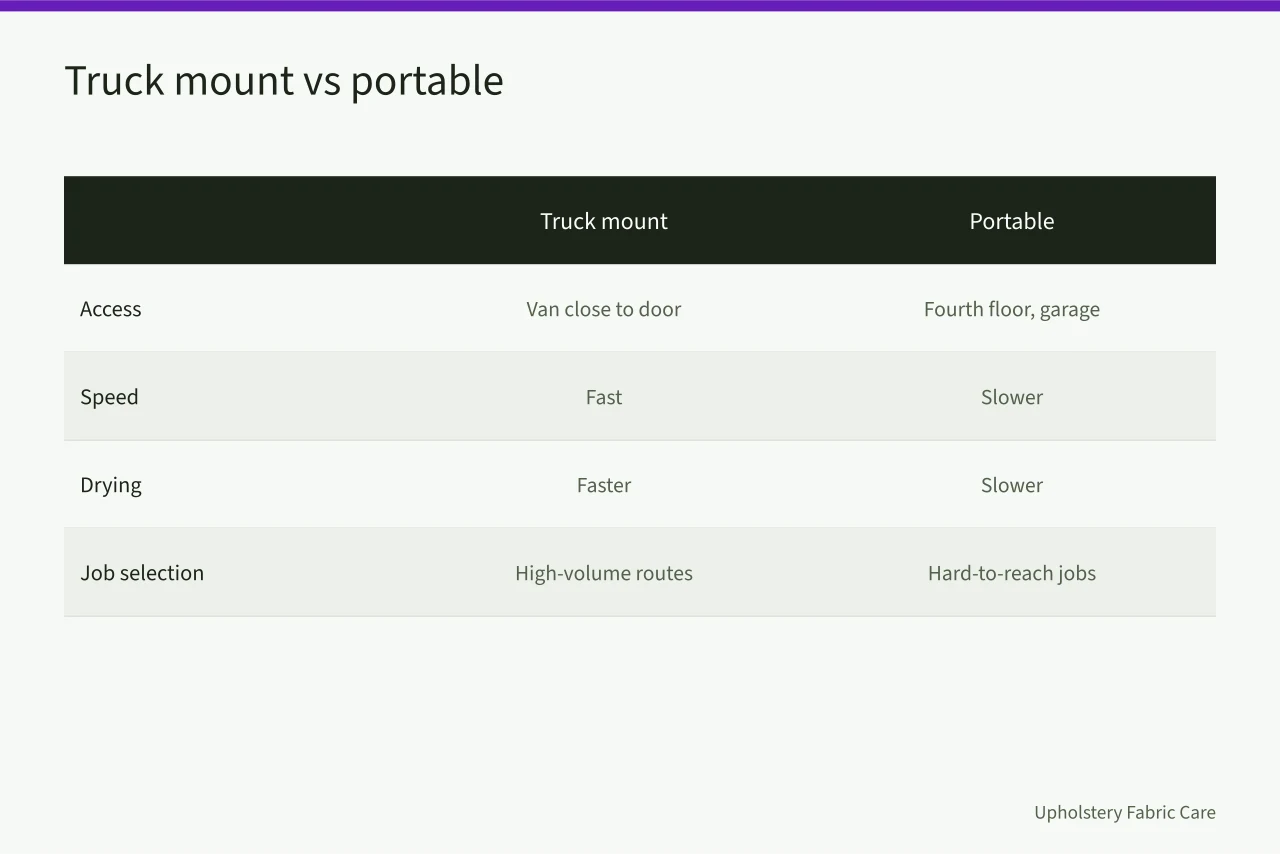
A portable reaches the fourth floor and the parking garage, and it runs slower and dries slower. Many businesses need both, and the decision is which jobs each one is allowed to take.
Route density is the number that pays for the second van. Two jobs twenty minutes apart cost less than two jobs an hour apart, and the second pair may not cover its own fuel.
That is why a minimum charge exists. Set your own variables: minimum charge M, average drive time D, and jobs per day J. If M does not cover the labor and fuel that D implies, the schedule is the problem, not the price.
Small jobs are not the enemy. Small jobs far apart are.
Where callbacks come from
Callbacks are the cost that eats expansion margin, and most of them have four causes.
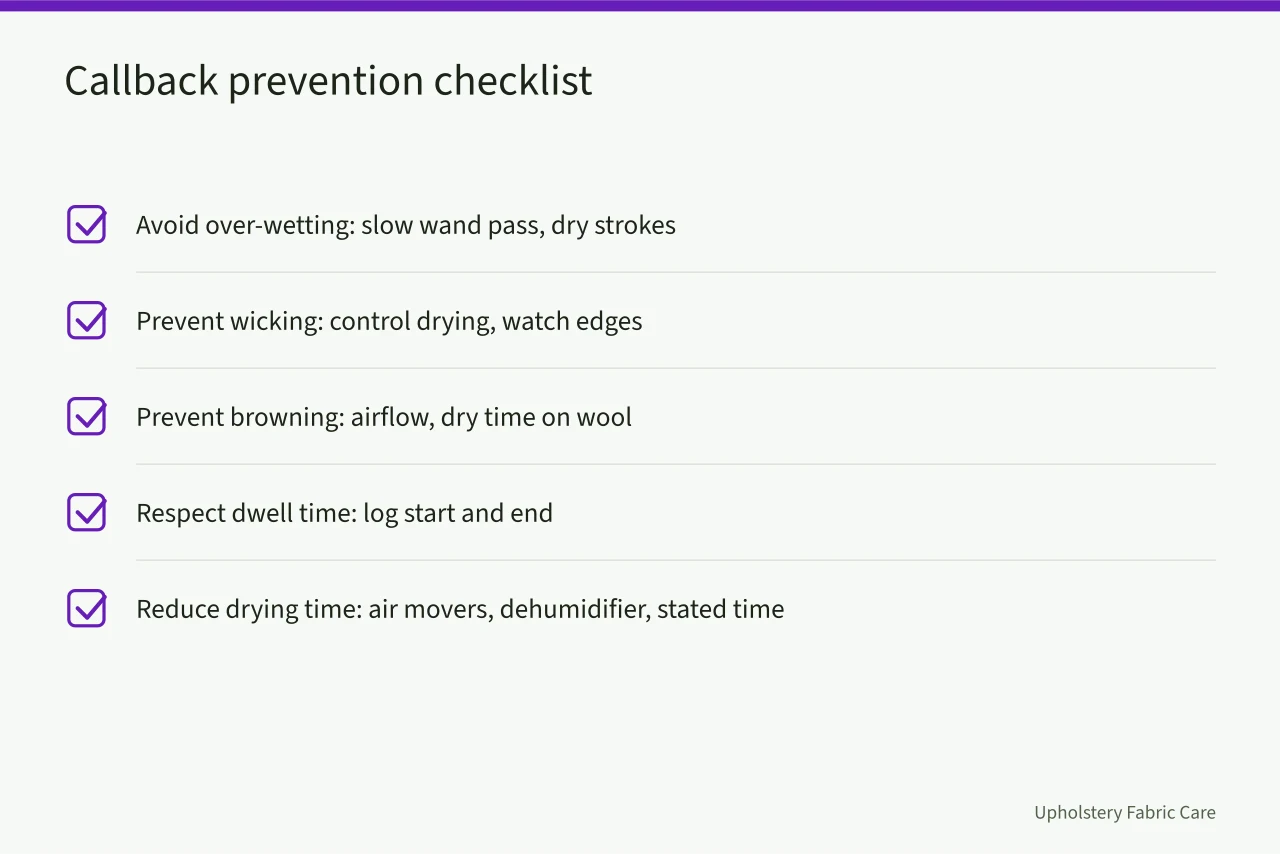
Over-wetting is the first. Too much water, too slow a wand pass, or too few dry strokes leaves the backing wet, and the customer finds it the next morning.
Wicking is the second. Soil travels to the surface as the carpet dries and leaves a brown line at the edge of the clean area. It is a drying problem, not a cleaning problem.
Browning is the third. It shows up on wool and on jute backing when the fiber stays wet too long. Airflow and dry time prevent it.
Dwell time is the fourth. Pre-spray needs time to work, and the label states how long. Log the start and end time on the ticket. A technician who sprays and immediately wands is leaving soil behind and adding a return trip.
Drying time is the number the customer remembers. Air movers, a dehumidifier in humid weather, and a stated dry time on the invoice all reduce the callback.
Protector, records, and the back office
Protector reapplication is a line item, not an upsell. It goes on after the carpet is dry, and the product label sets the coverage and the cure time. Record what you applied and when.
Wastewater disposal varies by state and municipality. Confirm with your local authority before you add a second truck and a second drain.
Licensing and safety requirements also vary. OSHA's cleaning industry page lists the hazards in this work: chemical exposure, slips, ergonomic strain, and equipment. A second crew doubles your exposure to each one.
For the business side, the SBA business guide covers planning, finance, hiring, and expansion in plain order. For local wage data when you price a second technician, the BLS occupational employment tables publish estimates by state and metro area.
A worked example
A one-van operation wants a second truck. Run the numbers in your own figures.
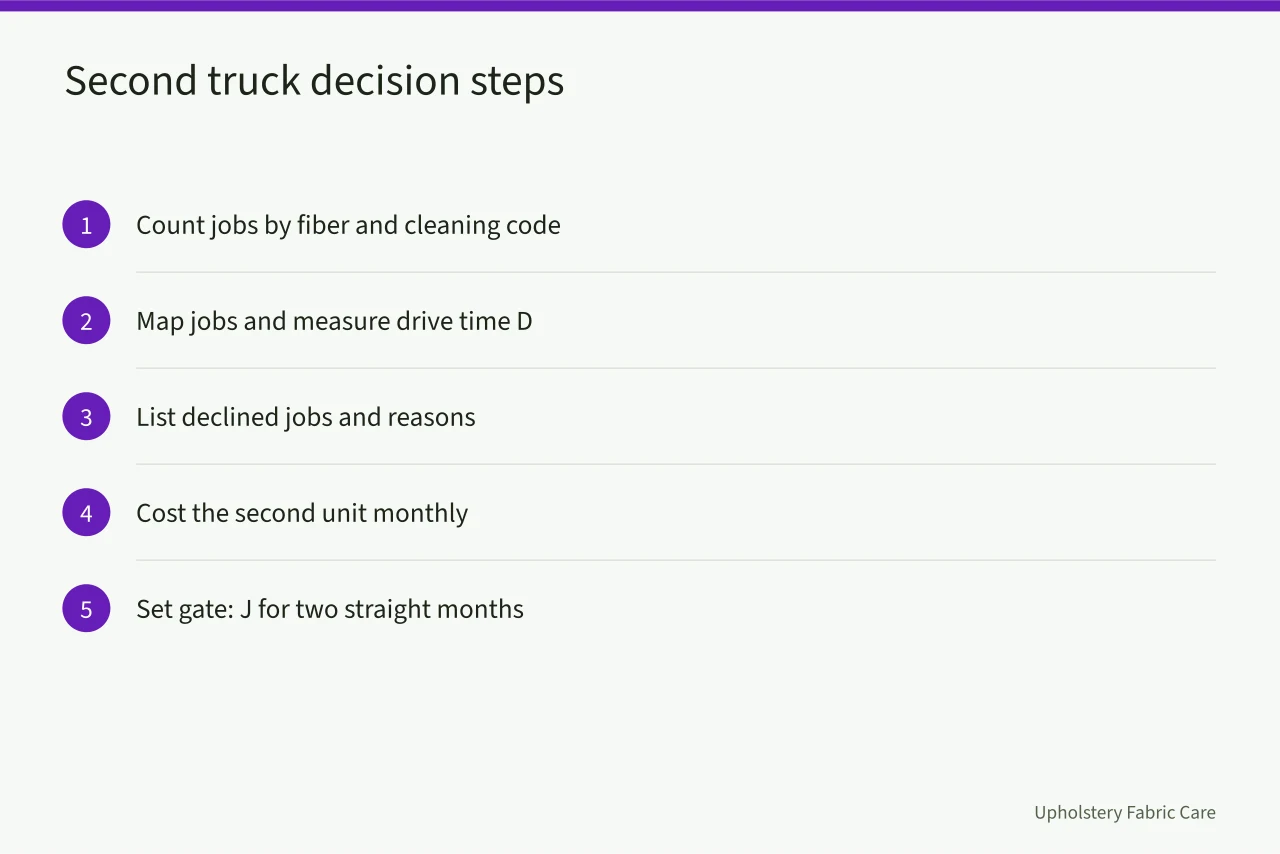
- Count last month's jobs and mark each one by fiber and cleaning code. If a third are S or X, your second truck needs low-moisture capability, not just a bigger machine.
- Map the jobs and measure drive time between consecutive stops. If average
Dis over thirty minutes, density is your bottleneck, not capacity. - List the jobs you declined last month and why. Fiber, code, distance, or schedule. The reason tells you which expansion solves a real problem.
- Cost the second unit: vehicle, machine, hoses, chemicals, insurance, and one technician's wage. That total is your added monthly cash need before any new revenue.
- Set the gate. If booked jobs per week do not reach your target
Jfor two straight months, the second truck waits.
The example is arithmetic, not a forecast. Substitute your own numbers and the answer changes.
Common questions
Does a second truck mean I can take more fiber types?
No. Capability comes from training and equipment, not from the count of vehicles. A crew that has not been trained on viscose and wool will still turn those jobs down, or worse, take them.
How do I know if my market wants low-moisture cleaning?
Count the S-coded furniture and the viscose rugs in the jobs you already run. If that share is growing, the demand is already in your book. Do not buy the capability for a market you have not measured.
What is the first thing to standardize before expanding?
The work order. Fiber belongs on every ticket. Cleaning code belongs on every ticket. Test result belongs on every ticket. Dwell time belongs on every ticket. Method belongs on every ticket. Dry time belongs on every ticket. A second crew working without those fields will produce callbacks you cannot trace.
When should the second location wait?
When route density is the constraint. A second location doubles your fixed cost and splits a thin schedule. Fix drive time in the first market before you open a second one.