Guides
Top carpet cleaning companies options compared and reviewed
Compare named carpet cleaning companies by the methods they run, the industry codes they read and the customer proof they leave behind in reviews.
What to take away
- Five named companies to compare: Chem-Dry, Stanley Steemer, Zerorez, Oxi Fresh, COIT.
- Ask which rig arrives. A truck-mount, a portable and a low-moisture rig do not clean the same fibers the same way.
- Ask who reads the cleaning code, and what the technician records before the wand moves.
- Ask what a wicking or browning callback costs, and who pays for the return trip.
- Ask the minimum charge and the drive-time radius. Both say more about the work than the advertising does.
The five companies, compared by method, code and reviews
Chem-Dry is a franchise network built on carbonated hot water extraction. Franchisees run their own trucks, so quality tracks the owner. Good fit where you want a national brand with local accountability. Pricing is set per franchise, typically $35 to $75 per room in most markets as of 2026. Check the local franchise's Better Business Bureau profile and Google reviews, since ratings vary by owner.
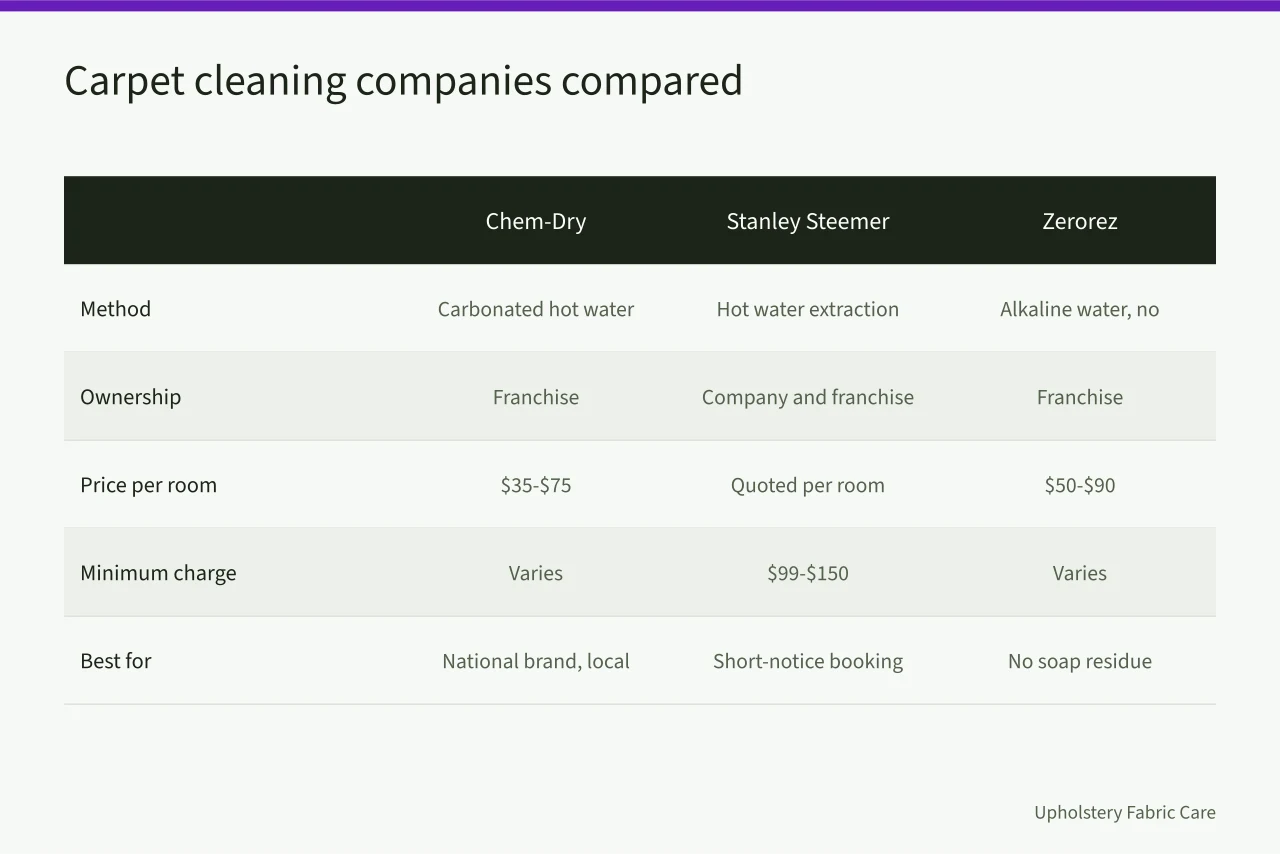
Stanley Steemer runs company-owned and franchise trucks across most US metros. It is the largest name in residential carpet cleaning and the easiest to book on short notice. Pricing is quoted per room, with add-ons for protector and stairs. Minimum charges often fall between $99 and $150. Stanley Steemer holds an A+ rating from the Better Business Bureau and carries thousands of Google reviews across locations.
Zerorez franchises clean with alkaline water and no detergents, then extract. The pitch suits households avoiding soap residue. Pricing runs above the regional average and is quoted by area, often $50 to $90 per room. Locations maintain BBB profiles and reviews that mention no sticky residue.
Oxi Fresh uses a low-moisture oxygen system, so carpet is walkable quickly. It suits offices, rentals and anyone who cannot wait a day for drying. Pricing is per room and published on its site, often starting around $49 per room with conditions. Google reviews per location note fast dry times.
COIT cleans carpet, upholstery, tile, stone and air ducts, and has done so since 1950. That range suits a whole-house job booked once. Pricing is quoted after an on-site or phone assessment, with minimums typically $150 or more. COIT holds an A+ BBB rating and long-running customer reviews.
What decides the quote
Hot water extraction flushes soil out with heated solution and immediate vacuum recovery. Low-moisture encapsulation lifts soil into a crystallizing polymer that vacuums away later. Dry compound spreads a moistened absorbent across the pile, is agitated in, then vacuumed out.
A truck-mount carries its own water, heat and vacuum, so it handles large areas and heavy soil. A portable reaches upper floors and buildings without hose access but recovers less water, and over-wetting is the risk. Which rig decides which jobs a company can accept is covered in the market and expansion guide.
Read the code on the fiber, not the room
| Code | What it means | Where you find it |
|---|---|---|
| W | Wet cleaning methods only | Often on nylon and polyester carpet |
| S | Solvent or dry methods only | Common on viscose and some wool upholstery |
| WS | Either wet or dry | Most residential upholstery |
| X | Vacuum only, no liquid | Some delicate and bonded fabrics |
Viscose, also sold as rayon, loses strength when wet and can brown permanently. A company that quotes over the phone without asking the fiber has not read the code. The code sits on a tag under the cushion or on the manufacturer's care label, and the manufacturer is the authority on what the fiber tolerates.
What a technician records before the wand moves
- Fiber and cleaning code, written on the work order.
- A colorfastness test on a hidden area, with the result noted.
- Pre-spray left to dwell for the time the product label states.
- Wand passes counted so the pile is not over-wet.
- Drying set up, with an expected dry time told to the customer.
Wicking pulls soil up the fiber as it dries. Browning is residue left by overwetting or slow drying. Both are prevented at the pre-spray and drying stages, not by a second visit. Protector reapplication belongs on the work order, because it changes how the carpet soils next time.
Questions that sort the quotes
Ask what training the technicians hold and who supervises them. Ask how wastewater is captured and disposed of, since the local sewer authority decides that. Ask whether the company carries care, custody and control coverage for damage to the customer's property.
The SBA business guide sets out how a legitimate operator is structured and registered. Wage data for the trade sits in the BLS occupational tables. Chemical handling and equipment hazards are described in the OSHA cleaning industry guidance.
Common questions
Does the cheapest quote cost less?
Rarely. A low price often means a portable, a short dwell time, or no protector, and a callback costs the customer a day. Compare the method, the drying time and the recorded test result, not the headline number. Named examples: Oxi Fresh publishes per-room rates, Stanley Steemer adds protector and stair fees, and Zerorez prices above the regional average.
Why does one room take longer than another?
Fiber, soil load and drying all vary. Wool holds water longer than olefin, and viscose may rule out wet cleaning entirely. The technician should name the constraint before starting. Companies that read the code, such as those above, will ask about the fiber before quoting.
What if the carpet browns after cleaning?
That points to overwetting or slow drying, and it is the company's callback to fix. Ask what their drying setup is before you book, and get the expected dry time in writing. COIT and Stanley Steemer both offer callback policies; confirm the terms for your location.
Should I expect a fixed price?
Ask for the minimum charge, the drive-time radius and what a callback visit costs, then compare those three across quotes. Chem-Dry and Zerorez quote by room or area, Oxi Fresh publishes per-room prices, and COIT assesses first. Typical minimums run $99 to $150, but no price is universal.