Guides
How to keep carpet cleaning jobs on time without the jargon
Carpet cleaning jobs stay on time when the minimum charge covers drive time, setup and product, so run the arithmetic before the schedule fills up.
What to take away
- The minimum charge is a decision about drive time, not about square footage. Run it against your own loaded hourly cost.
- A job that loses money at the far edge of the territory is telling you the territory is wrong, not the crew.
- Callbacks sort into three causes: browning, wicking, and a test you skipped. Each one points at a different fix.
- The Friday review changes one intake question or one schedule rule per week. Nothing else.
- Chemical labels, safety data sheets and training sit under the OSHA hazard communication standard, and wastewater disposal is set locally.
The small job that eats the day
A single-room job forty minutes away is not a small job. It is a small invoice attached to a large amount of driving, and the invoice is the only part the customer sees.
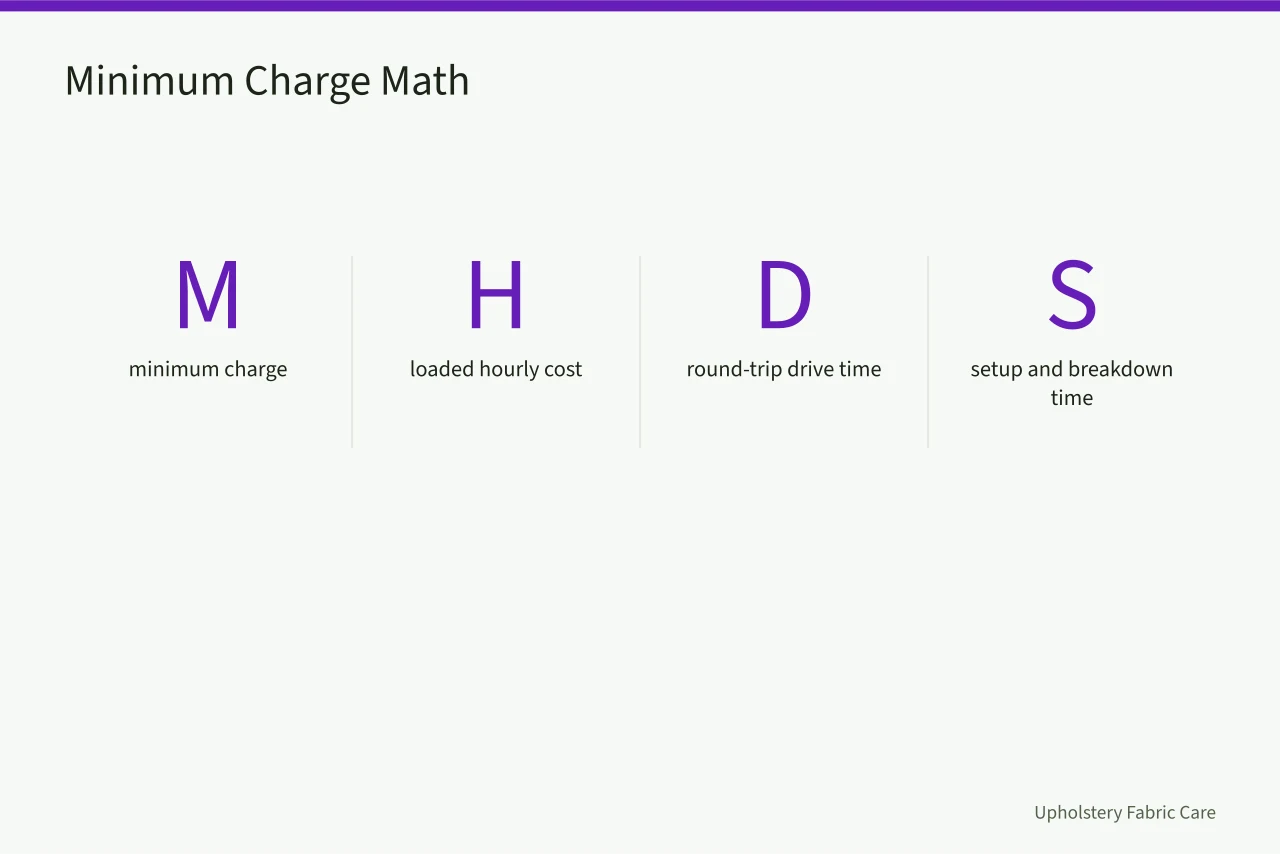
Work it in named variables. Let M be your minimum charge. Let H be your loaded hourly cost, meaning wages plus payroll burden plus the share of the van, the machine and insurance that the hour actually consumes.
Let D be round-trip drive time in hours. Let S be setup and breakdown time in hours.
Let P be product and consumables for the job.
The job is worth taking when M is greater than (D + S) times H, plus P.
Owners who have never run this usually find the same thing: the minimum charge covers the cleaning and the drive eats the rest. The fix is one of three. Raise the minimum. Charge a trip fee outside a radius you set. Or stop quoting that radius.
Where the hours actually go
Setup is the step owners underestimate. Hose run, machine placement, pre-spray, and the walkthrough at the end all sit outside the cleaning itself, and none of them shrink because the room is small.
Dwell time is the one part of the job you cannot compress. It comes off the product label, and the technician records when the pre-spray went down and when extraction started. A skipped dwell does not save the time. It moves the work to the wand, and the wand leaves water behind.
That water is the callback. Browning is dye wicking to the surface as the carpet dries. Wicking is soil traveling up the fiber with moisture. Both show up a day later, and both mean a second visit on an invoice you already spent.
The Friday review, four steps
Set aside an hour at the end of the week and work these in order.
- Pull the jobs that ran long. For each one, name the step that overran: intake, dwell, drying, or the drive. One step per job, not a list.
- Check quoted drying time against what the customer reported. A gap between the two is an airflow problem or an over-wetting problem, and the two have different fixes.
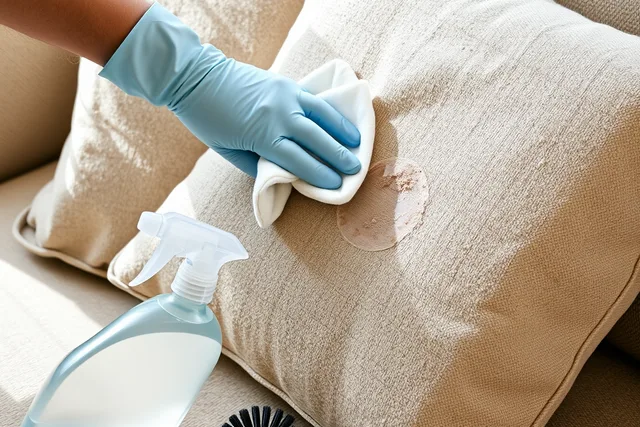
- Sort the callbacks. Browning, wicking, or a test you did not run. Colorfastness testing before a wet method is what prevents the third category, and a white towel on a hidden area is the whole test.
- Change one thing. One intake question, or one schedule rule. Do not hand the crew a speed instruction. Speed is what caused the callback.
The point of the review is not the report. It is that each week ends with exactly one change, small enough that the crew notices it and large enough to matter.
What the machine decides before the phone rings
A truck-mount runs on the vehicle, so the driveway has to be reachable and the hose run has to be workable. A portable goes up stairs and into buildings where the truck cannot park. Which machine you own decides which jobs you can quote, and that decision is made long before a customer calls.
Route density is the other half of the same decision. Three jobs on one street is a different day from three jobs across the county, even at the same price. Group work by area and let the schedule absorb the drive time instead of the technician.
Records that answer two questions at once
The IRS recordkeeping guidance sets out what supports income and expenses. The same file can hold the fiber, the cleaning code, the colorfastness test result and the dwell time for each job.
That matters because the cleaning code is the manufacturer's instruction, not yours. W means water-based products are acceptable, S means solvent only, WS means either, X means vacuum or light brush only. Where a piece has no code, or the code and the fiber disagree, the manufacturer is the authority.
Chemical handling falls under the OSHA hazard communication standard: labels, safety data sheets, and training for anyone using the products. The OSHA cleaning industry guidance covers the rest of the physical hazards on a route.
Wastewater disposal is a local question. Your sewer authority or state environmental office decides where extraction water goes, and the answer varies by municipality. Ask before you discharge, and keep the answer in the file.
Common questions
Does a minimum charge fix the small-job problem?
Only if it covers drive and setup at your own costs. Run M against (D + S) times H plus P with your numbers. If the far territory still loses money, the answer is the territory, not the minimum.
Why does the Friday review change only one thing?
Because a crew given five changes adopts none of them. One intake question or one schedule rule is small enough to stick and specific enough to check the following Friday.
What causes most callbacks?
Water left in the backing. Over-wetting shows up as browning or wicking a day later, and the return visit costs more than the extra dry passes would have.
How do I quote a job I have not seen?
Ask for the fiber, the cleaning code and a photo of the soil before you commit to a duration. If the customer cannot supply them, book a longer window and confirm on arrival.