Guides
How to build carpet cleaning packages that stay easy to sell
Packaging carpet cleaning services well means deciding what may sit in one package, what must stay separate, and what the wording has to exclude in writing.
What to take away
- A package sells certainty about scope and duration. If it does not reduce the customer's uncertainty, it is only a discount.
- Three package structures dominate this trade, and each hides a different thing from the customer.
- Two services may share a package only when they share a method, a fiber tolerance and a drying profile.
- The wording carries the risk. What a package excludes has to be legible before the technician arrives.
What a package is actually selling
Customers buy packages to stop making decisions they are not equipped to make. A homeowner cannot tell you whether their stairs need the same treatment as their hallway, and does not want to be asked at the door.
A good package answers three questions in advance: what will be cleaned, how long the space will be unusable, and what happens if something unexpected is found. One that only bundles a price is a discount with a name.
The service definitions underneath a package come from the services and packages guide, where a service is defined as fiber, soil, method and room rather than as a menu line.
Three structures and what each one hides
| Structure | How it is sold | What it hides from the customer | Where it works |
|---|---|---|---|
| Room count | A fixed number of rooms or areas | The size difference between rooms and what counts as a room | Standard residential layouts with similar room sizes |
| Whole property | The whole carpeted area of a home | Which areas are excluded and what happens with heavy soil | Repeat customers whose property you have already measured |
| Interval plan | Scheduled visits at a set frequency | What each visit includes and what carries over between visits | Commercial route work and high-traffic residential |
Room count packages fail on the definition of a room. Write it down: what is counted, what is treated as a separate area, and how stairs, landings, walk-in closets and open plan spaces are handled.
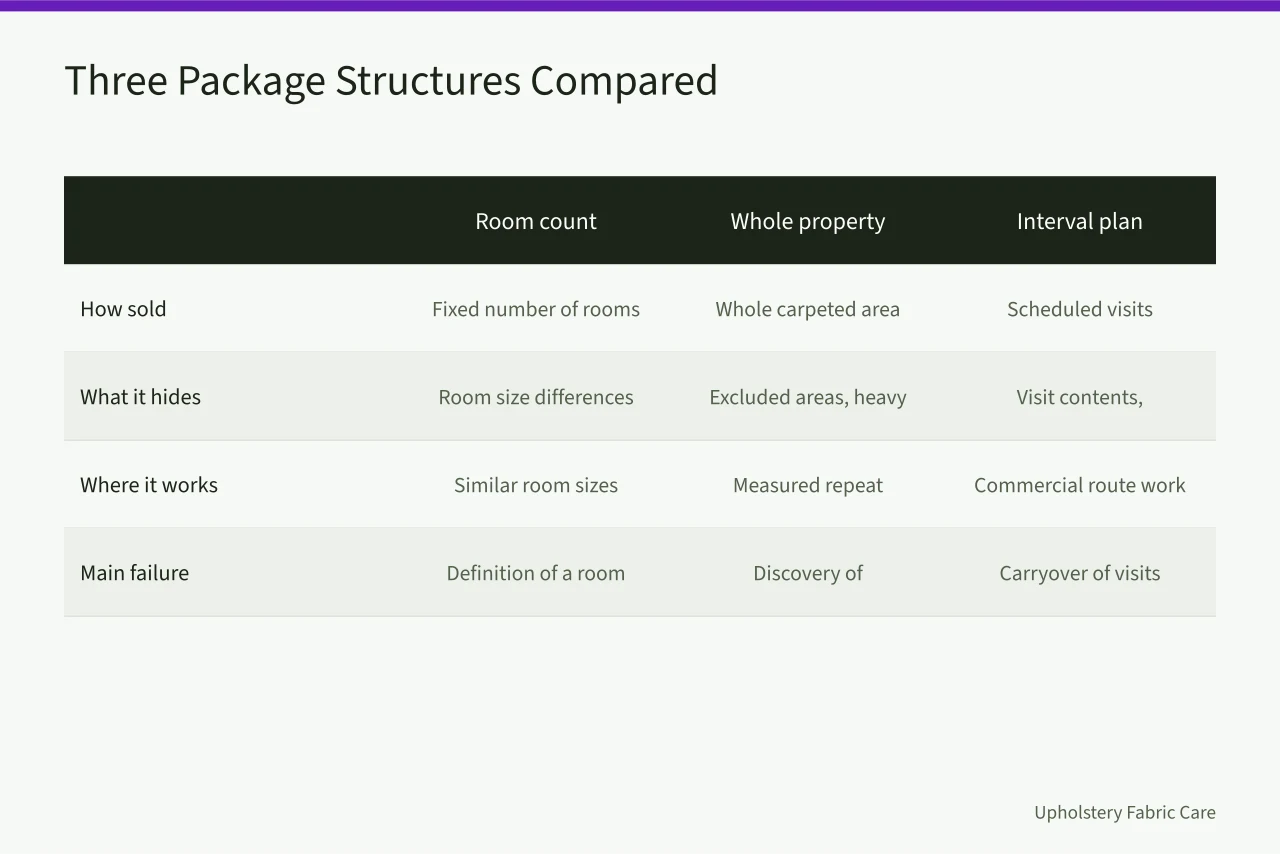
Whole property packages fail on discovery. State what happens when the technician finds a fiber that requires a different method, or soil that requires restorative work.
Interval plans fail on carryover. State whether an untaken visit rolls forward, and what happens if the customer cancels partway through.
Rules for what may sit in the same package
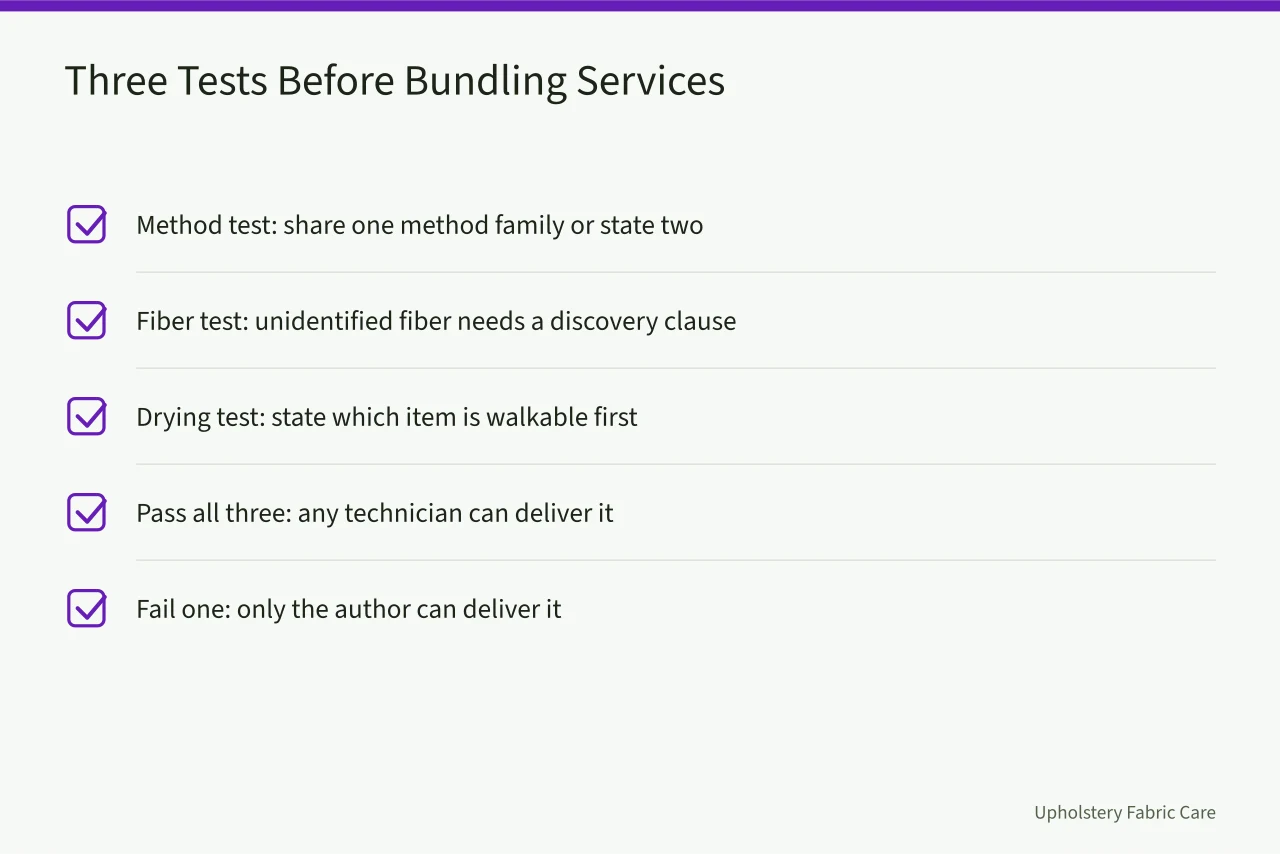
The method test: services in one package should share a method family, or state plainly it contains two. A room cleaned by hot water extraction and a sofa with an S code are two jobs with two product sets.
Bundling them silently guarantees a scheduling surprise. Two product sets on the vehicle carry employer duties in the OSHA hazard communication standard.
The fiber test. If the package covers an area whose fiber has not been identified, it has to carry a discovery clause. Viscose in particular changes the job entirely, and no package price should be quoted as final over an unidentified fiber.
The drying test. Services that leave a space usable at different times should not be sold as one duration. If the carpet is walkable before the upholstery is dry, say which is which.
A package that passes all three can be staffed by a technician who has never seen the property. One that fails a test can only be delivered by whoever wrote it, which the hiring and training guide treats as a capacity problem rather than a sales one.
Wording that keeps a package honest
Six lines belong in every package description, and they take one sentence each.
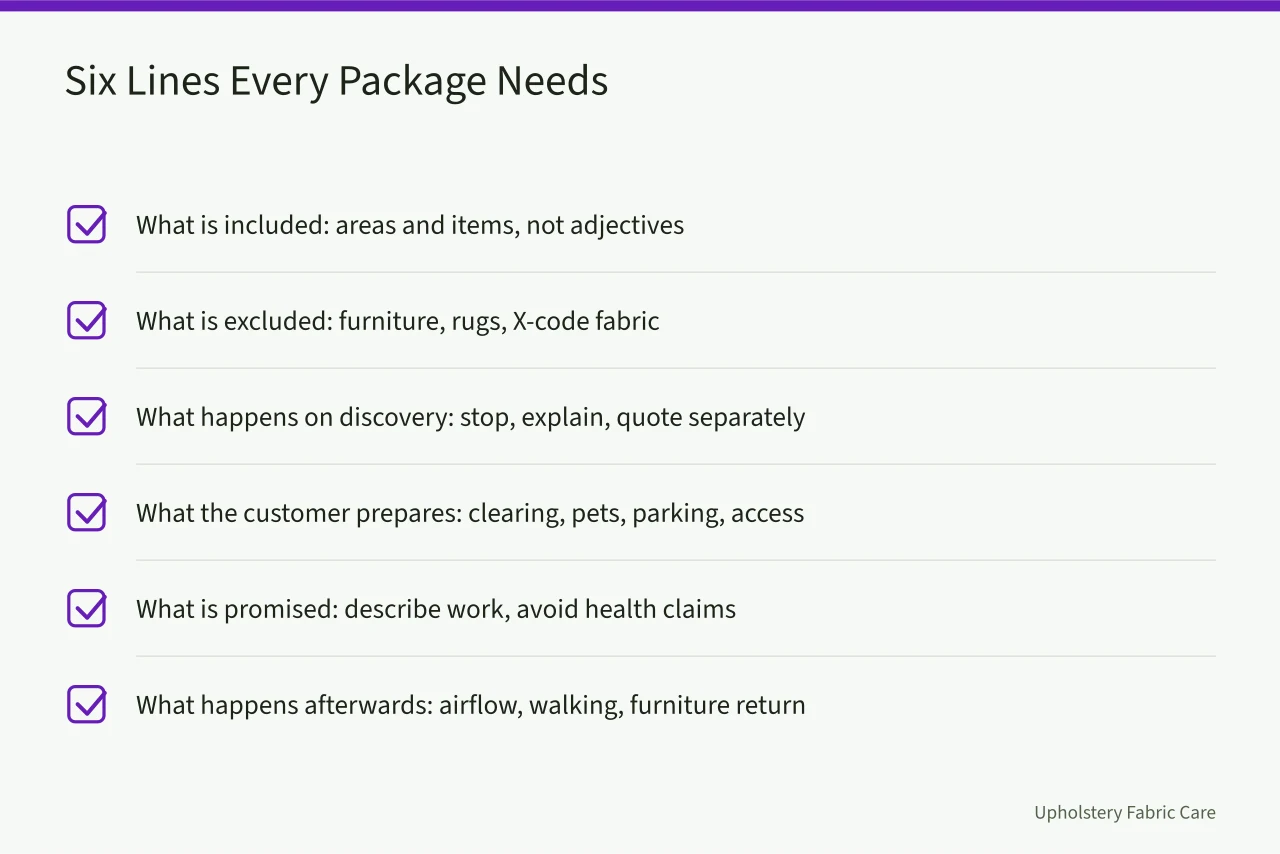
What is included, stated as areas and items rather than as adjectives.
What is excluded, named specifically. Furniture moving above a stated weight, area rugs, and any fabric carrying an X code are the usual three.
What happens on discovery. The technician stops, explains, and quotes the additional work separately. Nothing extra is performed on the assumption that the customer would have agreed.
What the customer prepares. Clearing small items, securing pets, and providing parking and access is a real part of the job duration.
What is promised. Describe the work performed. Avoid claims about health, air or the elimination of anything: those must be substantiated before they are made, as the FTC advertising guidance for small business explains.
What happens afterwards. Airflow, walking on damp carpet, and when furniture may be returned to its place.
A package that assumes fast drying assumes airflow capacity. The equipment and setup guide treats that as a purchase decision rather than an afterthought, and the cost of it belongs in the carpet cleaning business plan rather than in the package margin.
Which packages are worth building at all should be settled against your own contribution figures, using the audit in the most profitable carpet cleaning services piece.
Common questions
Should a package have a fixed price or a from price?
A fixed price is honest only when the scope is fixed, which usually means a property you have measured. For new customers, a from price plus a discovery clause produces fewer disputes at the door.
Can a package include an unlimited spot treatment?
Spot removal and stain removal are different outcomes, and unlimited language invites the second while pricing the first. State that spots are part of the clean and that permanent staining, dye damage and fiber damage are assessed separately.
Do interval plans need a contract?
Anything with recurring payment should be written, and the written terms should state cancellation, carryover and price review. Have the form reviewed by an attorney in your state before it is used.
How many packages should a small operation offer?
Few enough that a technician can explain any of them from memory at a doorstep. Three is usually plenty. Every additional package multiplies the chances of quoting the wrong one.