Guides
Should a carpet cleaning business buy new or used equipment for a small operation
New vs used carpet cleaning equipment, compared on the criteria that actually differ, with an inspection protocol and the questions to put to a seller.
What to take away
- A carpet cleaning business buying new or used equipment for a small operation faces one comparison: a known maintenance history at a higher price against an unknown one at a lower price.
- Six criteria separate the options. Purchase price is only one of them.
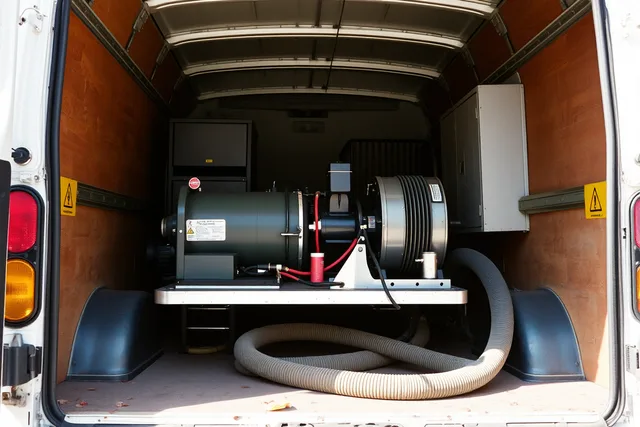
- Named machines show the spread. A new Prochem Peak truckmount typically lists from $20,000 to $28,000 installed. A used one often sells for $7,000 to $14,000.
- The lower-risk first purchase for a solo operator is a used machine with a documented service record and a portable backup.
- Parts availability outlives both machines. A cheap unit without parts support is a scheduled outage.
What the choice is really between
A new machine buys a warranty, a known starting condition, a dealer relationship and a service history you create. A used machine buys a lower entry figure and a history somebody else created, documented or not.
Reliability is a property of maintenance, not age. An eight-year-old Prochem Peak with a complete service record can beat a two-year-old HydraMaster Boxxer 318 that three operators ran hard and none serviced.
The prior question is which machine type you need. A solo operator with light residential work may start with a portable Mytee LTD12. A one-van operation chasing commercial jobs usually needs a truckmount such as a Sapphire Scientific 370SS. The equipment and setup guide treats that as a job-selection decision.
New vs used on six criteria
| Criterion | New | Used |
|---|---|---|
| Purchase outlay | Higher, quoted, predictable | Lower, negotiable, variable |
| Maintenance history | Begins with you | Somebody else's, documented or not |
| Warranty | Manufacturer terms apply | Usually none, sometimes a remainder |
| Downtime risk in year one | Lower, and covered where it occurs | Higher, and yours to absorb |
| Financing | Often available through the dealer | Usually cash or a general loan |
| Parts and service access | Current model, supported | Depends on model age and dealer support |
| Typical small-operation examples | Mytee LTD12 portable, HydraMaster Boxxer 318 truckmount | Used Mytee LTD12, used Boxxer 318 |
Financing changes which column is reachable, not which is better value. General guidance on approaching a lender is in the SBA business guide; the terms come from the institution.
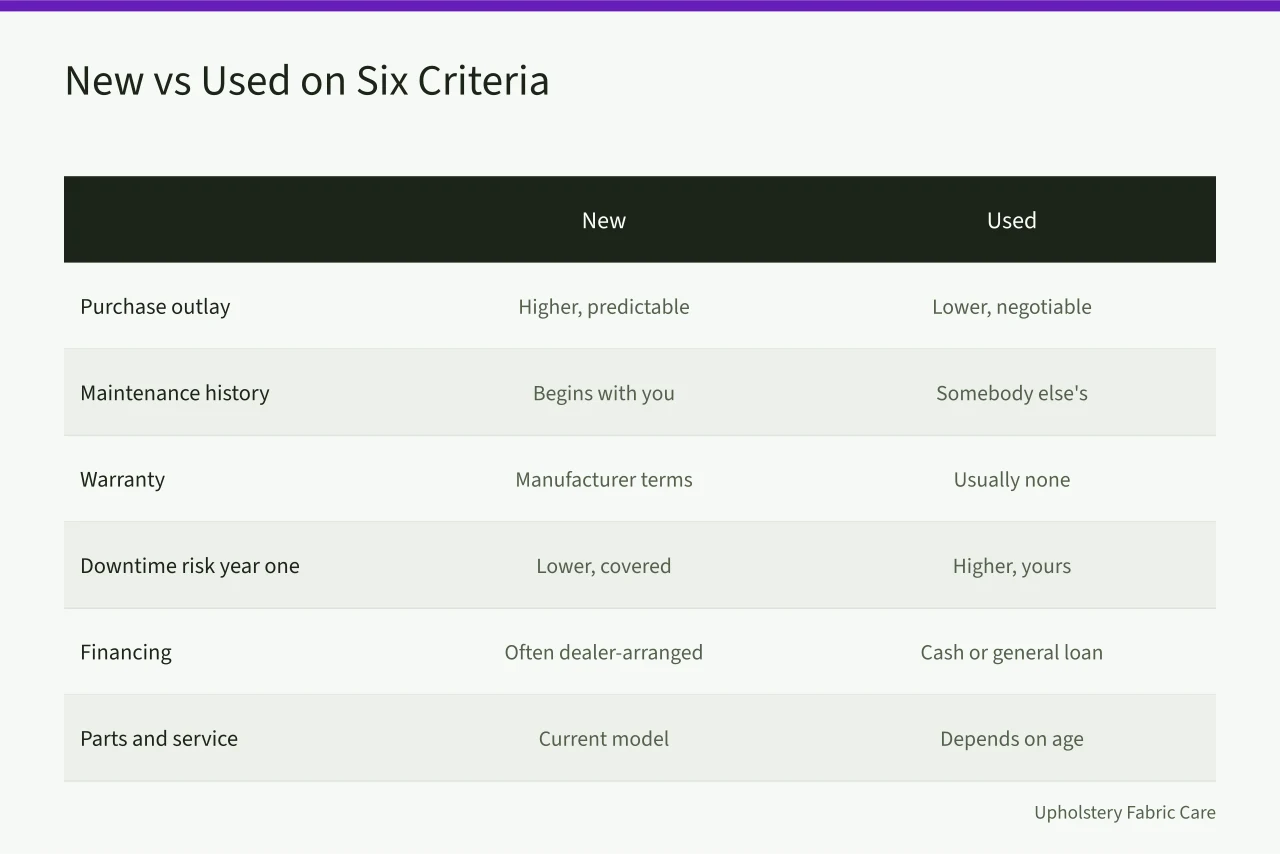
The fourth row decides most purchases. A single machine business cannot absorb an unplanned week out of service. That risk is priced into the difference between the two columns whether or not the buyer notices.
Show the numbers
| Prochem Peak truckmount | $7,000–$14,000 |
|---|---|
| HydraMaster Boxxer 318 | $4,500–$9,000 |
| Sapphire Scientific 370SS | $8,000–$15,000 |
| Mytee LTD12 portable | $1,000–$2,200 |
| Rug Doctor Mighty Pro X3 | $300–$800 |
| Rotovac 360i | $450–$850 |
These are typical ranges as of 2026, before negotiation and local tax. Condition, hours and included tools move the used figure.
Inspecting a used machine
Do this in person, with the machine running, on a floor rather than in a yard.
- Read the service record before you look at the machine. No record means you are buying an unknown, and the price should reflect that.
- Check hours or usage against the record. A gap between them is a question, not necessarily a problem.
- Start it cold and listen. Run it warm and listen again. Changes between the two states are worth asking about.
- Inspect the water path end to end for leaks, corrosion and repairs that were not done by a dealer.
- Inspect the recovery side, including the tank interior. It tells you how the previous owner treated the machine when nobody was watching.
- Test vacuum and pressure against the specification the manufacturer publishes for that model. Do not use a figure the seller quotes.
- Run it on an actual carpet for long enough to see whether anything changes under sustained load.
- Check parts availability for that model with a dealer before you agree a price, not after.
Any step that cannot be completed is a reason to reduce your offer or to walk. A seller who will not allow a running inspection has answered the question.
Questions to put to a seller in writing
Ask these for a Prochem Peak, a HydraMaster Boxxer 318 or any portable on a marketplace listing.
- Why is the machine being sold, and what is replacing it?
- Who serviced it, how often, and can that record be produced?
- What has been repaired or replaced, and by whom?
- Has it been stored where it could freeze, and what was done about that?
- What is included: hoses, wands, tools, spare parts, manual?
- Is there any remaining warranty, and is it transferable?
Written answers tend to be more accurate than spoken ones.
What neither option fixes
A machine does not fix a territory. If drive time is eating your day, a faster unit shortens the part of the day that was already productive.
A machine does not fix technique. Over-wetting, poor dry stroke discipline and skipped pre-vacuuming produce the same callbacks on any equipment.
A machine does not fix a menu you cannot staff. The competence to run it is a separate purchase, and the hiring and training guide treats it that way.
A machine does not fix compliance. Registration, insurance and disposal obligations follow the business. The licensing and compliance guide names which authority answers which question. How either purchase is recorded and depreciated is for your own tax adviser, working from current rules such as the IRS starting a business guidance.
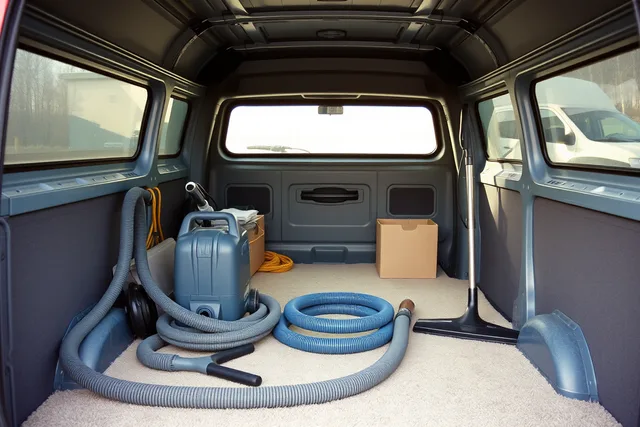
The surrounding kit list is the same either way, and it is in the equipment checklist for new owners. Enter both routes into the same cost lines in your carpet cleaning business plan so the comparison is made on total cost rather than sticker.
Common questions
Is there a mileage or hours figure above which a used machine is not worth buying?
Not one that transfers between models. A Prochem Peak and a Mytee LTD12 have different service lives. Ask the dealer who supports that model what its service life looks like and what the expensive components cost to replace.
Does buying used make sense for a first machine?
Often, if the inspection is thorough and a fallback exists for the week it is in the shop. A used HydraMaster Boxxer 318 can be a first truckmount when a portable Mytee LTD12 covers calls during repairs. Less so when the schedule has no slack at all.
What about ex-demonstration or dealer-refurbished units?
They sit between the columns. Ask what refurbished covers, what warranty attaches, and who performed the work. Get the answer in writing.
Should financing change the decision?
It changes affordability, not value. Compare total cost including finance charges against the used price plus expected maintenance. Judge the downtime risk separately.