Guides
WSIB Ontario and WCB Alberta compared for carpet cleaning staff
Ontario and Alberta cover carpet cleaning crews through different workers compensation boards, with separate tests for contractors and payroll rules.
What to take away
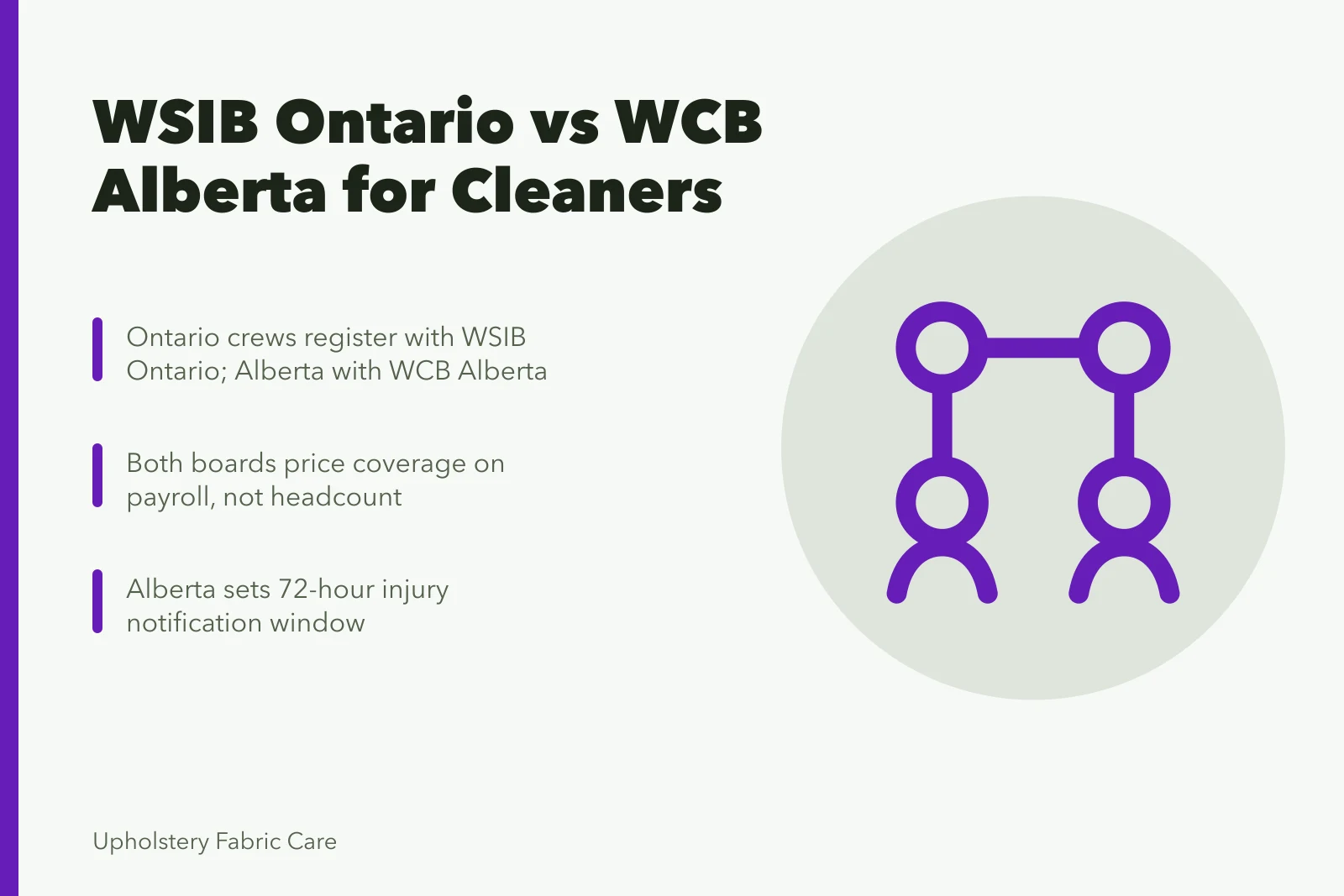
- Ontario crews register with WSIB Ontario; Alberta crews register with WCB Alberta. A crew working in both provinces usually needs an account in each.
- Both boards price coverage on payroll, not headcount. Your rate comes from a classification unit in Ontario and an industry rate in Alberta.
- Ontario presumes a person working in your business is a worker. Alberta asks about control, tools and chance of profit before it treats a contractor as one.
- Ontario wants a lost-time injury reported within three days; Alberta within 72 hours. Both charge penalties for late reports.
- Ask a subcontractor for a clearance certificate before the first job. Without it, their unpaid premiums can land on you.
What WSIB Ontario covers for carpet and upholstery cleaning crews
WSIB Ontario provides no-fault workplace insurance for most Ontario businesses. A carpet cleaning company with staff in the province registers once it meets the coverage threshold for its industry, and cleaning services generally fall under mandatory coverage.
Covered workers get loss-of-earnings benefits, health care and return-to-work support after a workplace injury. For a cleaning crew, that means claims from lifting a portable up a stairwell, a fall from a ladder, or a skin reaction to a pre-spray.
The board also covers occupational disease where the work is linked to it. WSIB decides claims and sets benefits.
You pay premiums on insurable payroll, at a rate set by your classification unit. Alongside the premium come duties: report injuries, offer modified work where you can, and cooperate with a return-to-work plan. The board audits records and charges penalties when reporting falls short.
The Ontario Ministry of Labour, Immigration, Training and Skills Development enforces the Occupational Health and Safety Act separately. WSIB handles the insurance side, not the safety inspections.
Payroll cost is the other half of the same decision. carpet cleaning employee pay sets out how hourly rates and payroll taxes stack up before premiums are added.
What WCB Alberta covers for the same work
WCB Alberta covers most Alberta employers, carpet and upholstery cleaning included. Coverage is mandatory for many industries, and a business owner without staff can apply for optional personal coverage.
Benefits mirror Ontario's: medical care, wage replacement and return-to-work services. The system is funded by employer premiums on payroll at an industry rate.
Alberta sets a 72-hour window to notify WCB of an injury that causes lost time or needs treatment beyond first aid, and an employer report follows. Late reporting draws penalties. WCB works alongside Alberta Occupational Health and Safety, which enforces the province's safety rules.
Employment standards sit next to those obligations and cover hours, overtime, rest breaks and minimum wage. The rules your cleaning staff are entitled to are published at Employment standards | Alberta.ca.
Premium rates and classification units side by side
Neither board quotes you a number in advance. Both build your rate from payroll and claims experience, and both reset it annually.
Ontario assigns a rate group and a classification unit by type of work. Carpet and upholstery cleaning lands in a cleaning services unit, and the rate is a percentage of payroll. Alberta sets a rate per $100 of insurable earnings for each industry, and cleaning services has its own.
Your own claims history moves the rate in both provinces, as does the claims cost of the group you sit in.
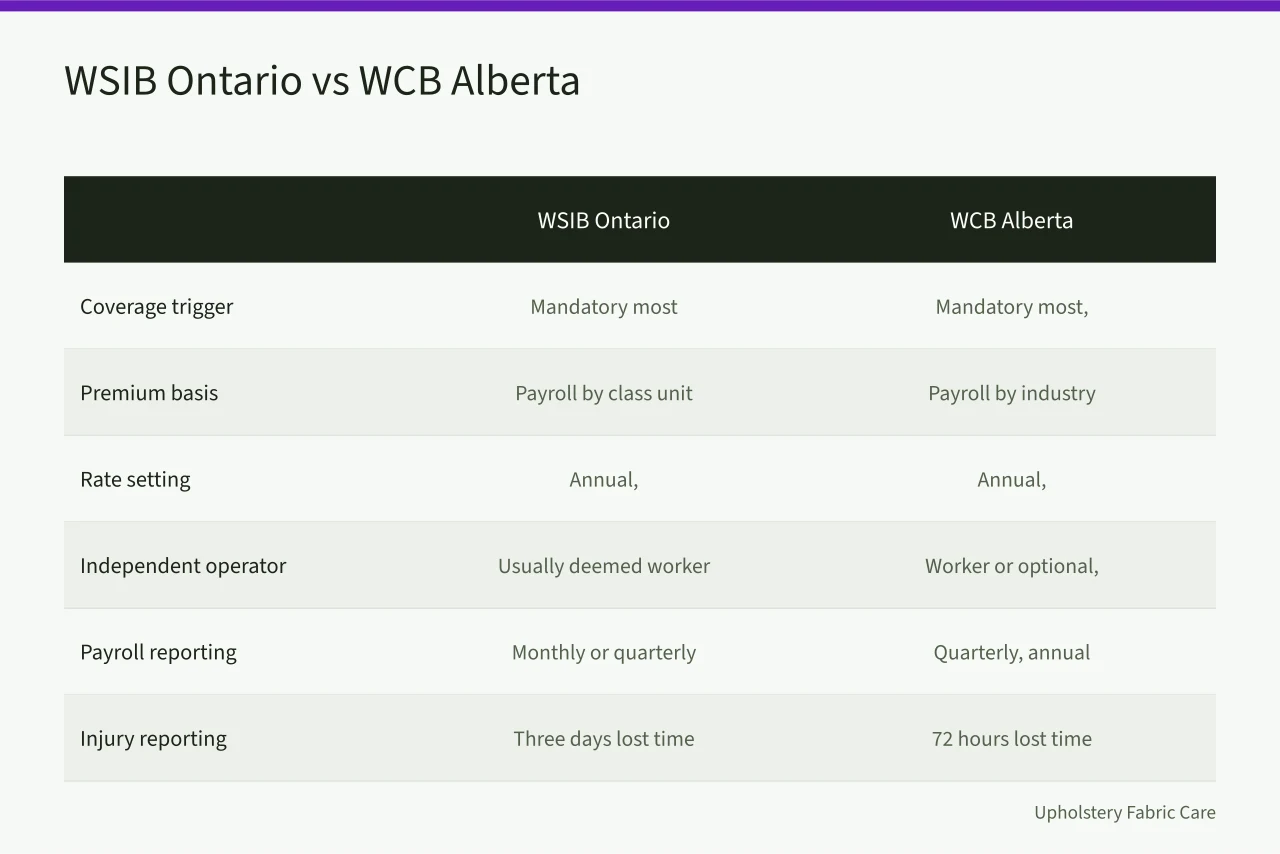
| Feature | WSIB Ontario | WCB Alberta |
|---|---|---|
| Coverage trigger | Mandatory for most cleaning businesses | Mandatory for most, optional for some owners |
| Premium basis | Payroll by classification unit | Payroll by industry rate |
| Rate setting | Annual, experience-rated | Annual, experience-rated |
| Independent operator | Usually deemed a worker | Worker or optional coverage, by test |
| Payroll reporting | Monthly or quarterly | Quarterly with annual reconciliation |
| Injury reporting | Three days for lost time | 72 hours for lost time |
British Columbia runs a third version of the same idea. WorkSafeBC publishes the classification unit and rate for carpet cleaning work at Find your classification unit, industry, or rate - WorkSafeBC, which is the fastest way to see how a province splits the trade.
Independent operator rules and who counts as a worker
This is where the two provinces part company, and where a cleaning company gets caught.
Ontario starts from a presumption: a person working in your business is a worker, whatever the invoice calls them. To be exempt, an operator has to carry their own WSIB coverage, run a separate business, and sit outside your control. Miss any of those and their payroll belongs on your report.
Alberta runs its own test, weighing control, ownership of tools and chance of profit. A contractor with WCB coverage, or a director of a corporation, can be exempt. Otherwise the board may treat them as a worker.
Hiring a subcontractor without checking is the expensive version of this mistake. If they are uncovered, you can be assessed for their premiums.
Both boards audit and both reclassify. Retroactive premiums and fines follow. The cheap protection is a clearance certificate from the board confirming the subcontractor's account is current, and it is worth having before the first job, not after.
Workers compensation is one line in a wider risk plan. carpet cleaning business insurance covers the liability and property side that the boards do not.
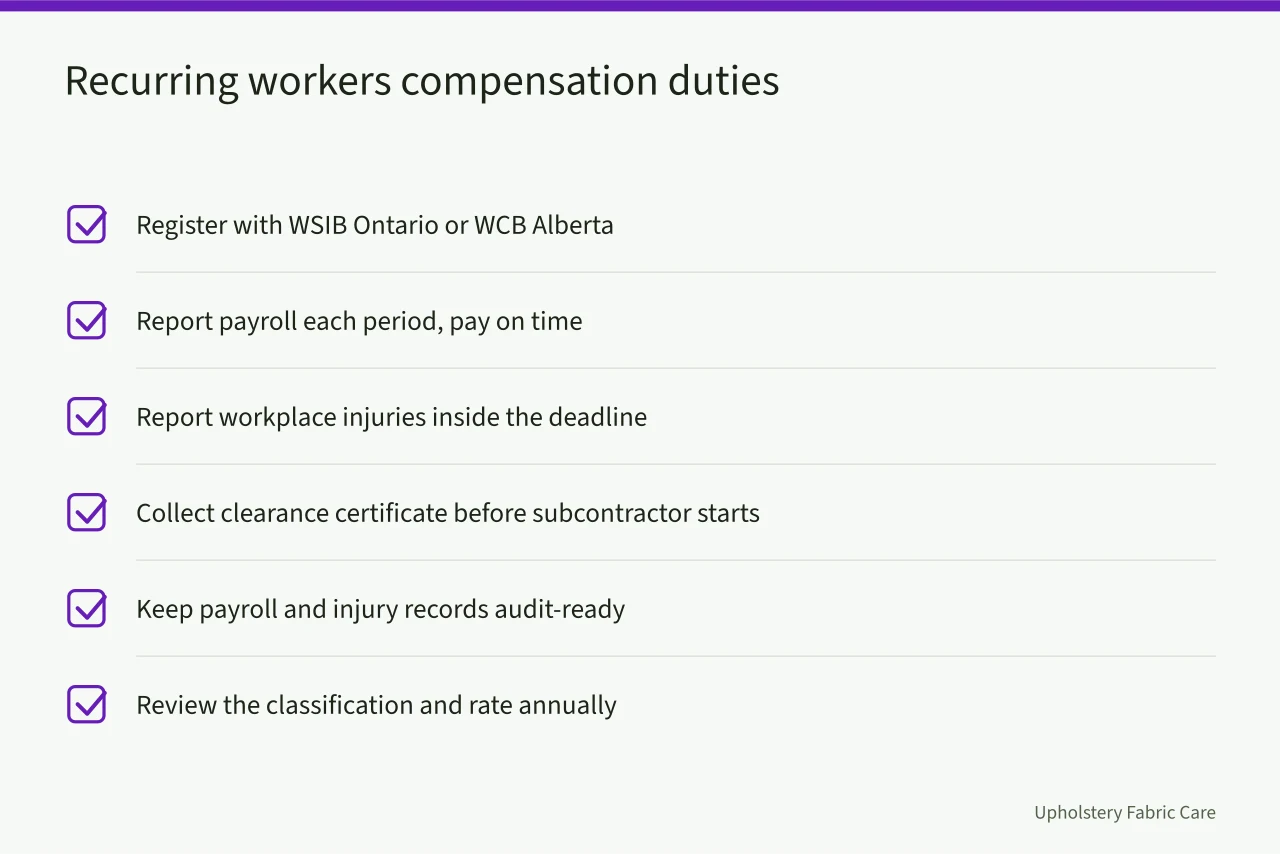
Reporting payroll, injuries and clearance duties in each province
Ontario reports payroll to WSIB monthly or quarterly, depending on premium volume, and premiums are paid on insurable earnings. Changes to the business, such as a new location or a change of ownership, are reportable too. Unpaid premiums accrue interest.
Alberta reports quarterly and reconciles at year end against actual payroll. Overpay and you get a refund; underpay and you settle the difference.
Both provinces expect records of hours worked and wages paid, kept well enough to survive an audit.
Injury reporting runs on a clock. Ontario wants a work-related injury reported within three days where the worker loses time or needs care beyond first aid, plus an employer's report. Alberta's window is 72 hours. A fatality or serious injury goes to the occupational health and safety regulator as well.
Clearance certificates matter whenever a subcontractor is on site. WSIB issues them in Ontario, WCB issues clearance letters in Alberta. Either one confirms the account is current and shields you from the subcontractor's unpaid premiums.
Choosing coverage when a crew works across the Ontario-Alberta line
Coverage normally follows where a worker is based or mainly works. Send a crew across the line and the question becomes how long they are there and whose direction they work under.
The two boards have agreements that prevent double coverage, but the agreements only work when you report the arrangement correctly. A short project may sit under your home province. Ongoing work in the other province usually needs an account there.
A Toronto carpet cleaning company wins six months of office work in Calgary. The owner holds WSIB Ontario coverage for the crew. In Alberta, those cleaners may be workers under WCB Alberta, which means registering, reporting the Alberta payroll and paying premiums. The Ontario portion of their work still runs under WSIB.
Skip the Alberta registration and the penalties and unpaid premiums arrive together.
Cross-border work pulls in employment standards as well. Ontario's Employment Standards Act sets overtime, vacation pay and termination rules for work performed in the province, and it is published at e-Laws | Ontario.ca. Alberta's standards apply to the Alberta work periods. A crew that crosses the line can sit under both sets in the same month.
Getting the crew itself right is the other half of the job. carpet cleaning hiring covers recruitment and onboarding for a team that works in two jurisdictions.
Common questions
Do I need WSIB Ontario with only one part-time cleaner?
Yes, if you are in a mandatory coverage industry and meet the payroll threshold. Cleaning services generally fall under mandatory coverage. Register and report the cleaner's payroll.
What happens if I misclassify a worker as an independent operator?
Both boards audit and reclassify. You can owe retroactive premiums, penalties and interest. Confirm the operator's status and coverage before the first shift, not after an audit notice.
How often do I report payroll in each province?
WSIB Ontario takes monthly or quarterly reports depending on premium volume. WCB Alberta takes quarterly reports with an annual reconciliation against actual payroll.
What is a clearance certificate and why do I need one?
It is a document from the workers compensation board confirming a subcontractor's coverage is current. It protects you from liability if that subcontractor stops paying premiums.
Firms comparing how the trade is run elsewhere can look at carpet cleaning companies, and the wider compliance picture sits in carpet cleaning licensing requirements.