Guides
Pricing upholstery cleaning in Toronto against Vancouver rates
Upholstery cleaning pricing in Toronto and Vancouver reflects distinct local cost bases, wages, and competition, so each city needs its own rate sheet.
What to take away
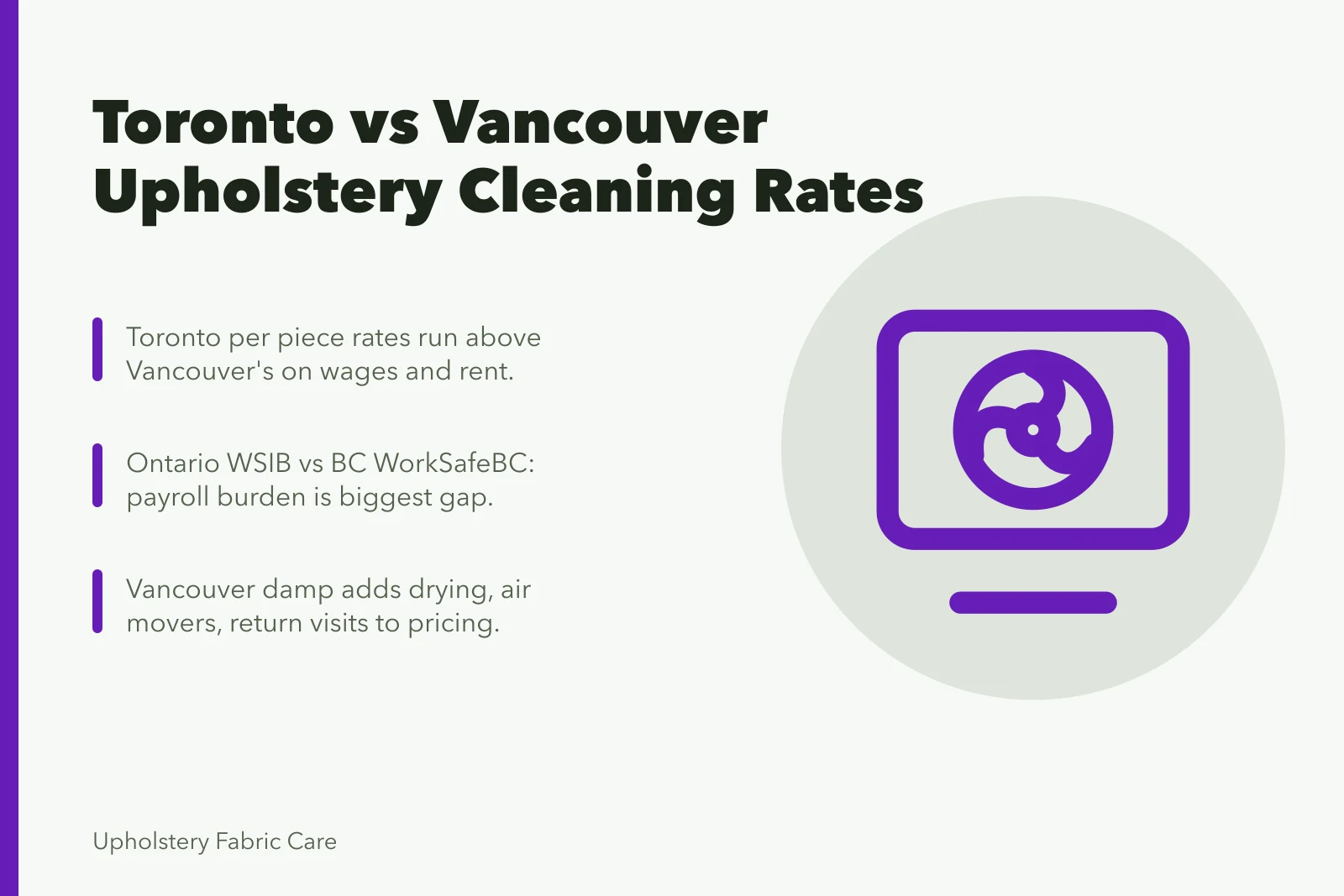
- Toronto per piece rates run above Vancouver's on loaded wages and rent; Vancouver per room rates catch up once drying and moisture treatment are priced in.
- Payroll burden is the biggest single gap. Ontario runs WSIB, BC runs WorkSafeBC, and both add CPP, EI, vacation and holiday pay on top of the bare wage.
- Coastal damp makes Vancouver upholstery a drying job. Longer extraction passes, more air movers and occasional return visits belong in the Vancouver column.
- Toronto property managers buy per piece for lobby and hallway items; Vancouver strata councils buy per room or per building schedules and ask about moisture.
- One sheet, two columns, indexed to the Consumer Price Index each year. A single national rate loses money in one city or prices you out of the other.
What a per piece and per room price covers
A per piece price covers one item: sofa, loveseat, armchair, dining chair or mattress. It includes pre-vacuuming, pre-treatment, extraction and a set dry time. Stain work beyond general spotting, pet enzyme treatment, mould remediation and protector go on separate lines.
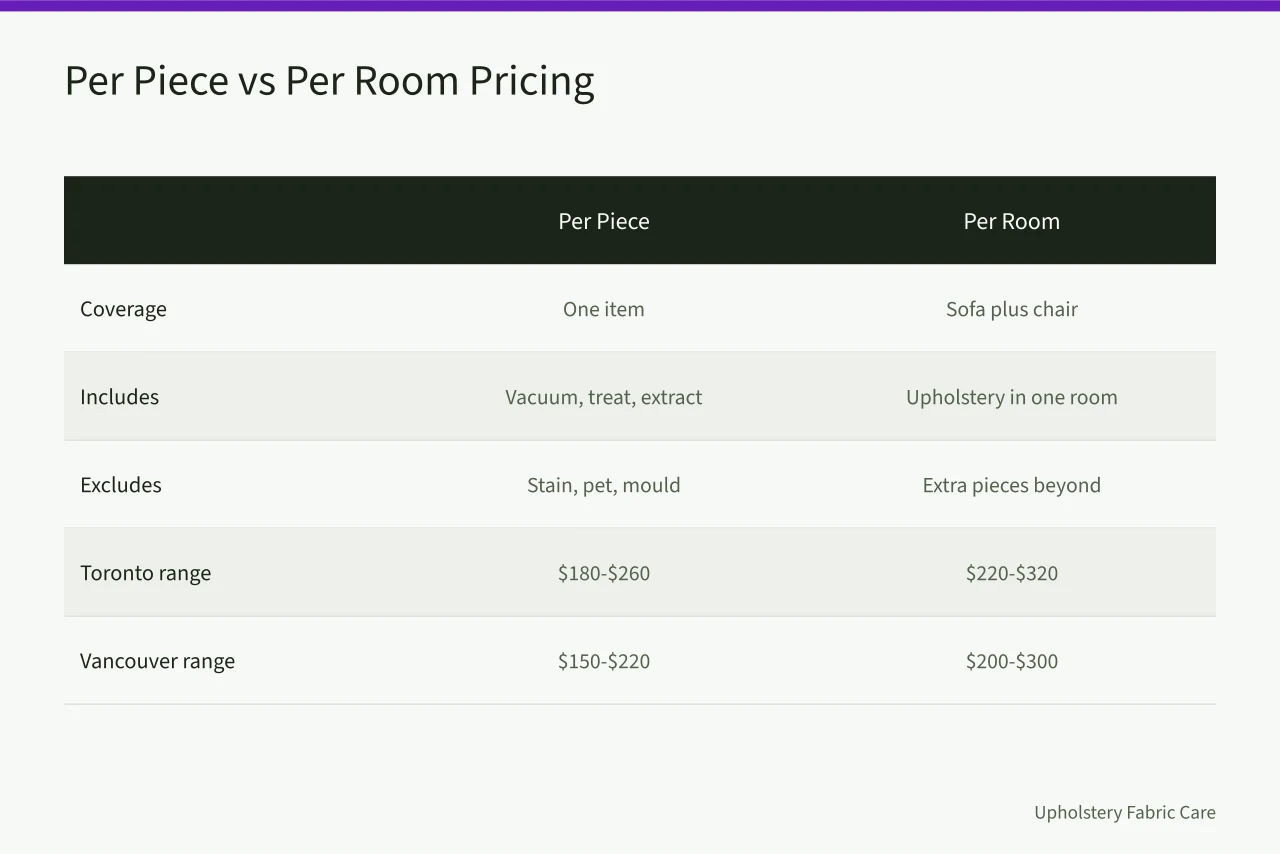
A per room price covers the upholstery in one room, usually a sofa plus a chair or two. Customers compare it easily. You carry the risk when the room holds more pieces than the quote assumed, so write the piece count into the scope.
Ranges for owner-operated firms, not franchise minimums, sit near $180 to $260 per sofa in Toronto and $150 to $220 in Vancouver. Per room work lands near $220 to $320 in Toronto and $200 to $300 in Vancouver. Your own cost base decides whether those numbers hold.
A full carpet cleaning pricing build loads every cost line before you set a rate. Do that before you compare yourself to either city.
Wage and labour cost differences
Labour is the largest cost in upholstery cleaning, and the two provinces do not price it the same. Toronto's deeper technician market supports higher wages. Vancouver wages run lower on average, and the gap narrows once BC statutory costs land on top.
BC's Employment Standards Act sets minimum wage, overtime, statutory holiday pay and rest periods for cleaning crews. Ontario's Employment Standards Act covers the same ground with different numbers. Copying a wage rate across the provincial line misstates your hourly cost.
Payroll burden is where the real figure lives. Ontario adds WSIB premiums, CPP, EI, vacation pay and public holiday pay. BC adds WorkSafeBC premiums plus the same federal contributions. The rate you pay a technician is not the rate the job costs you.
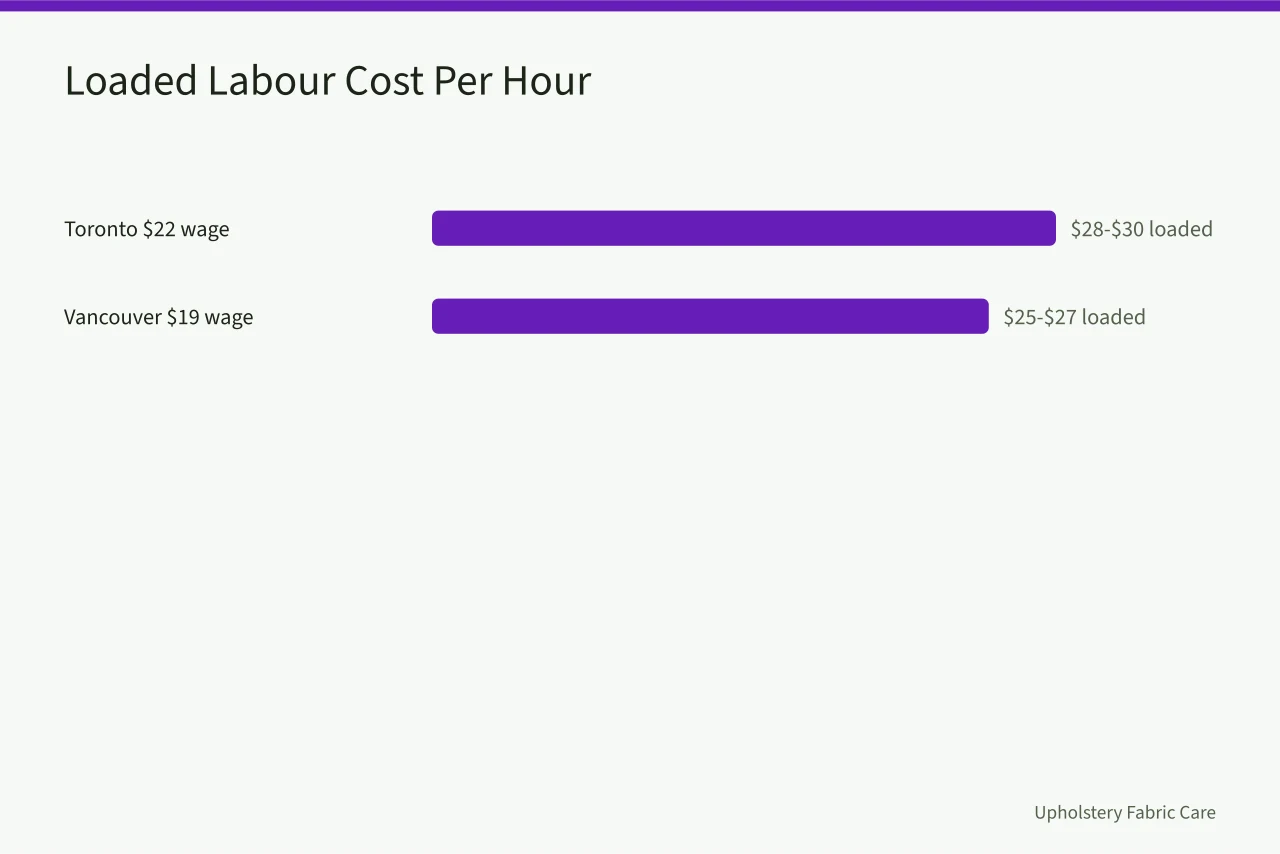
Two technicians on a five-hour job is ten labour hours, so a $3 loaded difference is $30 on one job.
Across a month of condo work that gap decides whether the contract is worth keeping.
Price the labour line properly with the guide to pricing carpet cleaning services, then check your real carpet cleaning employee pay before you quote the next building.
Fuel, rent and vehicle costs
Both cities carry expensive fuel and commercial rent, but the cost takes a different shape in each. Toronto work spreads across the Greater Toronto Area, so vans cover more kilometres per job. Vancouver work is denser, and bridges, traffic and parking tickets eat the saving.
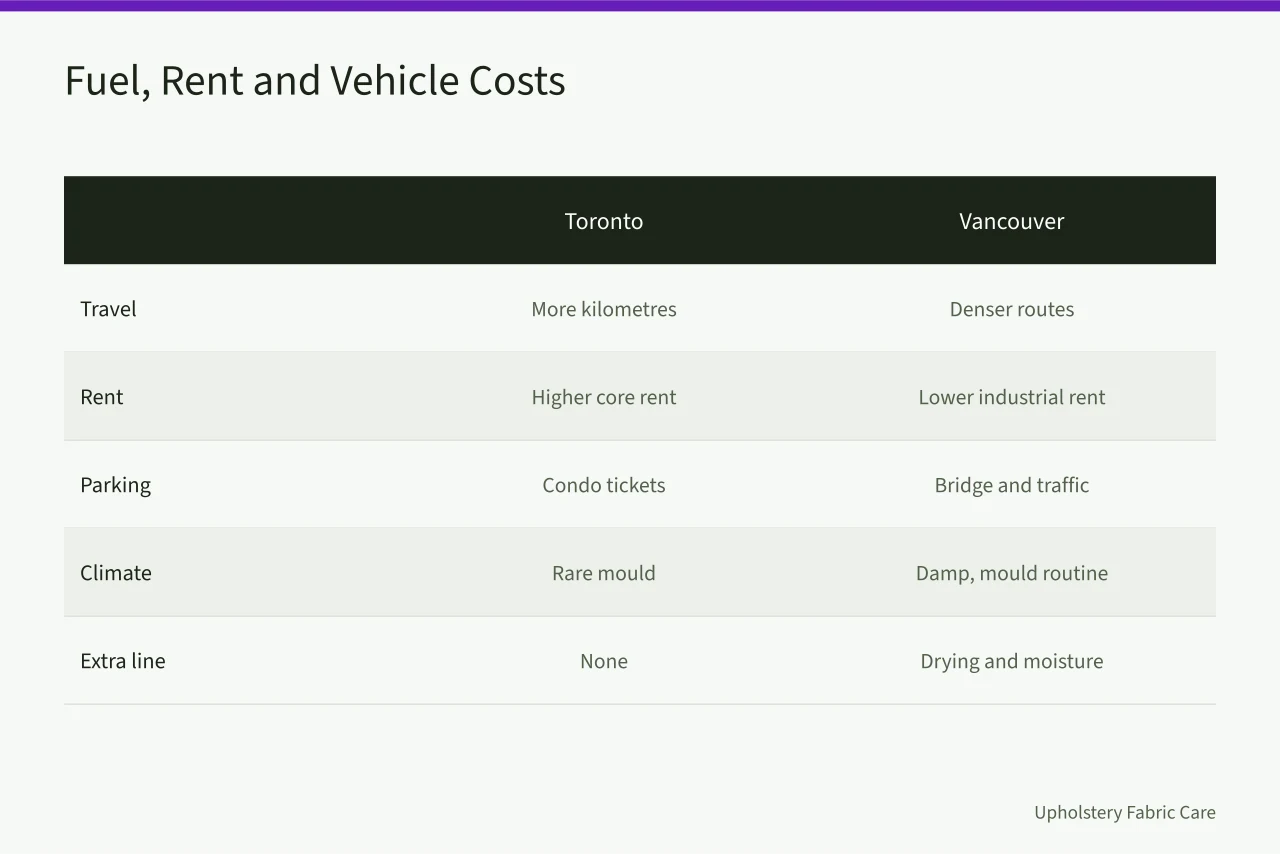
A small shop or storage bay costs more in Toronto's core than in most Vancouver industrial areas. Home-based operators dodge rent but still pay insurance, and parking differs. A downtown Toronto condo ticket can cost more than the fuel for the whole job.
Vancouver's wet coastal climate adds a line Toronto does not carry. Damp upholstery needs longer extraction passes, more air movers and sometimes a return visit. Mould and mildew treatment on strata furniture is routine there and rare in Toronto. Price it into the Vancouver per room rate rather than absorbing it.
The Consumer Price Index Portal publishes provincial and city indexes. Use them to adjust both columns annually instead of guessing, and to see how much of a fuel or rent jump is local.
Condo and strata contract pricing
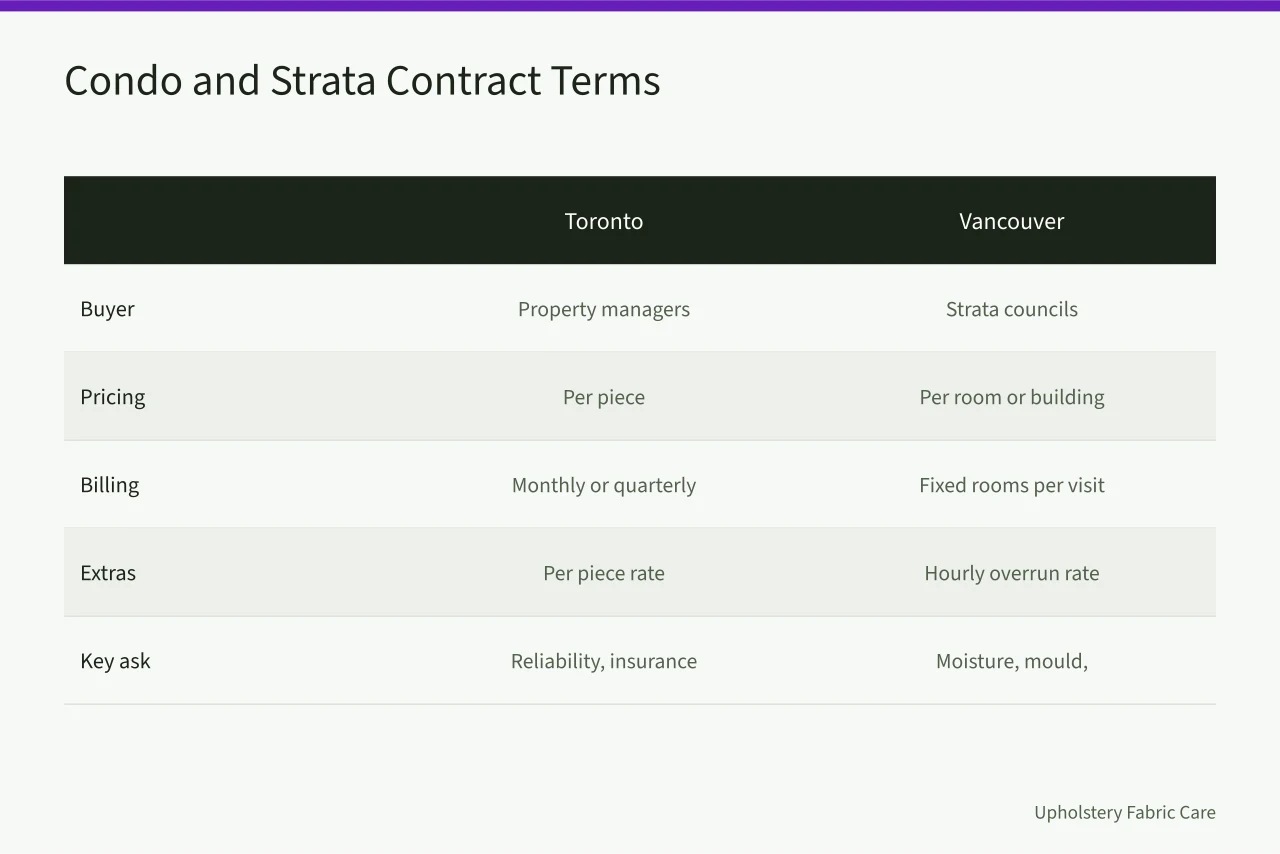
Toronto is Canada's largest condo and rental market. Carpeted high-rise hallways and upholstered lobby furniture produce steady contract demand, and property managers usually want per piece pricing for lobby sofas, bench seating and runners, billed monthly or quarterly. Contracts are won on reliability and insurance paperwork as much as on price.
The CMHC 2025 Rental Market Report | CMHC tracks rental supply and vacancy in major centres. It shows where new buildings are opening and where shared upholstery will need maintaining.
Vancouver's strata housing works differently. Strata councils buy cleaning for common areas and sometimes for furnished amenity rooms. They want per room or per building schedules, and they ask about moisture, mould and drying because damp upholstery recurs on the coast. Name a moisture treatment step and a dry time in the quote.
Toronto contracts often set a minimum monthly visit plus a per piece rate for extras. Vancouver contracts more often bundle a fixed number of rooms per visit with an hourly rate for overruns. Both cities expect a certificate of insurance, a clear scope and a named contact.
Plan crew time against the CMHC Housing Market Outlook 2026 | CMHC before you commit to a new tower.
Building a Toronto-versus-Vancouver price sheet
One sheet, two columns. Every cost line gets a Toronto figure and a Vancouver figure, and every price gets a margin check. The table is a worked example for a three-seat sofa and a standard room.
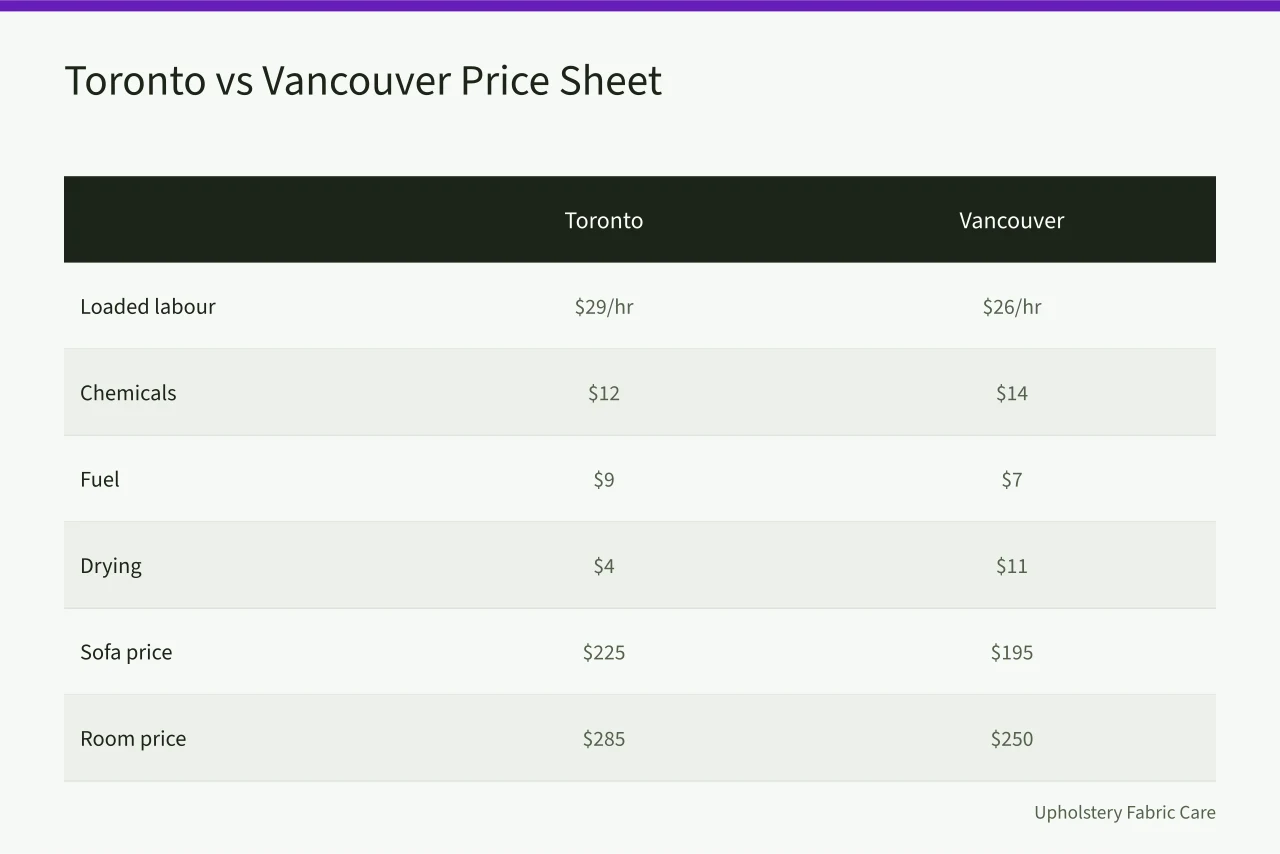
| Line | Toronto | Vancouver |
|---|---|---|
| Loaded labour per hour | $29 | $26 |
| Labour hours per sofa | 1.5 | 1.5 |
| Chemicals and supplies | $12 | $14 |
| Fuel and vehicle | $9 | $7 |
| Drying and moisture treatment | $4 | $11 |
| Target margin | 55% | 55% |
| Per piece sofa price | $225 | $195 |
| Per room price (sofa plus chair) | $285 | $250 |
Worked example: the Toronto sofa takes 1.5 labour hours at $29 loaded, plus $12 chemicals, $9 fuel and $4 drying. Direct cost is $68.50. At a 55 percent margin the price is about $152. Travel between jobs, admin time and equipment wear carry it to the quoted $225.
The same job in Vancouver costs $39 labour, $14 chemicals, $7 fuel and $11 drying, or $71 direct. The same margin gives about $158, and the quoted $195 covers the drying risk and the smaller job pool.
Steps to set both columns:
- List every direct cost for one sofa and one room in each city.
- Add loaded labour using provincial payroll burden, not the bare wage.
- Add fuel, parking, rent share and insurance per job.
- Set a target margin and calculate the price.
- Compare with local market rates and adjust the scope, not the margin.
Checklist before either price goes out:
- Loaded labour uses WSIB or WorkSafeBC premiums plus CPP and EI.
- Fuel and parking reflect real routes in each city.
- Drying and moisture treatment appear as a Vancouver line.
- Condo scope names piece counts or room counts.
- Prices index to the Consumer Price Index each year.
- Margin survives a rework visit.
Review carpet cleaning profit margins every quarter. A contract that cannot hold margin after a rework gets repriced or dropped.
Common questions
Why are Toronto upholstery rates higher than Vancouver rates?
Toronto carries higher loaded wages, higher commercial rent and longer travel distances. Vancouver offsets some of that with lower wages, but wet weather adds drying and mould treatment costs that narrow the gap.
Should a condo contract be priced per piece or per room?
Toronto property managers usually prefer per piece, because they budget for specific lobby and hallway items. Vancouver strata councils often prefer per room or per building schedules, because common areas are managed as a whole.
How do I handle sales tax in each city?
Ontario charges HST and British Columbia charges GST, with PST on some goods. Register with the Canada Revenue Agency, show the tax as a separate line on every quote, and keep the business number current.
How often should the two columns be revised?
At least once a year, and sooner if fuel or rent moves sharply. Use the Consumer Price Index to separate local cost changes from national inflation before changing a published rate.