Guides
Sourcing truck-mount equipment in Canada, duties and suppliers
Sourcing truck-mount equipment in Canada means handling duty, GST and freight costs, and knowing which distributors and brands to call first.
What to take away
- Canadian truck-mount buyers deal with a short list of distributors: Aramsco Canada, Interlink Supply, Cleaner's Supply, Jon-Don and Prochem's Canadian dealer network.
- The brands you will be quoted are Prochem, Sapphire Scientific, HydraMaster, Butler and Truckforce, plus Cobra and Mytee on the portable side.
- CBSA assesses duty on the value for duty, which includes freight and insurance to the Canadian border, not just the machine price.
- GST or HST is payable at the border; a registered business claims it back as an input tax credit, but the cash leaves first.
- Ask every dealer for a written landed cost quote: freight, duty, tax, liftgate and residential delivery.
What Canadian cleaners actually run
Most Canadian carpet cleaners put a truck-mount in a van or trailer. The common shapes are a slide-in with a 20 to 30 horsepower engine, a direct-drive unit bolted to the van engine, and a 40-plus horsepower unit for multi-truck operations.
Tank size matters more here than in warmer markets. Winter work moves indoors, jobs run longer, and a small waste tank means more trips to the drain.
Portables split into two groups: 10 to 15 gallon machines for apartments and high-rises, and 20 to 30 gallon units for commercial work where the van cannot park at the door. A portable gets into downtown Toronto, Montreal and Vancouver buildings with no loading dock. It also reaches rural Newfoundland and Labrador properties where a van cannot.
Truck-mounts win on heat and vacuum. A well-set-up unit holds 220 to 240 degrees Fahrenheit at the wand, which breaks soil faster and uses less chemical. Portables run cooler and need longer dry strokes.
If your work is residential carpet in a mid-sized city, a truck-mount pays for itself in labour. If it is condos, offices or remote cabins, a portable earns more per dollar invested. Our carpet cleaning equipment guide breaks down what each machine does.
One Canadian factor decides more jobs than horsepower: freeze protection. A truck-mount left overnight in an unheated Manitoba or Saskatchewan garage can crack a pump or heat exchanger. Budget a heated bay or a winterizing routine. Portables stored in a heated shop avoid the problem.
Van or trailer? A trailer keeps the van free and swaps between vehicles. A van-mounted unit is harder to steal and easier to park in a driveway. Check provincial commercial vehicle weight and registration rules before you commit.
The distributors and brands you will be quoted
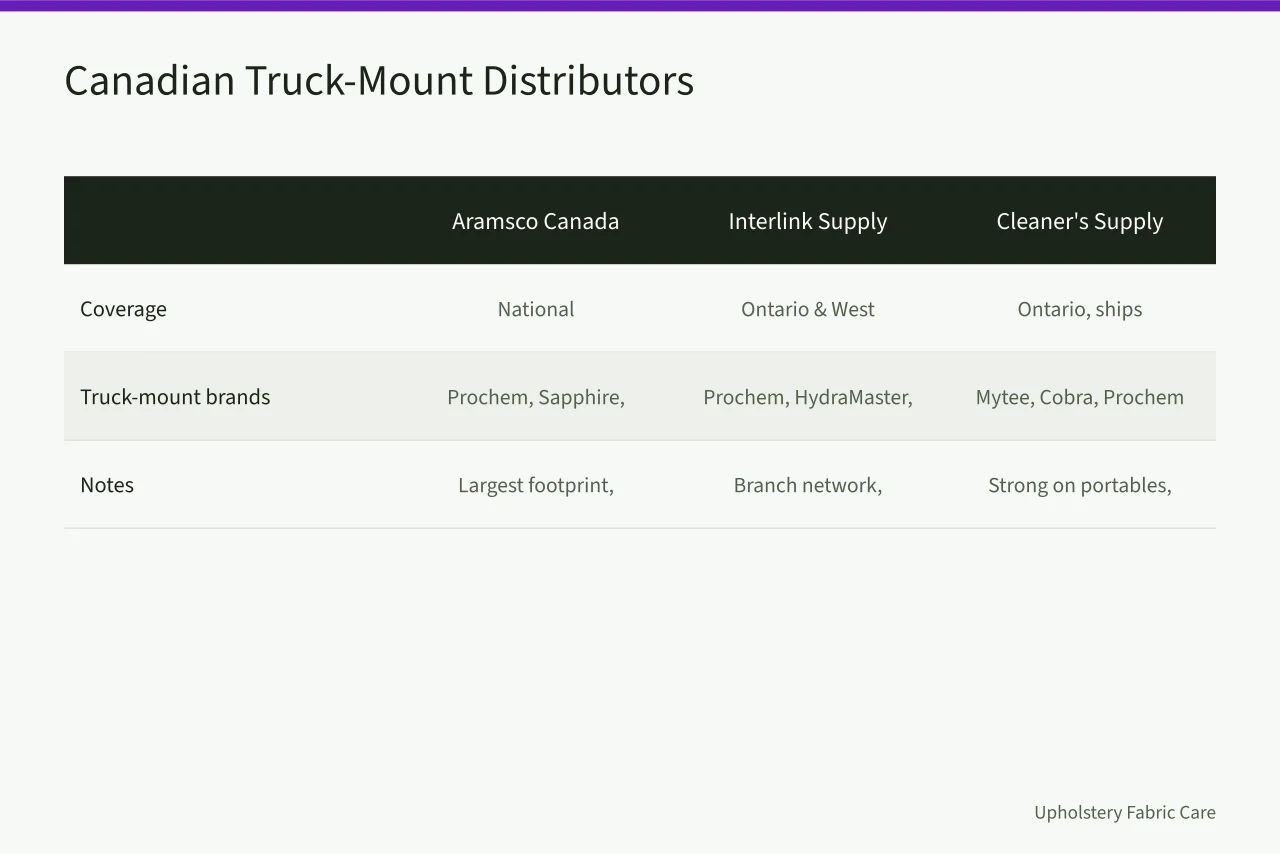
Canadian supply is concentrated in Ontario, British Columbia, Alberta and Quebec, with smaller dealers serving the Atlantic provinces and the Prairies. Most dealers carry one or two truck-mount brands, so the dealer you pick decides the brand you run.
| Distributor | Coverage | Truck-mount brands | Notes |
|---|---|---|---|
| Aramsco Canada | National, branches in Ontario, BC, Alberta, Quebec | Prochem, Sapphire Scientific, HydraMaster | Largest Canadian footprint, stocks parts and chemicals |
| Interlink Supply | Ontario and western Canada | Prochem, HydraMaster, Sapphire Scientific | Branch network, training and service |
| Cleaner's Supply | Ontario, ships nationally | Mytee, Cobra, Prochem | Strong on portables, wands, hoses and consumables |
| Jon-Don | Ships into Canada from US branches | Prochem, Sapphire Scientific, Mytee | Useful for remote buyers, cross-border freight |
| Prochem Canadian dealers | Regional independents | Prochem | Warranty service through the dealer, not the factory |
Brands you will see on the floor: Prochem, Sapphire Scientific, HydraMaster, Butler and Truckforce on the truck-mount side; Mytee, Cobra and EDIC on portables. Butler and Truckforce build van-mounted systems rather than slide-ins, which suits a dedicated cleaning van but not a trailer swap.
Every dealer stocks a limited range. For a brand-by-brand view, see our list of carpet cleaning equipment brands.
When you call, ask three questions: which brands they stock, how far their service radius reaches, and whether they lend a loaner unit during warranty repairs. A dealer 20 minutes away with a loaner policy beats a cheaper unit shipped from 2,000 kilometres away.
Confirm the dealer is authorized by the manufacturer before you sign. Grey-market units may carry no warranty in Canada, and some manufacturers will not honour a unit bought outside their Canadian dealer network. Get parts and labour coverage in writing.
ISSA Canada and the Canadian Institute of Cleaning Professionals run training and events, and their member lists point to distributors and manufacturer representatives in each province.
If you are new to the trade, see the carpet cleaning equipment checklist. It covers what to order alongside the machine:
- wands
- hoses
- solution lines
- vacuum hose
- chemicals
- PPE A dealer can bundle those into one invoice and one freight charge, which matters on a remote delivery.
CBSA duty on an imported unit
The Canada Border Services Agency assesses duty on imported truck-mount and portable units. The rate depends on the tariff classification and the country of origin. Most truck-mounts fall under tariff headings for cleaning machinery.
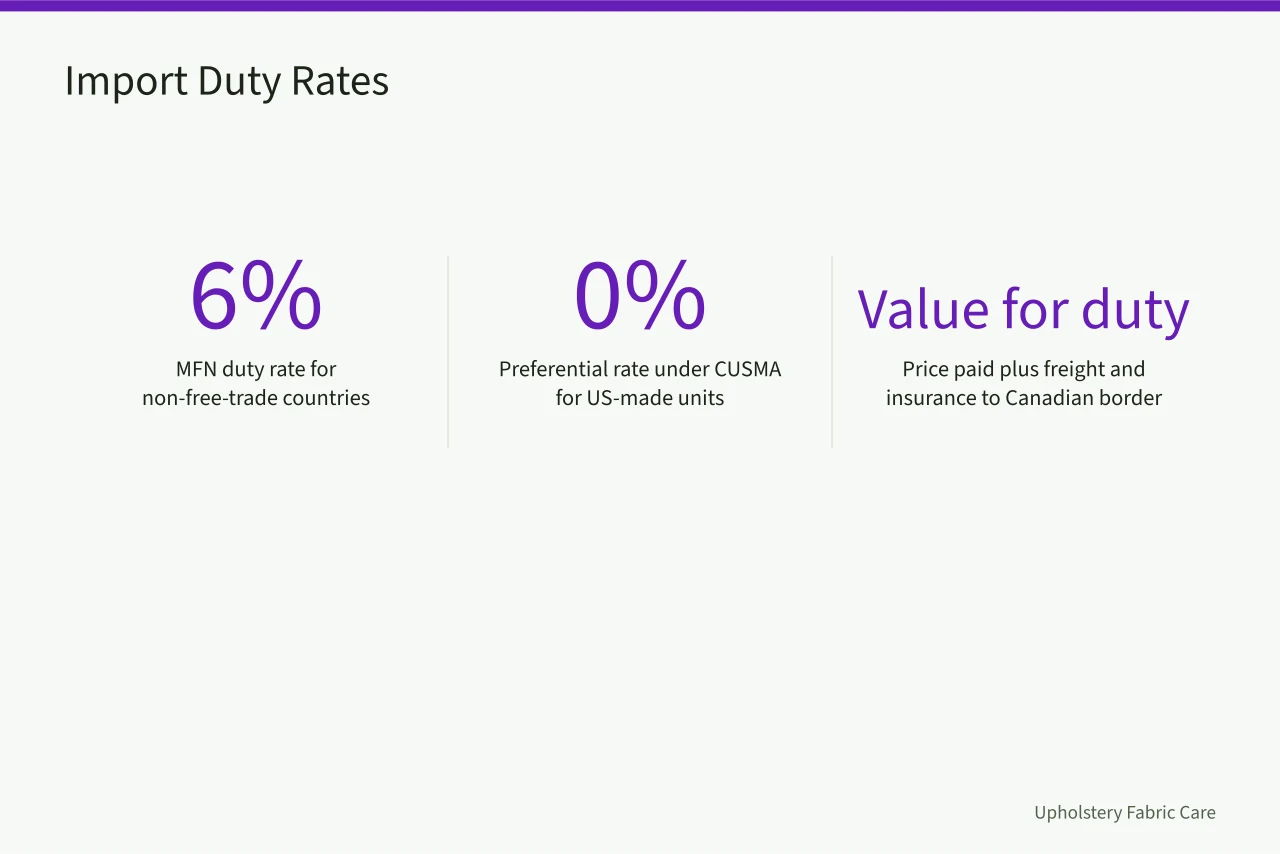
Units made in the United States may qualify for preferential treatment under the Canada-United States-Mexico Agreement if they meet the rules of origin. Units made in China or another non-free-trade country usually attract the Most-Favoured-Nation rate, which can be 6 per cent or more.
You need a business number to import commercially. The Canada Revenue Agency issues it, and you also need a CBSA account.
Federal starting a business guidance covers registration, and the permits and licences lookup tells you whether your cleaning business needs a provincial or municipal licence before you import.
Duty is calculated on the value for duty: the price you paid plus freight and insurance to the Canadian border. Buy a used unit from a US seller and ship it to Ontario, and the freight is part of that value.
Keep the commercial invoice, bill of lading and proof of origin. Without proof of origin, CBSA may apply the higher rate.
Import for your own business use and the duty is generally not recoverable. Import for resale and duty becomes a cost of goods, so it belongs in your landed cost. Duty at 6 per cent on a purchase price of $30,000 adds $1,800 before tax.
Some dealers import in bulk and clear customs themselves. Then duty is already inside the price you pay, and you handle only GST or HST on the Canadian invoice. Ask whether the quote is landed, duty paid and delivered. That one question prevents most surprise charges.
Provincial safety rules apply once the unit is in service. WorkSafeBC, WCB Alberta and WSIB Ontario set equipment and worker coverage requirements. The Canadian Centre for Occupational Health and Safety publishes guidance on handling the chemicals you run through the machine.
GST and HST at the border
GST or HST applies to most imported truck-mount and portable units. The rate depends on the province where the goods are delivered or where the importer is located. The CRA sets out the GST/HST rates by province and how to charge and collect them.
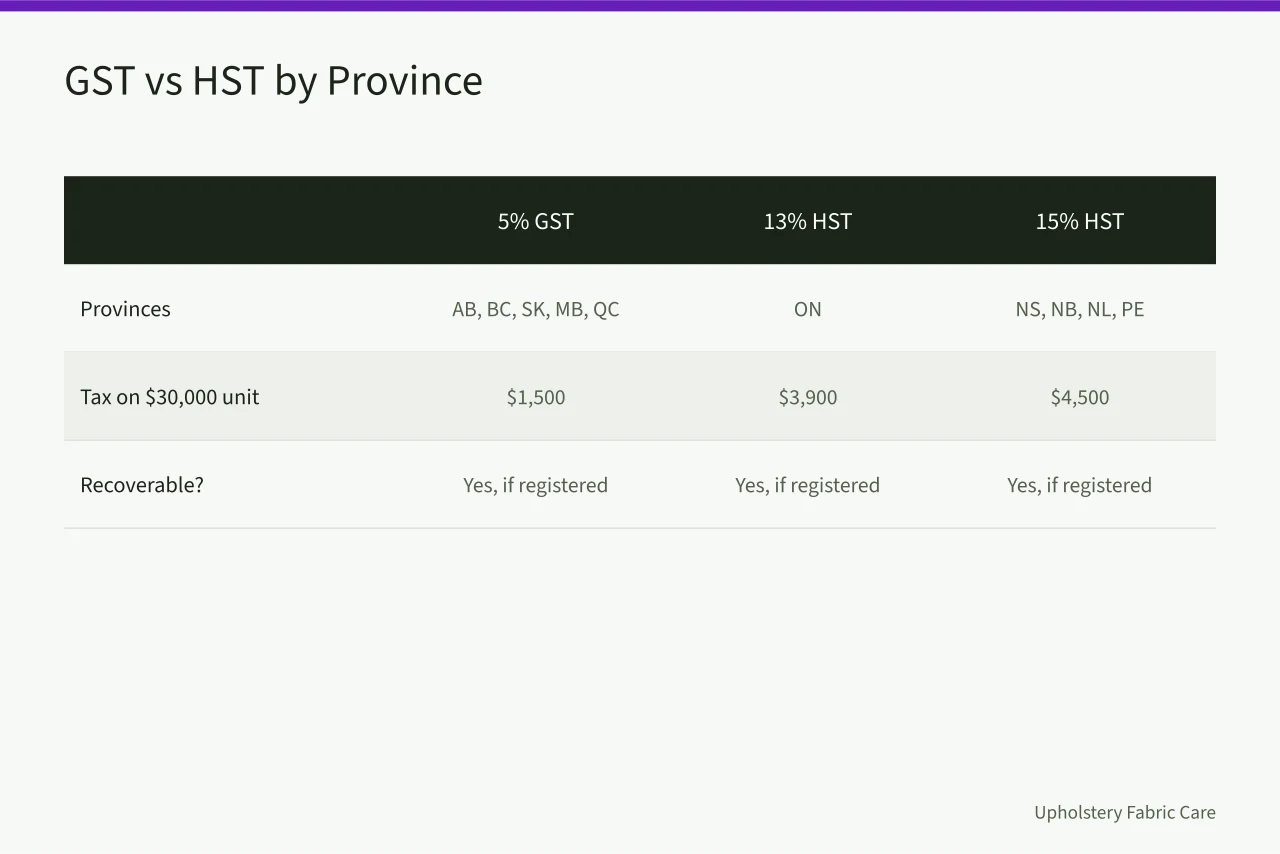
A GST-registered business pays the tax at the border and claims an input tax credit on its return. The tax is not a permanent cost, but the cash is gone until the return is assessed.
On a $30,000 unit in Ontario, HST at 13 per cent is $3,900. You recover it later. You still need it on hand at import.
Not registered, and you pay the tax with no way to claim it back. Registering for GST/HST is usually worthwhile once you are importing equipment and selling services, and you can register voluntarily before you reach the small-supplier threshold.
Quebec applies QST on goods brought into the province, so a unit used in Montreal carries that tax on top of GST. Register for QST if you operate there and claim it the same way.
Resell the unit and you charge GST or HST on the sale if you are registered, whether the buyer is a business or a consumer. Keep the import documents, the ITC claim and the resale invoice. The CRA can ask for all three on audit.
Health Canada matters if you import chemicals alongside equipment. The consumer product safety publications explain labelling and safety requirements. Cleaning chemicals sold in Canada need bilingual labelling in English and French, and some products need child-resistant packaging.
Freight to remote markets
Freight can change the economics of a purchase. A truck-mount weighs 400 to 900 pounds and a portable weighs 80 to 250 pounds. Carriers price by weight, dimensions and distance.
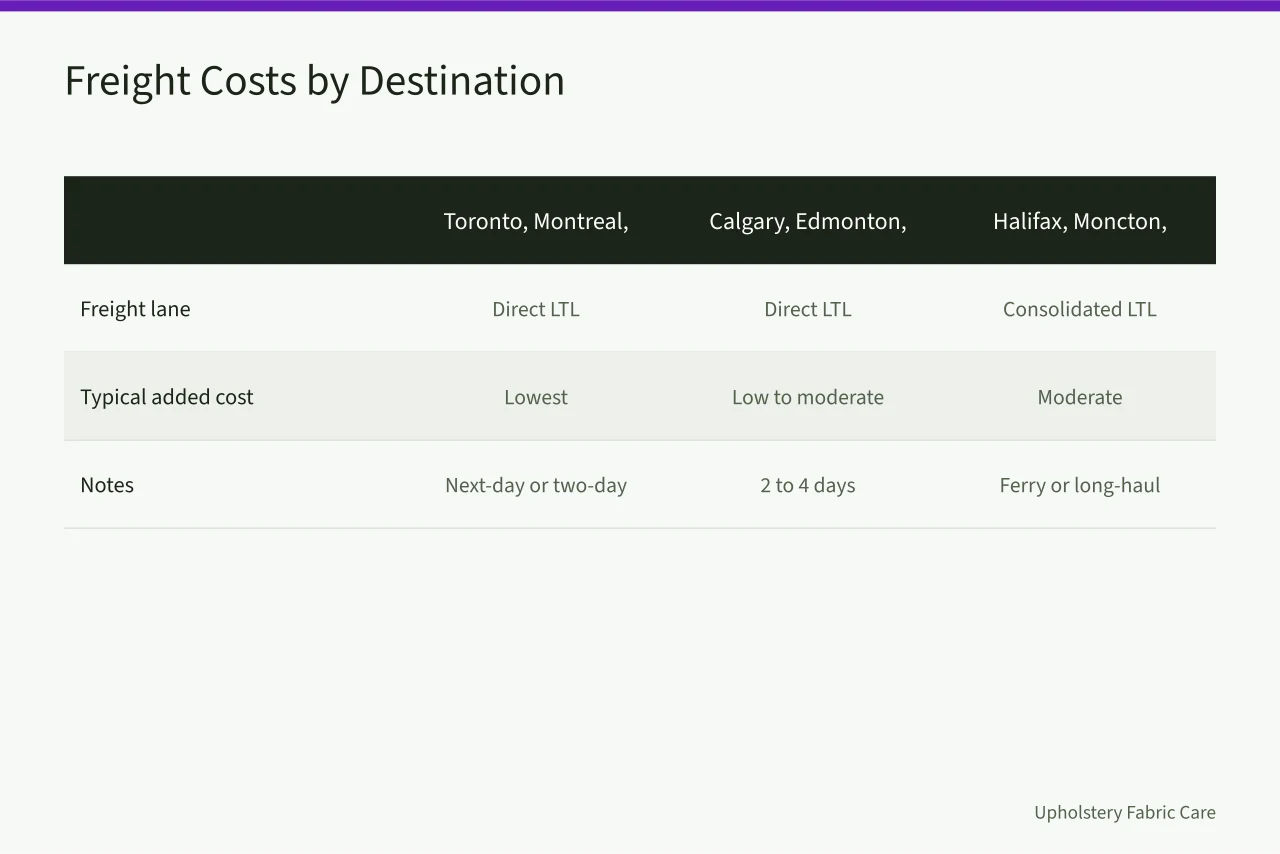
To a city on a major lane, a truck-mount might ship for a few hundred dollars. To a remote community, the same unit can cost thousands. The table compares typical conditions, not quotes.
| Destination | Freight lane | Typical added cost | Notes |
|---|---|---|---|
| Toronto, Montreal, Vancouver | Direct LTL | Lowest | Multiple carriers, next-day or two-day |
| Calgary, Edmonton, Winnipeg | Direct LTL | Low to moderate | Good coverage, 2 to 4 days |
| Halifax, Moncton, St. John's | Consolidated LTL | Moderate | Ferry or long-haul leg adds time |
| Rural Prairies | LTL plus local | Moderate to high | Last-mile surcharge common |
| Northern Ontario, northern Quebec | LTL plus air or barge | High | Seasonal access limits |
| Newfoundland outports, Arctic communities | Air or sealift | Highest | Book weeks ahead, weather delays |
Buy from a dealer who already ships into your region. A dealer in Edmonton knows the lanes to Yellowknife. A dealer in Halifax knows the ferry schedule to Newfoundland. Ask for a landed cost quote in writing, including freight, duty, tax and any liftgate or residential delivery fee.
Winter changes freight. Roads into northern Ontario and northern Quebec carry spring load restrictions, and sealift to Nunavut communities usually runs once a year. Order early if your market depends on those lanes.
Order the unit and your full consumables list together. One pallet costs less than three. If you are budgeting a launch, our guide to carpet cleaning startup costs shows where freight fits in the total.
New versus used for a one-van operation
New buys a warranty, dealer support and a known service history. Used can cut the purchase price by a third or more, but you inherit the maintenance record. For a small operation the decision comes down to cash flow and downtime tolerance.
A new truck-mount under warranty makes a failed pump or blower the dealer's problem. A used unit makes it yours, and you lose working days. For a one-van operation, a week of downtime can wipe out the savings. With a second unit or a portable as backup, used gets less risky.
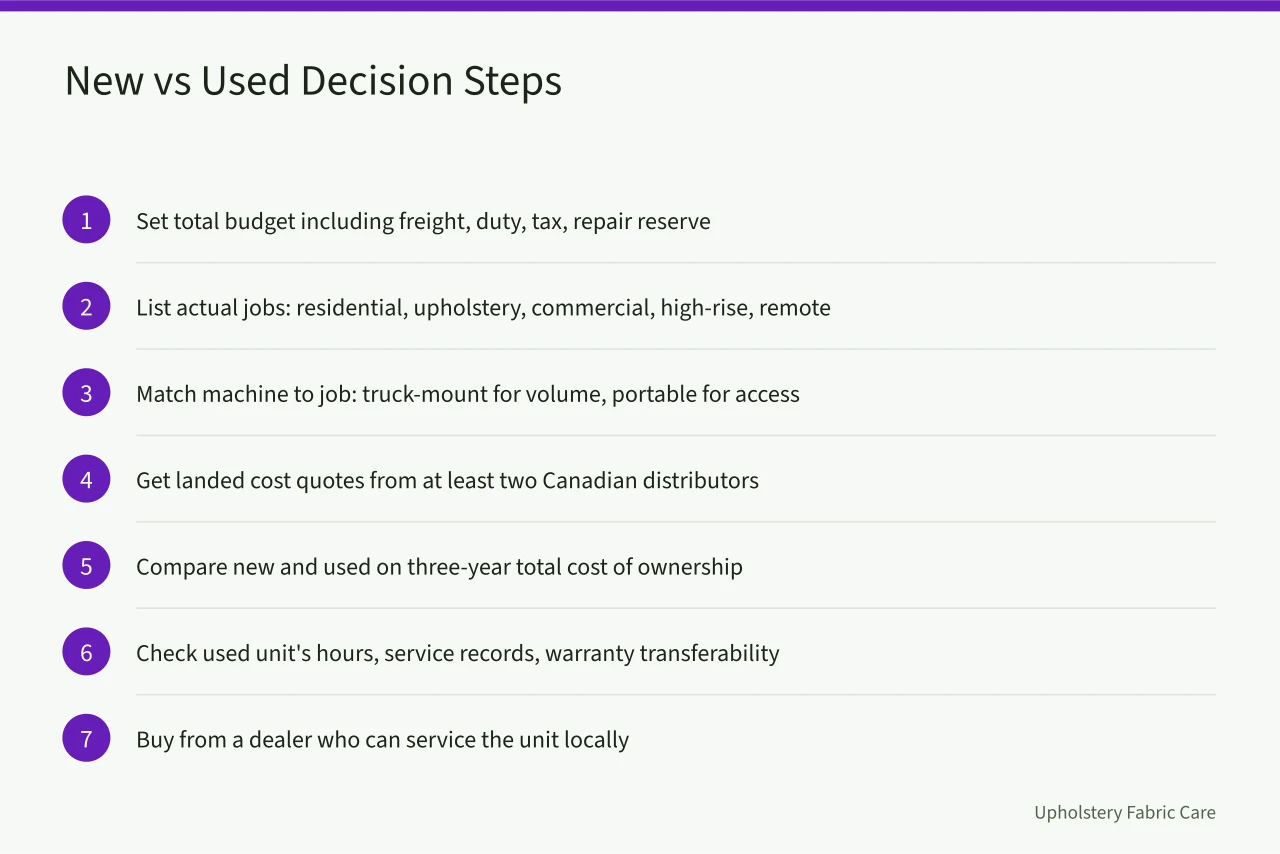
Use this sequence.
- Set your total budget, including freight, duty, GST or HST and a repair reserve.
- List the jobs you actually do: residential carpet, upholstery, commercial, high-rise, remote.
- Match the machine to the job: truck-mount for volume, portable for access.
- Get landed cost quotes from at least two Canadian distributors.
- Compare new and used on three-year total cost of ownership, not purchase price.
- Check the used unit's hours, service records and whether the manufacturer transfers the warranty.
- Buy from a dealer who can service the unit inside your region.
A worked example. A Halifax cleaner buys a used truck-mount for $18,000. The buyer also pays these costs:
- $1,200 freight
- $1,080 duty at 6 per cent
- $2,340 HST at 13 per cent Landed cost: $22,620.
A new comparable unit at $32,000 lands near $38,000 with the same freight and tax. The used unit saves roughly $15,000, but hold back $4,000 for year-one repairs. Our new vs used carpet cleaning equipment guide runs the same comparison for portables and smaller units.
Leasing spreads the cost and keeps the warranty, but you pay interest over the term. Buying used outright works only if you can absorb a repair bill in the first year. Either way, confirm the dealer's service radius and parts stock before you pay.
Common questions
Do I need a business number to import a truck-mount?
Yes. The CRA issues a business number, and you need a CBSA account for commercial importing. Register both before you place the order.
Is duty always charged on imported equipment?
No. Units made in the United States may qualify for preferential treatment under CUSMA if they meet the rules of origin. Others usually attract the Most-Favoured-Nation rate.
Can I claim back the GST or HST I pay at the border?
If you are GST-registered, you generally claim an input tax credit on your return. If you are not registered, the tax is a permanent cost.
Which dealer should a remote buyer call first?
Start with a distributor that already ships into your region, such as Aramsco Canada or Jon-Don, and ask for a written landed cost quote. A dealer who knows your freight lane will price the delivery more honestly than one who does not.