Guides
Finding good staff for a carpet cleaning business
Hire carpet cleaning technicians by testing fiber identification, cleaning codes and wand control on a real job, then checking references for reliability.
What to take away
- A technician who cannot name the fiber and read the cleaning code will wet something that should never be wet, and the callback is yours.
- Test on a real job: hand them a swatch of wool, nylon, polyester, olefin, cotton and viscose and ask which ones change the method.
- The cleaning code decides the method. W means water-based, S means solvent only, WS means either, X means vacuum only.
- Reliability shows on the stain that will not lift, not on the easy room.
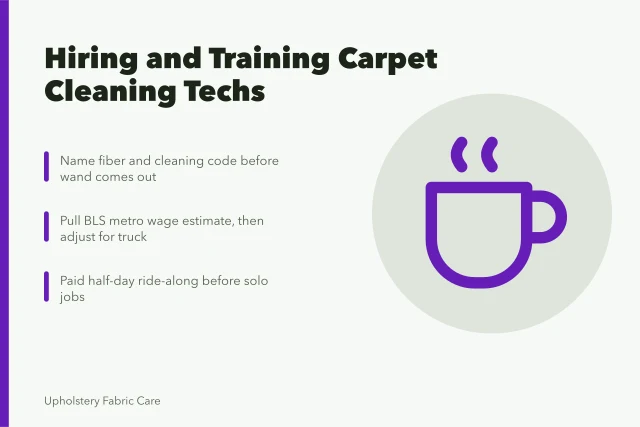
- Pay ranges come from your own market, checked against the BLS wage tables, never from a guess.
What the job actually requires
Carpet cleaning is a trade of judgments made in a stranger's house. The technician identifies the fiber, finds the cleaning code, tests for colorfastness, and then chooses a method.
Get the fiber wrong and the mistake is permanent. Wool and cotton can shrink. Viscose, sold as rayon or viscose, can brown or lose pile when it gets wet, so a code that permits water still may not permit water here. Nylon and polyester tolerate most methods. Olefin is oil-loving and wicks.
The cleaning code is a small tag, usually under a cushion or on the furniture frame. W, S, WS or X. The code and the manufacturer's care instructions outrank anything the customer says about how the last company did it.
The paid trial task
Run the candidate on a real job with a trainer watching. Score these, in this order.
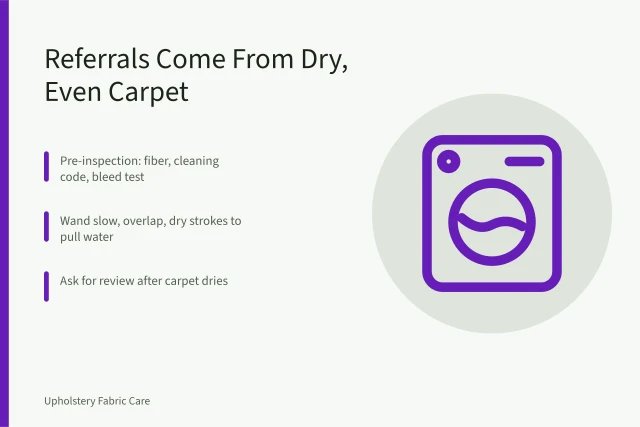
- Identify the fiber and read the cleaning code aloud before any product is mixed.
- Test colorfastness on a hidden area and show you the towel.
- Pre-spray, then wait the dwell time the label states, and say the time out loud.
- Run the wand in overlapping passes and stop before the carpet is soaked through.
- Set airflow and give the customer a realistic drying time.
Over-wetting is the most common new-hire fault. It shows up two days later as browning or wicking, which is a callback, and callbacks are what a small operation cannot absorb.
Ask which method they would choose for a low-moisture encapsulation job and why. A technician who only knows hot water extraction will push a wet wand at everything.
Authorization, in writing
Keep one page per person listing what they may do alone. Who may mix product. Who may run the truck-mount. Who may quote a price. Who may re-clean a complaint without asking.
Nobody touches a customer's furniture until they have read the label and the safety data sheet for every product on the van. The label is the authority on dilution and use, and the record of who was trained on it is what protects you.
Licensing, wastewater disposal and employment rules vary by state and municipality. Confirm with your state board and your sewer authority, and take wage, overtime and recordkeeping questions to the Department of Labor small business guidance. Hiring questions go to the EEOC small business resource center.
References and the first quarter
Call references and ask about reliability before skill. Did they arrive when they said? Did they finish the job they started? A technician who is slow but honest is trainable. One who is fast and careless is not.
Pair every new hire through a full cycle. That cycle is inquiry, quote, job, drying check. It also includes invoice and follow-up. Then review at ninety days against the written role, not against how well you like them. The hiring and training guide covers the records to keep.
| Fault | What it looks like | What it costs |
|---|---|---|
| Wrong fiber call | Viscose or wool wetted | Replacement, not a re-clean |
| Skipped code check | S-only fabric sprayed | Dye bleed, ruined piece |
| No dwell time | Product sprayed and scrubbed off | Soil left behind, callback |
| Over-wetting | Damp carpet next morning | Browning, wicking, return trip |
| No airflow set | Rooms closed up wet | Odor, longer dry, complaint |
Common questions
Do I need to test fiber knowledge before hiring, or can I train it?
Train it, but test for it. A candidate who cannot tell viscose from polyester on day one can learn, but only if they understand why the difference matters. Test the reasoning, not the vocabulary.
How do I check wages without guessing?
Use the BLS occupational tables for your state and metro area, then compare against what local ads actually offer. Set your range from your own numbers, never from a national average.
What if a new hire damages a customer's carpet?
That is why the pre-inspection form, the colorfastness test and the insurance policy exist. Document the condition before the job, and take the claim to your insurer rather than settling it quietly.
Should I hire experienced technicians only?
Experience helps, but habits travel with it. A technician trained badly elsewhere will need unlearning. Test the fundamentals on a real job and let the result decide.