Guides
What Upholstery Fabric Codes on Furniture Tags Mean
Upholstery fabric codes on furniture tags tell you which cleaning method a fabric can survive. Here is what W, S, WS, X and the rest actually permit.
What to take away
- The codes W, S, WS and X are voluntary industry cleaning marks, not government safety ratings.
- The federal care labeling rule, 16 CFR Part 423, applies to textile wearing apparel and some piece goods, not to sofas and chairs.
- A wrong method can void a furniture warranty even when the tag itself carries no legal force.
- Water-based cleaners on an S fabric can shrink, stain or distort the cover, and the damage often shows up days later.
- The tag is a starting point. The fabric mill's own test data is the document that decides a claim.
Furniture tags look official because they are printed on stiff stock and stitched into a seam. Most of them are not. The cleaning codes you see on American upholstery come from a voluntary labeling convention that mills and furniture makers adopted so retailers and cleaners would stop guessing.
Who writes the rules and who does not
The Federal Trade Commission enforces care labeling under 16 CFR Part 423. That rule covers textile wearing apparel and certain fabrics sold by the yard. It does not require a care label on a sofa, a sectional or a dining chair. So when you read a furniture tag, you are reading a private standard, not a federal mandate.
Three layers of authority surround the same couch. Federal law governs apparel labeling. State law governs consumer warranty terms and, in some states, upholstered furniture flammability. The private layer matters daily: the mill's cleaning recommendation, the furniture maker's warranty language, and the cleaner's liability terms.
ASTM publishes standardization work on upholstery fabric care that mills use for those recommendations. The Wikipedia article on care labels explains how the W, S, WS, and X convention maps to textile cleaning methods.
What each code permits
| Code | What it permits | What it forbids |
|---|---|---|
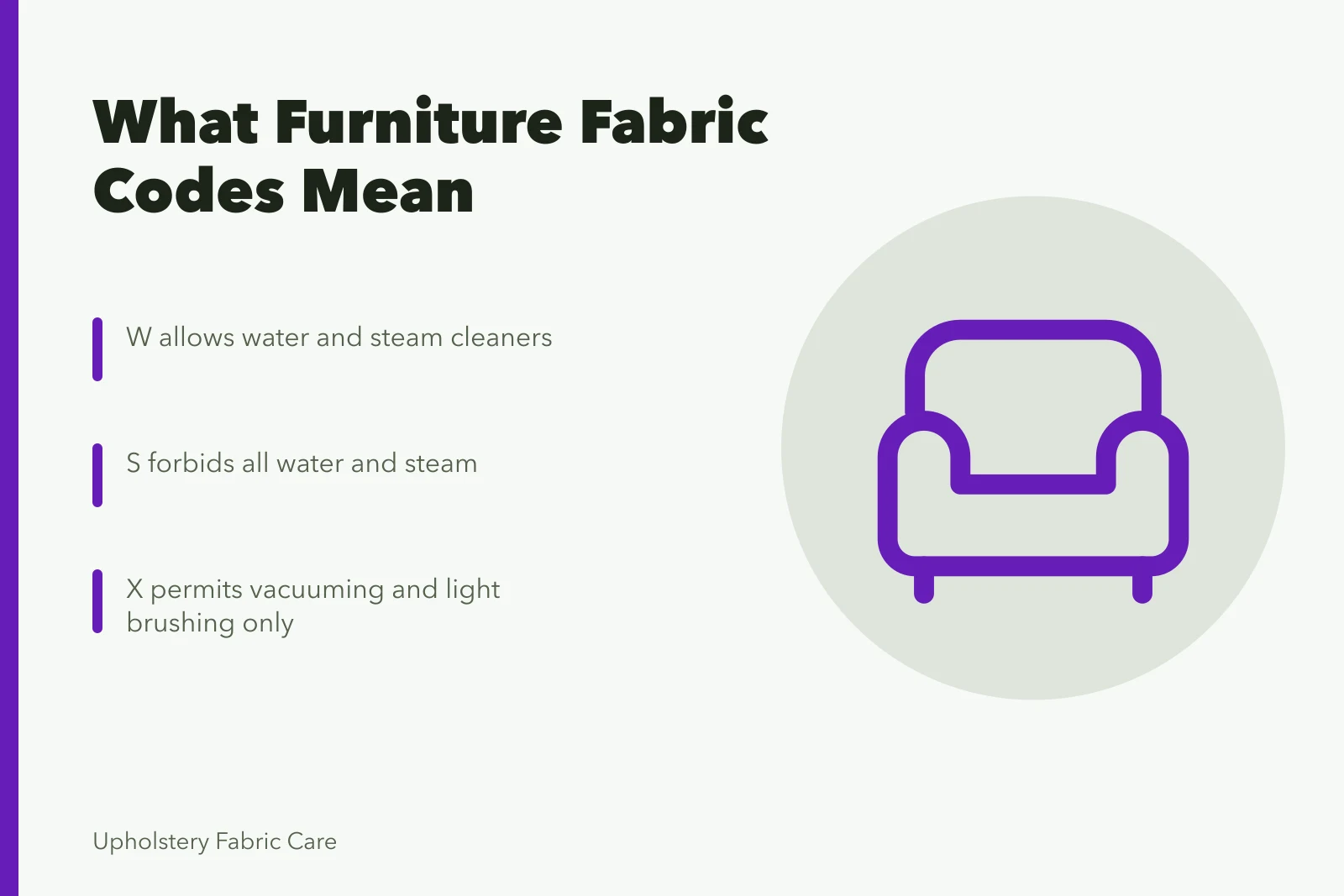
| W | Water-based cleaners, including steam | Solvent-only dry cleaning as the sole method |
| S | Water-free solvent cleaners only | Any water or steam |
| WS | Either water-based or solvent cleaners | Nothing by category, but test first |
| X | Vacuuming and light brushing only | All liquids, water and solvent alike |
| SW | Same as WS, order of preference varies by mill | Assuming water is always safe |
Some tags add a fifth mark for leather or for a specific finish. Read the whole tag, not just the letter. A cushion cover that zips off may carry a different code from the frame.
What triggers a warranty claim
A warranty claim usually turns on whether the cleaner followed the tag. If the tag says S and the technician used a hot water extractor, the maker can deny the claim on that fact alone. The denial does not require proof that water caused the damage.
A single mismatched method is enough to move a repair from warranty coverage to the owner's account, even when the visible damage appeared weeks later.
Non-compliance has a concrete, common consequence. Reupholstering a three-seat sofa typically runs into four figures in most US metros. The code matters more than the price of the cleaning itself.
The NFPA 260 standard for upholstered furniture flammability is separate from cleaning, but it explains why some covers carry finishes that react badly to solvents.
How to read a tag before anyone touches the couch
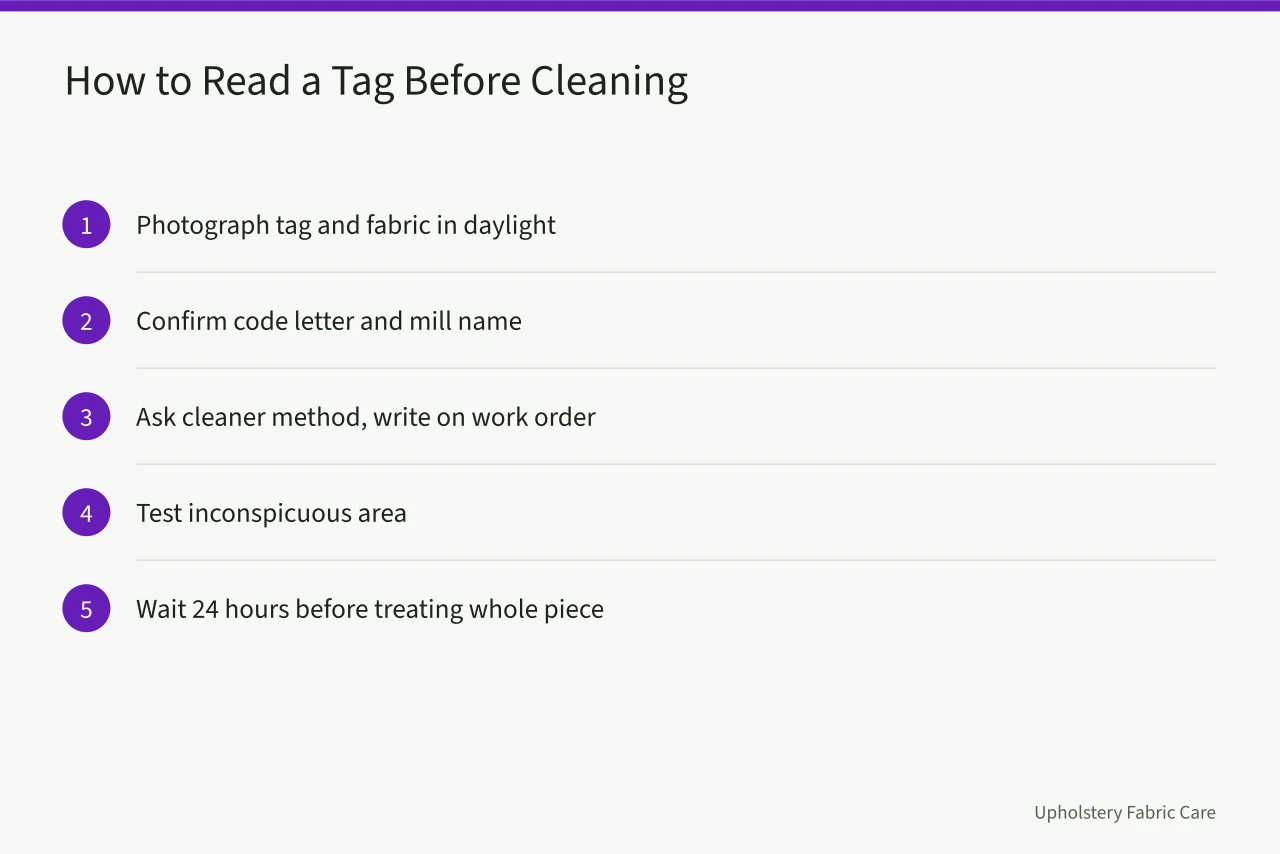
- Photograph the tag and the fabric in daylight before cleaning starts.
- Confirm the code letter and any mill name printed beside it.
- Ask the cleaner which method they intend to use and write it on the work order.
- Test an inconspicuous area, such as the back of a skirt or the underside of a cushion.
- Wait 24 hours before treating the whole piece.
If the tag is missing, treat the fabric as S until a mill spec or a fiber test says otherwise. Wool is the clearest case: the Wikipedia article on wool covers how moisture and agitation drive shrinkage, which is why an S code on a wool blend is not a suggestion.
Example
An Ohio homeowner owns a five-year-old sofa with an S tag. A technician uses a portable water extractor on the seat cushions.
Two weeks later the covers pucker at the seams, and dye wicked into the piping. The maker denies the warranty claim because the tag specified solvent cleaning, so the homeowner pays for new cushion covers out of pocket.
Common questions
Are furniture cleaning codes legally binding? No. They are a voluntary industry convention. What binds you is the warranty contract and, in some states, consumer protection law.
What does WS mean on a couch tag? It means the fabric tolerates either water-based or solvent cleaning. Test an hidden area first, because WS covers a wide range of blends.
What if the tag says X? Vacuum and brush only. No water, no solvent, no foam. If the fabric is soiled, a professional should assess it in person before any liquid touches it.
Can a cleaner refuse to work on a coded fabric? Yes, and a reputable one will. A refusal protects both parties when the tag and the visible fabric condition disagree.